Unmanned Search and Rescue?

Looks like sooner or later we are going to see unmanned surface vessels transiting the oceans. Both MarineLog and MarineLink report on a Chinese Study. The odd thing about these reports is that apparently, among other things, they were applying this technology to SAR. This from MarineLog:

The Unmanned Multifunctional Maritime Ships Research and Development Project, says MSA, realizes all-day networked sea supervision, intelligent search and rescue, motorized multipoint coverage by shore-vessel based detection and control platform managing unmanned search and rescue vessels on a low-cost basis, which effectively improved the ability and efficiency in maritime search and rescue.

(MarineLink apparently working from the same press release consistently substitutes the phrase “maritime cruise and rescue.”)

Frankly I have a hard time visualizing what unmanned surface vessels could do for search and rescue.

Electronic Monitoring of the Tuna Fleet

Bairdmaritime reports,

“NOAA Fisheries has completed the first fleet-wide implementation of electronic monitoring in the United States.

“As of June, electronic monitoring is required on all vessels fishing with pelagic longline gear in the Atlantic and Gulf of Mexico. Electronic monitoring is intended to provide an effective and efficient way to monitor and verify Atlantic bluefin tuna catches in the pelagic longline fishery.”

Electronic monitoring replaces on board observers.

A couple of things come to mind.

  • Would be great if all F/V were monitored electronically so that we would not have to go looking for them. Air Searches would them be primarily to determine if there are F/Vs out there that are not tagged electronically.
  • We still need to check them underway to make sure they are not exceeding limits by offloading catch before returning to port.
  • What about the Pacific where there is a very valuable tuna fishery that is seldom sees a cutter?

USNI USCG Issue

The U. S. Naval Institute has published their annual “Coast Guard Issue.” It has some thoughts worth taking a look at, and there are cogent comments attached to at least one of the on-line articles.

If you are not a member, you probably should be, but if you don’t have access to the print version, a lot of the material is available on-line. As usual, some on-line articles are “open content” that can be viewed by anyone, while some are “members only.”

The Coast Guard specific “open content” articles include:

“The Demise of the Cutterman,” a feature length article that has attracted a lot of comment.

“Nobody ask me but…The U.S. Coast Guard Must Retain Its Most Talented Officers,” a short piece on assignment and promotion policies.

The Coast Guard specific members only articles are:

“Bring on the Workhorses” about the need to replace the WMECs with Offshore Patrol Cutters.

“The ’85 Percent Solution’,” which advocates for ice strengthened National Security Cutters.

“U.S. Coast Guard Resources,” which is actually in two parts.
—“References” a pdf which identifies all CG flag officers and five most senior enlisted with job titles and photos, and
—“Organizational & Information Services,” a pdf that includes an organizational wiring diagram and some informational phone numbers.

Helo vs Drone

WarIsBoring reports on an exercise that included the shoot down of two small drone targets. Both are recorded in the video above. The first shoot-down is done using a door mounted 7.62mm machinegun like those used in Coast Guard airborne use of force equipped helicopters. The second used a fixed forward firing 20mm gatling gun on an MH-60S (correction applied to the original here).

It seems likely that well financed criminal organizations will soon be using drones to scout ahead of their drug running vessels (if they are not doing it already).

Can we shoot them down?

I wonder if the downwash from the helo might be enough?

Long Range Interceptor In Action

I would not normally talk about a routine law enforcement action, but this video has some interesting aspects.

Stratton recently intercepted a second semi-submersible, that had been spotted by a Navy patrol aircraft, arresting its four crewmembers and recovering 12,000 pounds of its 16,000 pound cargo of Cocaine, before the semi-submersible sank under tow.

What I wanted to point out in the video was:

First, the instrumentation on the 35 foot Long Range Interceptor ship’s boat (time 1:12). (Correction–I made and error here, this is actually the instrumentation on a 26 foot “Over-the-Horizon (OTH) IV” of which the Coast Guard has procured 101.) It looks a lot like the “glass cockpit” of a modern light plane. Long Range Interceptors are only deployed by the Bertholf class National Security Cutters. (The OTH-IV is operated from the NSCs, WHECs, WMECs, and WPCs. Anyone know if they are also operated from WAGBs and WLBs?)

Second, was the way the boat was recovered in the stern ramp of Stratton (2:25 to 3:00). Note there is no one in the bow to attach the line that will pull the boat up onto the ramp. In 2013 we had a fatality on the Waesche because the automatic capture mechanism was not working properly and Petty Officer Travis Obendorf was on the bow of the boat. You can access the accident report here.

“Commandant Sees Bright Future for Coast Guard Acquisition Programs”

National Defense Magazine reports that the Commandant, while addressing the National Press Club on August 5, made some remarkably positive statements about his expectations for the coming budget year.

“One day after the Coast Guard’s 225th birthday, its commandant predicted that the service would be receiving a big present this year: the largest acquisition budget in its history.”

There were few details, but the Commandant did refer to the prospects for Coast Guard Icebreakers.

“’This is generating a lot of interest and I’m very optimistic that on my watch we will see — no fooling — forward progress as we look at building a national fleet of icebreakers,’ he said.”

We will have to wait to find out what this really means.  Will the OPCs be funded; will the program be accelerated? Will we ever see Multi-Year funding of the Webber Class WPCs? Will we see the four aircraft shortfall in the planned fixed wing fleet addressed (and the additional recently identified shortfall in fixed wing flight hours)? Will we see new Inland tenders and new domestic icebreakers? Will we see the obsolete shore facilities upgraded?

Certainly we will not see all the problems fixed in 2016.

Funding for an icebreaker alone could result in the largest budget ever, but I’ve seen no indication we are far enough along in the procurement process to warrant full funding in FY2016. We have authorization for the Navy to build Icebreakers for the Coast Guard. But that would not increase AC&I budget.

The FY2016 AC&I budget request was only $1,017.3M. In 2012 the AC&I budget was $1,463,968,000. I am not sure that FY2012 was the largest ever AC&I budget, but it does mean if the 2016 budget is going to be “the biggest” Congress will need to add at least $446.7M. I suppose several projects could be aggregated to come up to this amount, but there I another possibility.

Could this mean the Coast Guard will get a ninth Bertholf class? It makes a certain amount of sense. The FY2016 budget request funds not a single major cutter. The Fleet mix study has documented the need for a ninth Bertholf. We have a hot, increasingly efficient shipbuilding process, and the shipbuilder, HII, is certainly not without influence in Congress. A third NSC in Hawaii could significantly boost our presence in the Western Pacific and would make the long promised Crew Rotation Concept more nearly possible (not to say I think it could work).

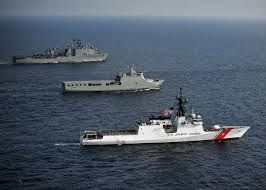
Waesche Carat 2012

Just adding a Bertholf class to the FY2016 AC&I request would bump it to close to $1.7B, still short of the $2+B/year the CG needs. Will we see genuine long term movement to adequate funding for the Coast Guard?

“Sailing into the Future with the United States Coast Guard”–NavalHistory.org

Interesting piece from the US Naval Institute’s Naval History Blog.

In honor of the United States Coast Guard, which turned 225 years old this week, the Naval History Blog offers a selection from a speech delivered by A. Denis Clift, Vice President for Planning and Operations at the United States Naval Institute.

It primarily deals with the Coast Guard’s growing role in the National Intelligence organization and is a bit old, dating from 2000, but it fills in some history I was not aware of, and seems to demonstrate a lot of continuity in mission requirements. It even delves into Coast Guard Intelligence operations during Prohibition.

Thanks to Lee for bring this to my attention.