
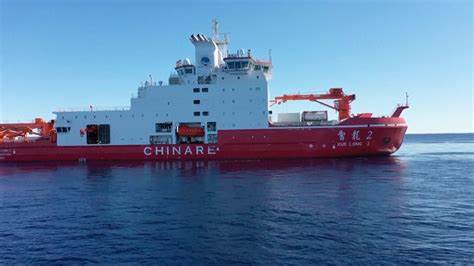
Chinese Icebreaker
Interesting Engineering has a story about China’s third polar icebreaker expected to be ready in 2025.
It appears to be a relatively light polar icebreaker,
“The proposed length of the vessel is 338 feet (103 meters) and is being built for a displacement of over 10,000 tons (9,200 tonnes). It can accommodate a crew of 80 people and travel at speeds of up to 16 knots…”
That is about the length of the Canadian Arctic and Offshore Patrol Ship, but about 50% heavier. I appears to be a bit smaller than M/V Aiviq that the Coast Guard apparently intends to buy.
Given the relatively small size, it is unlikely this is the nuclear icebreaker that has been talked about.
The article makes much of the ability to support a deepsea submersible, but it does not make clear what special provisions will be provided. Will it have a stern launch or moonpool or just cranes?
Why the submersible, when remotely operated vehicles are now so capable, is also not clear.
I think Russia has at least as much reason to be concerned about China’s icebreaker capabilities as the US, since Russia wants to monetize passage through the Northern Sea Route, and I doubt the Chinese will stand for that in the long run.
Thanks to Mike for bringing this to attention.
 Chuck Hill's CG Blog
There was some additional information in the following Chinese-language article I read through Google Translate:
https://www.jiemian.com/article/9630351.html
The new icebreaking research vessel will reportedly be built to Polar Class (PC) 4 which puts it roughly between the Canadian AOPS (PC 5 with PC 4 bow) and Aiviq (ABS A3; about the same level as PC 3). Its icebreaking capability is reportedly 1.2 metres, making it slightly less-capable than the previous Chinese polar research vessel, Xue Long 2, which was built to PC 3 rating and could break 1.5-metre ice.
The article also has a photograph of the ice model tests which indicate a fairly conventional twin-azimuth propulsion configuration. The funnel implies a standard diesel-electric power plant.
The article also refers to a 4.8-by-6.0-metre (about 15 by 20 ft) moon pool which seems a bit undersized for the manned submersibles mentioned in the article (for example Deep Sea Warrior is reportedly 9.3 m/30½ ft long). The large A-frame shown in the side profile as well as the submersible on the aft working deck indicate launching primarily over the transom. Perhaps smaller ROVs and such can be launched through the moon pool in addition to other scientific equipment.
As for the external appearance, they’ve apparently taken the “make it look modern” route rather than “form follows function”. Visibility from the wheelhouse both forwards and abaft appears to be particularly bad for tactical ice navigation.
One thing I disagree with is this vessel’s ability to enable “China’s naval ships to navigate without restrictions and bolster its presence in the polar regions”. Being able to operate in ice on its own is a prerequisite but not a guarantee for being able to support other vessels’ operation in the same waters. Neither this nor the other Chinese research icebreakers are particularly suitable for assisting other ships in ice-covered waters.
If we are counting, this is in fact China’s fourth icebreaking research vessel; the third is the former early-1980s Canadian offshore vessel Ikaluk which was salvaged from a scrapyard by a Chinese reality TV star after a long career in offshore business first in Canadian Arctic and later in Russia. After a voyage to Antarctica, it was donated to the Sun Yat-sen University and refit for research work. I have yet to see it leave its home port for anything but the first shakedown cruise to the ice-covered Bohai Sea.
@Tups, I was hoping I would hear from you about this ship. Thanks.
Chuck, I have to ask, how is Russia attempting to monetize passage through the Northern Sea Route? Are they telegraphing interest in charging fees to transit outside their recognized territorial limits? The thought of this makes me wonder what Canada’s thoughts are in relation to their sovereignty claims on Northwest Passage transit
The Russians require that ships transiting the Northern Sea Route pay for Russian pilots and escort by icebreakers.
The Canadians apparently consider the NW Passage internal waters and contend there is no right of innocent passage.
The Canadian and Russian claims are similar.
The Russians also got very bitter few years ago when first a French Navy offshore support and assistance vessel Rhône and then the Norwegian Coast Guard icebreaking patrol vessel Svalbard transited the Northern Sea Route without bothering to ask permission or icebreaker escort. They took a high-latitude route well north of Russian territorial waters.
As the polar ice pack keeps retreating, we are likely see more and more ships taking the “Arctic shortcut” without permission or assistance from the Russians.
Similar go-around is of course not possible in the Northwest Passage where Greenland and the Canadian Arctic Archipelago prevents taking a more northern route.
Of course there’s the ultimate Arctic route that the French cruise ship Le Commandant Charcot will sail next year: straight across the North Pole from Alaska to Svalbard. Tickets start at hefty $45,000…
Paging Chuck Hill,
Your wanted on the dock. Guess where our old 110’s went
Greece Receives First Island Class Patrol Vessels From The U.S.
https://www.navalnews.com/naval-news/2023/07/greece-receives-first-island-class-patrol-vessels-from-the-u-s/
I would have thought they would go to Dominican republic, Lebanon or even Iraq