

Friend and contributing author Peter Ong provides us a bit of information about the interior of the Offshore Patrol Cutter.
While the exterior details of the OPCs are generally known among readers, what about the OPC’s interior features, and how are three OPC’s interior features improved over the 270-foot and 210-foot Medium Endurance Cutters (MECs) that have served for 30 to 55 years, respectively?
The USCG Office of Public Affairs, Coast Guard Headquarters, Washington, DC, replied to my inquiry in late November 2023.
“Like the National Security Cutters, the Offshore Patrol Cutters (OPC) will have smaller berthing areas to accommodate mixed-gender crews, crew lounges, training rooms, and a gym. What makes the OPCs unique is that the cutter’s design is focused on improving flow (i.e., how the crew can go about their day-to-day routine as easily as possible). Here are a few examples:
- Mixed-gender Locker Room between Combat Information Center (CIC) and the Boat Deck: The OPC will have an actual locker room, similar to shore-based boat stations, that allows personnel to change into and out of their law enforcement and boat gear attire. It will also be adjacent to the CIC and boat deck and co-located with a small arms locker/weapons issue station and a dedicated washer/dryer.
- Food/Stores Flow: OPC reefers and dry stores are located on the same deck and immediately adjacent to the galley and mess deck. There is also an elevator large enough to hold a standard-sized pallet going from the flight deck straight to dry stores (and vice versa).
- Berthing/Stateroom Flow: Berthing areas and staterooms are more spread out than the Medium Endurance Cutters (MECs) but are also located near key watch areas for quick emergency response. Additionally, watchstanders will not have to transit through berthing areas during their rounds, unlike on the 210’ MECs.”
With an endurance of 60 days, the OPCs have the interior design improvements to accommodate a better operational and crew flow environment compared to the WMECs.
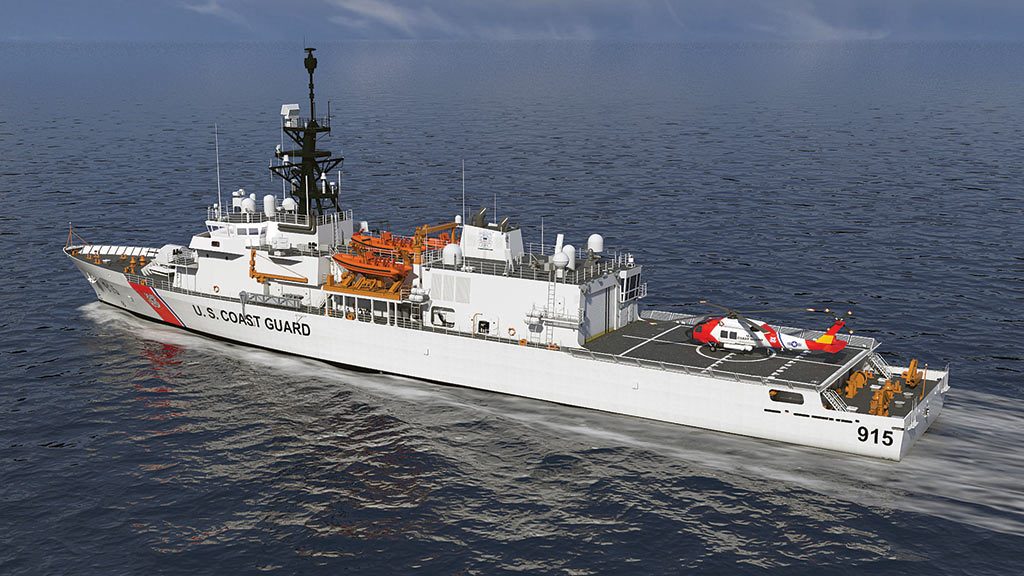
Offshore Patrol Cutter port quarter
 Chuck Hill's CG Blog
I think the bigger question is how this class compares with the NSCs.
With the size and cost of the OPC almost to parity with the NSCs, it’s a valid comparison.
I agree, we need to know why the cost of the OPC is so similar to the NSC, even though the OPC is smaller and deleted the rear boat launch ramp to SUPPOSEDLY save money (which apparently didn’t save any money anyway, considering the much smaller, much cheaper FRC are able to incorporate a rear boat launch ramp for a fraction of the cost of the OPC).
You always need to be sure to compare price to time. The 11th and cheapest NSC was ordered in Dec 2018 for 462.13 mil which is 565 mil today. That is also the shipbuilder contract price and I don’t think that reflects the purchase of GFE. Eastern’s contract award for their 4th and final OPC was awarded April 2022 for 325.10 mil which would be 346 mil today. Austal USA’s award for 11 OPC has a stated price of 3.3 billion or 300 mil a hull in June 2022 which is 311.5 today. So the OPC would appear to still be running well cheaper than NSC when comparing known apples to apples accounting for inflation.
Really, I think if we had started the OPC program first, and if we had come up with a platform as large as the current design, we probably would not have started the NSC program at all.
When I joined John J. McMullen Associates in 1999 we were part of a team with Avondale and Boeing. The only ship type that was specified was the NSC. For the rest the required missions were specified and the contractor teams were to come up with a mix of assets to accomplish them, not necessarily new design ships or even ships at all although I think everyone ended up with a patrol boat and a WMEC replacement. In the case of the winning team, they proposed stretching and SLEPing the 110 ft WPB which did not work out. Ultimately the Coast Guard took back the FRC and OPC designs from the contractor team.
The NSC was done under the Deepwater program. When it was shut down we (ELC/SFLC) were tasked with drafting specifications for the OPC to generally replace the capabilities of the WMECs. In doing it there was a lot of requirement-creep from HQ in addressing the many week points of the 210 and 270 classes (legend was always that the 270s had been designed to be 300′ and a red line was drawn at 270′). The NSC stern ramp davit system at that time was requiring a redesign and was seen as less effective for large vessels at sea and required a large amount of space. The benefits above and many external improvements came out of that. The OPC is going to be a great ship for the future of the Coast Guard.
I can assure you that the WMEC270s were never intended to be 300 feet. (Nor were the 255s supposed to be 355 feet long which is another story we used to hear.)
I was in headquarters when the design was done and wrote the resource change proposal for the COMDAC (command and control system) training facility.
When the ships that would be the Bear class were designed, the Coast Guard chief engineer was absolutely determined to meet the specs as cheaply as possible. He considered length a chief driver of cost and since the preliminary design was done in house, his opinion mattered a lot. The design came out as 267 feet, but naval engineers apparently virtually begged to be allowed more length to provide greater flare. They got three feet.
Maybe that is the eventual source of the “legend”. The short flair was a big factor in the poor seakeeping.
I will say that, while the 270s did not compare well what could have been an evolved 327, they were much better than the WMEC 143s. 205s, 213s, and converted 180 foot buoy tender WMECs. Going from a 327 to a 270 would have been a step down in terms of seakeeping.