
“Ukraine has claimed the destruction of another warship of the Russian Black Sea Fleet, the Ropucha class landing ship Cesar Kunikov (also written as Tsezar Kunikov) being the latest victim of explosives-laden naval drones off the coast of Crimea. Ukrainian officials claim that the landing ship was sunk in the overnight attack and available imagery shows the vessel capsized.”
I applaud what the Ukrainians are doing, but the Coast Guard needs to anticipate that we might someday be on the receiving end of this sort of attack. What are the Russians doing and could we do better?
So far, the Russian Black Sea Fleet has reportedly lost 24 surface units and a submarine to various forms of attack. But let’s look specifically at landing ships in the Black Sea which the Russians are using to transport supplies and reinforcements to Crimea.
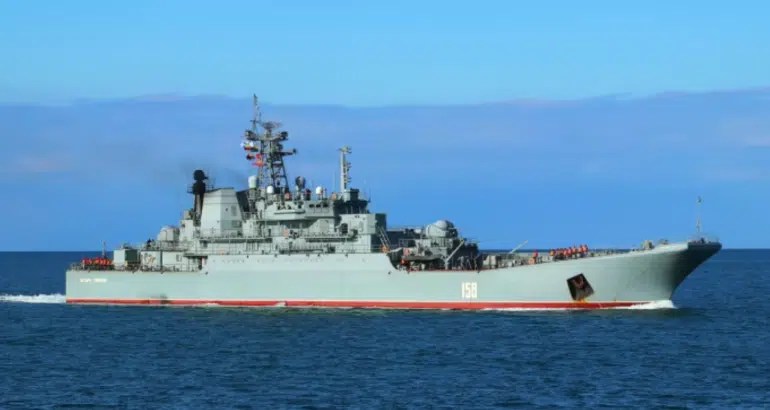
Ropucha-I class landing ship Caesar Kunikov (Russian MoD photo)
Russia has been able to add some small combatants to the Black Sea Fleet using its River systems, but they are unable to add large ships, including landing ships because Turkey has closed access to the Black Sea by warships from the Mediterranean, so Russia cannot expect reinforcements. Apparently anticipating closure of the Dardanelles, the Russian Navy moved six additional landing ships into the Black Sea. Wikipedia reports,
In February 2022, prior to the full-scale Russian invasion of Ukraine, the landing ships Korolev, Minsk, Kaliningrad, Pyotr Morgunov, Georgy Pobedonosets, and Olenegorsky Gornyak from the Baltic Fleet and Northern fleets departed their bases and passed through the Dardanelles Strait for claimed Military exercise in the Black Sea.
In addition, a Ukrainian ship of this type was added to the Russian Black Sea Fleet when Russia occupied Crimea, but that ship is reportedly inactive. The Russians are apparently having difficulty maintaining these approximately 40 year old ships.
“According to Ukrainian Navy spokesperson Dmytro Pletenchuk, the Black Sea Fleet now has only five Ropucha class ships remaining in service out of a previous total of 13 (additional units were transferred from the Baltic and Northern Fleets ahead of the full-scale invasion of Ukraine).” –This may refer to all types of LSTs, not just Rapucha class. They also lost a Tapir class LST.–Chuck
Ship Self-Defense:
Looking at this video, I could not help but think that the Ukrainians would have had a harder time if the Russian ship had enforced darken ship. At the very least the attackers might have had less time to coordinate their attack. The attacks are clearly made at night using electro optics, and a lighted target helps them. All that lighting also degrades the night vision of lookouts that might otherwise recognize that an attack is underway.
The Russian LST was well armed. The Rapucha class ship reported sunk, had two twin 57mm guns with a 200 round per minute rate of fire, so, theoretically, about four times the firepower provided by an NSC or OPC’s 57mm Mk110. You might think these would be effective against unmanned surface vessels, but I have yet to see any evidence in any of the videos of main gun systems being used against such attacks. They always seem to be pointed on the centerline.
It seems that in successful attacks, the target is late in recognizing it is under attack. I have to wonder if their weapons and sensors were manned and ready? Were lookouts posted? Were lookouts equipped with night vision devices?
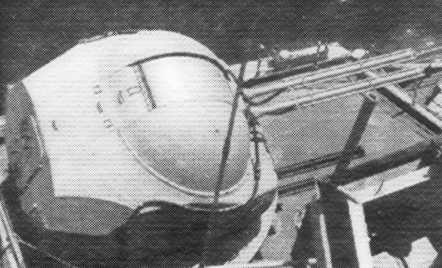
Russian/Soviet designed 57 mm/75 AK-725 mount.
Force Protection:
Apparently, the attack occurred near the end of its voyage from Novorossiysk to Sevastopol. The ship was close enough to Sevastopol that smoke from wreck was visible on shore.
If you are intending to intercept a ship that may use evasive courses. The most logical place to intercept it would be near the known starting and ending points and in this case the ending point would have been an easier place to stage an ambush. It would also be the easiest place to provide protective units.
In an earlier attack, we saw the attacking USVs engaged by a helicopter. In this case, there seems to have been no overwatch.
Small boat escorts might help, even if all they did was provide eyes and ears away from the light and noise of the target vessel that could recognize the threat.
It would of course be critical that they escorting vessels not be fired upon by the targeted vessel, so recognition signal lights would probably be appropriate.
Pairs of boats ahead and on either side of the escorted vessel could alternately sprint and drift so as to minimize noise.
I would estimate escorting boats would want to patrol about 4,000 yards from the escorted vessel, but this is something that could be tested using watercraft with similar characteristics to the kamikaze USVs.
If armed with machine guns, escorting boats could attempt to engage the threats. If using tracer ammunition, even if unable to destroy the threat, they would be pointing out the threat to the target ship.
In many of these videos, it appears that the first hit which immobilizes the target occurs with USV in a pursuit curve coming up the stern of the vessel. An escorting boat in the wake of target vessel would be in a good position to prevent that first immobilizing hit.
 Chuck Hill's CG Blog
Another analysis. https://www.navalnews.com/naval-news/2024/02/analysis-an-operational-view-on-the-usv-attacks-in-the-black-sea-from-an-admirals-eyes/
I have added another video to the end of the post that includes some video from the ship while under attack.
Yet another Russian warship upgraded to a submarine by Ukraine for no charge! With any luck, soon most of Russia’s surface ships in the Black Sea will be upgraded to submarines.
More info and video of the attack. Apparently 10 USV used in the attack.
Russian Ship Under Drone Boat Attack Seen In Dramatic Onboard Video (twz.com)
Looks like Ukraine may have sunk two more Russian LSTs.
Russia’s Huge Black Sea Fleet Losses After Two More Ships Hit (msn.com)
Looks like the are working on cutting Russia’s ability to resupply Crimea by sea.