

The first MH-60T medium range recovery helicopter to operate out of new Air Station Ventura lands on the station’s ramp on June 8, 2024. U.S. Coast Guard photo.
Below is information from the Acquisitions Directorate (CG-9) website. The first new Coast Guard Air Station in 25 years, and a money saving approach that will organically produce 36 aircraft and transition eight air stations from MH-65 to MH-60T operations.
The new airstation replaces a Coast Guard Airstation San Francisco detachment that operated two H-65s out of a leased hangar at Point Mugu.
Aug. 23, 2024
The Coast Guard on June 8 delivered an MH-60T medium range recovery helicopter to the service’s first new air station in 25 years, Air Station Ventura, located at Naval Base Ventura County in Point Mugu, California. CGNR 6055 is the first of three MH-60T Jayhawk helicopters that will be delivered to the air station; all will be derived from Navy hull conversions completed by the Aviation Logistics Center (ALC) in Elizabeth City, North Carolina.
This is the third delivery under the MH-60T Acquisition/Sustainment Program, which started as a service life extension program (SLEP) for the Coast Guard’s fleet of 45 Jayhawks. The program has since expanded to include increments for fleet growth as the service transitions to an all-MH-60T fleet.
Converted Navy hulls are one of the two hull sources being used in the program, along with newly manufactured hulls from the original equipment manufacturer, Sikorsky Aircraft Corp. Low-flight-hour Navy HH-60H and SH-60F Seahawk hulls are structurally converted into the MH-60T configuration. The program also includes replacement of critical dynamic components, such as main rotor blades, and new electrical wire harnesses. All aircraft production – the assembly and installation of dynamic components on the hulls – is completed at ALC.
The deliveries to Air Station Ventura are the first under Increment 2, the first fleet growth phase of the program, which will organically produce 36 aircraft and transition eight air stations from MH-65 to MH-60T operations. Converted Navy hulls will form the majority of the aircraft to be produced under Increment 2, according to Reid Adams, program manager for the MH-60T Acquisition/Sustainment Program. He noted that Navy conversion hulls are cost effective, saving the Coast Guard at least $5 million per aircraft compared to purchasing new hulls. ALC also has developed efficiencies that have shaved months off the Navy conversion process; each conversion can now be completed in under one year.
“We were able to utilize completed Navy hull conversions that were already in storage to facilitate the Ventura stand-up; this allowed the program to save one year on the ability to stand up Ventura,” Adams said.
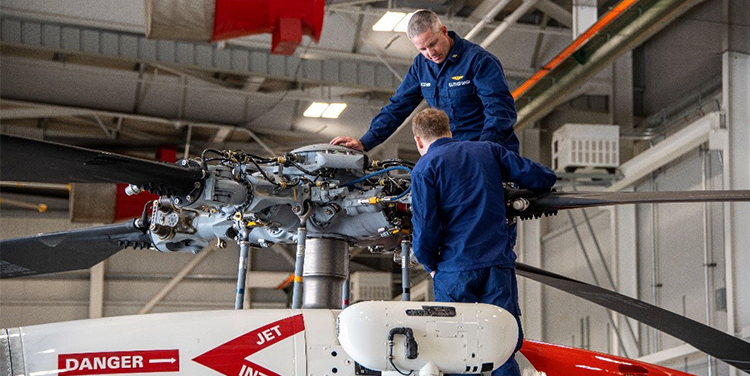
Crew members inspect the folding rotors on CGNR 6055 at Air Station Ventura. U.S. Coast Guard photo.
The MH-60T delivered to Air Station Ventura includes main and tail rotor fold-capability, enabling the helicopter to be deployed and hangared aboard the national security cutter, as well as future offshore patrol cutters and polar security cutters. This is the first Jayhawk with this feature since the 1990s, when the smaller MH-65s were deployed. With the move to an all-MH-60T fleet, this capability is essential for aircraft that will be used to support cutter operations.
This is the third Navy conversion hull delivered to the fleet under the MH-60T Acquisition/Sustainment Program; the first went to Aviation Training Center Mobile in 2021 and the second to Air Station Clearwater in 2022, both in support of SLEP activities on the legacy fleet of 45 MH-60Ts and now incorporated as Increment 1 of the expanded acquisition/sustainment program. Thirteen additional Navy hulls are in various stages of work from structural conversion to completed and in storage.
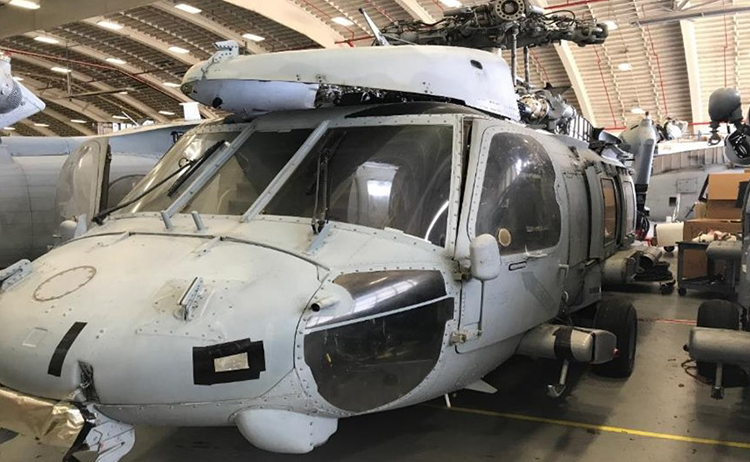
Each conversion of Navy HH-60H and SH-60F Seahawk hulls takes over 1,500 separate maintenance cards for mechanics to follow. U.S. Coast Guard photo.
“The next 13 hulls will be used to fulfill the SLEP or fleet growth demands, as required; with the new hulls now in the mix, the program anticipates the majority of the converted Navy hulls to be utilized for fleet growth purposes,” Adams said. Three new hulls have been delivered of the 45 currently on order with Sikorsky.
Ventura marks the Coast Guard’s first permanent air station in the region since 2016. Prior to breaking ground for Air Station Ventura in 2021, the service conducted aviation operations from a forward-operating base at Naval Base Ventura County supported by Coast Guard Air Station San Francisco.
Air Station Ventura features a $70 million state-of-the-art 43,000-square-foot hangar and a 12,000-square-foot administration and berthing facility. At full capacity it will house three MH-60T Jayhawk helicopters and approximately 100 personnel, significantly enhancing the Coast Guard’s capabilities in the region.
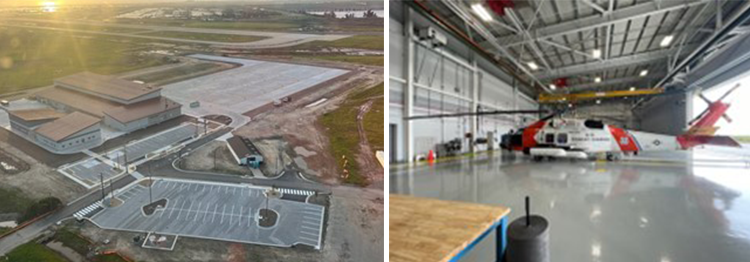
The new Coast Guard Air Station Ventura and its MH-60T hangar is located at Naval Base Ventura County in Point Mugu, California. U.S. Coast Guard photos.
For more information: MH-60T Acquisition/Sustainment Program page.
 Chuck Hill's CG Blog
Coast Guard Air Station Ventura conducts first rescue, medevacs man offshore Los Angeles > United States Coast Guard News > Press Releases (uscg.mil)
Oct. 14, 2024Coast Guard Air Station Ventura conducts first rescue, medevacs man offshore Los Angeles
U.S. Coast Guard Pacific Southwest Phone: 206-815-6689
SAN FRANCISCO — The Coast Guard medevaced a 63-year-old man experiencing severe abdominal pain from the cruise ship Grand Princess off Los Angeles, Sunday afternoon.
The patient was hoisted aboard the helicopter and was transferred to awaiting emergency medical personnel at Torrance Memorial Medical Center in Torrance, California.
Watchstanders from the Coast Guard District Eleven Command Center received the medevac request at approximately 1:00 a.m. Saturday. The cruise ship was put on a communications schedule until they were within range for an MH-60 Jayhawk helicopter aircrew from Air Station Ventura to conduct a hoist.
The Jayhawk aircrew conducted the hoist at approximately 2:30 p.m. Sunday, with an Coast Guard Air Station Sacramento C-27 Spartan aircrew providing overflight support.
This also marks the first rescue conducted by the newly established Coast Guard Air Station Ventura. The crew consisted of Lt. Rob Turley, Lt. Miguel Cortez, Petty Officer 2nd Class Curren Hinote, and Petty Officer 2nd Class Sam Monahan.
Coast Guard completes first MH-60T service life extension featuring newly manufactured hull
Nov. 1, 2024 —
CGNR 6063, the first MH-60T medium range recovery helicopter to complete service life extension program activities including the incorporation of a newly manufactured hull, arrives at Coast Guard Air Station Astoria, Oregon, on Aug. 8, 2024. U.S. Coast Guard photo.
The Coast Guard recently delivered the first MH-60T medium range recovery helicopter that was outfitted with a newly manufactured hull as part of the service life extension program (SLEP). This upgrade is a key initiative to complete SLEP work, which extends the operational lifespan of the H-60 fleet. CGNR 6063 was accepted at Air Station Astoria, Oregon, on Aug. 8.
The Coast Guard is taking two approaches to conduct SLEP activities for the service’s original fleet of 45 MH-60Ts, which have been in service since 1990 and are currently approaching the end of their service life: replacement of legacy hulls with low-hour, retired Navy H-60 hulls and incorporation of newly manufactured hulls. Parallel pathways provide multiple sources for hulls and support the timely completion of the SLEP process. Utilization of newly manufactured MH-60T hulls also provides approximately 20,000 additional flight hours, 8,500 more flight hours per aircraft, on average, compared to converted Navy H-60 hulls.
Sikorsky Aircraft Corp., the original equipment manufacturer, has delivered three of the 45 new hulls that have been ordered to date.
Hull replacement is just one component of the MH-60T sustainment effort. Critical dynamic components such as main rotor blades and electrical wire harnesses are also being replaced. Aircraft production, including the assembly and installation of these dynamic components, is being completed at the Coast Guard Aviation Logistics Center in Elizabeth City, North Carolina.
The sustainment effort has expanded to include increments for fleet growth as the service transitions to an all MH-60T fleet. Consolidation of the Coast Guard’s rotary wing fleet to a single MH-60T airframe is necessary to mitigate sustainability challenges with the MH-65 short range recovery helicopter and maintain the service’s rotary wing capability until recapitalization in line with the Department Defense’s Future Vertical Lift program.
For more information: MH-60T Acquisition/Sustainment Program page