

“The crew of U.S. Coast Guard Cutter Stratton (WMSL 752) encountered and shadowed four Russian Federation Navy (RFN) vessels 57 miles northwest of Point Hope, Alaska, Sept. 15, 2024. The Russian Surface Action Group consisted of a Severodvinsk-class submarine, a Dolgorukiy-class submarine, a Steregushchiy– class Frigate, and a Seliva-class tug. Stratton patrolled under Operation Frontier Sentinel, a Coast Guard operation designed to meet presence with presence when strategic competitors operate in and around U.S. waters. (U.S. Coast Guard courtesy photo)”
Below is a news release from Coast Guard news.
Point Hope, Alaska is well North of the Bering Strait and the Arctic Circle, bordering the Chukchi Sea, 312 miles SW of Utqiagvik (formerly Pt. Barrow) and almost a thousand miles North of Dutch Harbor. None of my Alaska Patrols ever got that far North.

Russian Yasen class SSGN
The Severodvinsk or Yasen class submarine is a nuclear submarine equipped with eight missile silos for up to 32 cruise missiles and ten torpedo tubes.

Russian Borei class SSBN
The Dolgorukiy or Borei class submarine is a SSBN with 16 silos for ballistic missiles.
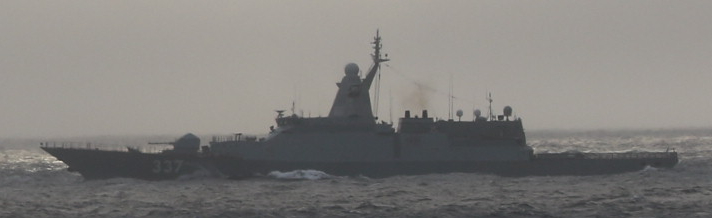
The surface combatant seems to have been miss identified. It is Gremyashchiy (337) lead ship of her class of 2,500 ton Project 20385 corvettes (NATO considers them frigates).
Note, USCGC Stratton is not an ice strengthened vessel.
This may have been a transfer of the SSGN and SSBN to the Russian Pacific Fleet.
The post story seems to indicate Stratton stumbled across this group. Shouldn’t we have known they were there?
JUNEAU, Alaska — The U.S. Coast Guard located four Russian Federation Navy (RFN) vessels Sunday, 57 miles northwest of Point Hope, Alaska.
While on a routine patrol in the Chukchi Sea, the crew of U.S. Coast Guard Cutter Stratton (WMSL 752) observed the RFN vessels transiting southeast along the Russian side of the Maritime Boundary Line (MBL).
The crew of the Stratton witnessed the RFN vessels cross the MBL into the U.S. Arctic and moved to observe the vessels. The Russian vessels were assessed to be avoiding sea ice on the Russian side of the MBL and operated in accordance with international rules and customs as they transited approximately 30 miles into the U.S. Exclusive Economic Zone.
“We are actively patrolling our maritime border in the Bering Sea, Bering Strait, and Chukchi Sea, with our largest and most capable cutters and aircraft, to protect U.S. sovereign interests, U.S. fish stocks, and to promote international maritime norms,” said Rear Adm. Megan Dean, Commander of Coast Guard District Seventeen. “Coast Guard Cutter Stratton ensured there were no disruptions to U.S. interests.”
The Russian Surface Action Group consisted of a Severodvinsk-class submarine, Dolgorukiy-class submarine, Steregushchiy– class Frigate, and Seliva-class tug.
The Stratton is patrolling under Operation Frontier Sentinel, an operation designed to meet presence with presence when strategic competitors operate in and around U.S. waters. The Coast Guard’s presence strengthens the international rules-based order and promotes the conduct of operations in a manner that follows international law and norms.
Coast Guard Cutter Stratton is a 418-foot legend class national security cutter homeported in Alameda, Calif.
 Chuck Hill's CG Blog
2 Russian ‘State of the Art’ Nuclear Submarines Complete 4,000-Mile Arctic Journey (msn.com)
This confirms that the two Russian submarines were being transferred from their Northern Fleet to their Pacific Fleet.