
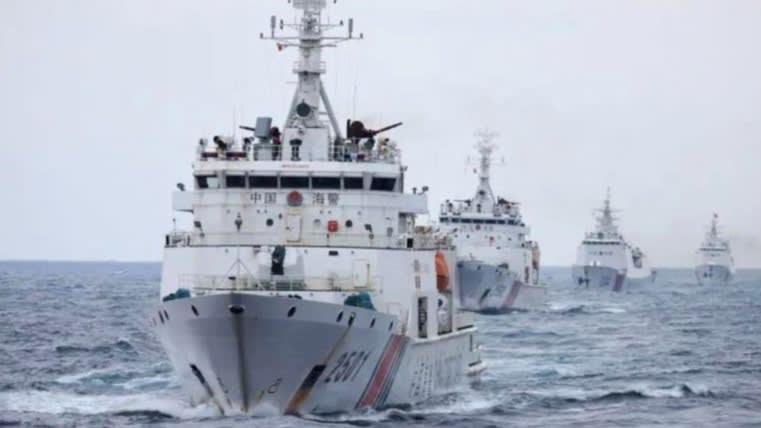
This Chinese coast guard ship 2501 and other are equipped with 76-millimeter guns. © Kyodo
The Department of Defense has issued its annual “Military and Security Developments Involving the People’s Republic of China, 2024.” The degree of annual expansion is extremely troubling. There is a brief look at the Naval aspects from Commander Salamander here. I think it is fair to say that the US Navy is rapidly losing its edge.
We should expect to see rising expectations for the US Coast Guard to be prepared to participate in a war with China.
I have reproduced the brief section devoted to the China Coast Guard (CCG) below. This is from the pages numbered 76 and 77. They are the 90th and 91st pages of the 182 page document.
For Perspective:
China’s undisputed EEZ, including territorial sea, is less than 8.5% that of the US and even their expansive claimed EEZ and territorial sea is less than 20% of that of the US.
The China Coast Guard has far more large patrol vessels (over 1,000 tons) than the US Coast Guard (about 150 vs 33), which they tend to operate in groups. Still the CCG probably has fewer personnel (no recent figures seem to be available) and far fewer aircraft. The CCG does not do aids to navigation or marine inspection, and it is not the country’s primary coastal search and rescue agency. In short it is much more focused, primarily on bullying China’s neighbors.
China Coast Guard
CCG Service Roles and Missions. The CCG is subordinate to the PAP (People’s Armed Police–Chuck) and responsible for a wide range of maritime security missions, including defending the PRC’s sovereignty claims; combating smuggling, terrorism, and environmental crimes; and supporting international cooperation in accordance with relevant international treaties. The Standing Committee of the PRC’s NPC (National People’s Congress, China’s Legislature–Chuck) passed the Coast Guard Law, which took effect on February 1, 2021. The legislation regulates the duties of the CCG, including the use of force, and applies those duties to seas under the jurisdiction of the PRC. The law was met with concern by other regional countries that perceive
the law as an implicit threat to use force, especially as territorial disputes in the region continue. The CCG is the PRC’s front-line force for carrying out “rights protection” (weiquan) operations in disputed areas of the PRC’s maritime periphery. The PLAN overwatches CCG operations to deter other claimants and provide the PRC an option to rapidly respond with force, if necessary.
CCG Capabilities and Modernization. The CCG’s continued expansion and modernization makes it the largest maritime law enforcement fleet in the world. Newer CCG vessels are larger and more capable, enabling them to operate farther off shore and remain on station longer. The CCG has over 150 regional and oceangoing patrol vessels (more than 1,000 tons). These larger vessels include over 20 corvettes transferred from the PLAN, which were modified for CCG operations. The newer, larger CCG vessels are equipped with helicopter facilities, high-capacity water cannons, multiple interceptor boats and guns ranging from 30 mm to 76 mm. Revised estimates indicate the CCG operates more than 50 regional patrol combatants (more than 500 tons), which can be used for limited offshore operations, and an additional 300 coastal patrol craft (100 tons to 499 tons). In 2023 and early 2024, the CCG launched seven offshore patrol ships as well as two additional patrol ships based on a large salvage ship design. Several more offshore patrol ships are likely under construction.
CCG Readiness. The CCG continues to operate in alignment with the Coast Guard Law, asserting the PRC’s claims in the East and South China Seas and Taiwan Strait, in what the law considers the “waters under the jurisdiction of China.” In these regions, the CCG uses aggressive tactics against foreign vessels, such as ramming, firing water cannons, and performing dangerous maneuvers, frequently working alongside the PLAN and CMM. The CCG annually sends two vessels on a month-long fisheries law enforcement patrol in the North Pacific. These patrols support the PRC’s membership in the Convention on the Conservation and Management of High Seas Fisheries Resources in the North Pacific Ocean.
 Chuck Hill's CG Blog
Chuck said: “We should expect to see rising expectations for the US Coast Guard to be prepared to participate in a war with China.”
My question is “How?” Significant swathes of CG personnel and leadership have all but forgotten, and have certainly pushed away, the national defense mission. No cutters are equipped for modern warfare beyond some SLQ-32s and RBOC.
can generate a lot of The commander of Indo-PacCom said recently that China’s Navy only has about 56 modern warships (surface – this number didn’t include subs) which are modern and capable. Still, the less capable Navy ships, plus China Coast Guard and China Naval Militia can generate a lot of numbers…
The Coast Guard has shown an ability to adapt to the demands of the time. Unfortunately, it may take too long to adapt to the role of Naval auxiliary.
Even in wartime the CG is going to have to continue to do a lot of its peacetime missions. War generates SAR cases. Port operations need to continue even if under Cyber attack.
But there is a lot more we could do, but it needs to be coordinated with the Navy.
The Coast Guard working with Navy Reservists is the logical agency to manage Naval Control of Shipping.
Coast Guard fixed wing air assets will be needed to provide Maritime Domain Awareness of unconventional maritime threats that might include mine laying or launching cruise missiles from merchant ships.
But the large patrol cutters are the thing we normally think about. We have seen NSCs host Navy helicopters and command ASW task forces in RIMPAC exercises. I think it is feasible to add a containerized towed array and Navy MH-60R helicopter detachment to NSCs without too much physical rearrangement. There are more MH-60s than the Navy has deployable ships to put them on, but crews for the helicopters and operators, maintainers, and supervisory personnel for both the helo det and the towed arrays need to be identified from the pool of recallable reservists and containerized towed arrays need to be identified, a prototype installation done, and necessary modifications to the ships need be done to provide necessary utilities when the containers are embarked.
Agree with everything you say, but I’m also very skeptical about the time factor. Even with utilizing Navy Reservists for Helo and Sonar crews, there is something to be said for experience. The Cutter Captains and operations department would need experience/training/practice to learn the details of ASW ops, and then there is the integration issue.
I love your idea, but sonars need to be purchased and located for quick installation. Same for the MH-60s. The Navy Reserve crews should do their 2 weeks aboard the CG Cutter, with their equipment installed & aircraft aboard, and for that 2 weeks the Cutter should spend at least 80% of its time conducting wartime ASW practice.
None of this is being done, as you point out; thus, the acquisition, integration, and training period will be many, many months. The war will be over before the CG is meaningful in the war zone or along the MDZs, other than long and medium range patrol aircraft identifying surface (only – no sub detection equipment) contacts (and even there, the CG assets have no capability to prosecute such contacts.
The planning of how to do things better is easy. The two biggest obstacles are: Funding, and (the biggest): the mindset of so much of the CG that they don’t want the military mission. Posters on your blog have fought the idea…. It is a rampant, problem mindset issue. People want to be rescuers, marine environment protectors, and maybe even law enforcement, but stretch that to Nat’l Defense, and it’s a “nope.” The reasoning that there is no time to “catch up” when war breaks out is unassailable, yet, people refuse to look at the Nat’l Defense mission as anything other than an esoteric idea of “rareness.”
One other quick thing: “The CG has shown an ability to adapt to the times.”
Yes it has, BUT, not in this day and age. WWII: CG manned transports and assault boats (right in their wheelhouse; not much extra training needed). The harder change was shifting Cutters to ASW work, BUT, in WWII, 5” guns, depth charge racks, and K-guns were not all that difficult to train up. Quick wasn’t a problem.
Vietnam: CG sent PBs for Operation Market Time. Boardings, small arms, and .50s/81mms were easy to train on (and install for the innovative 50/81s). Quick wasn’t a problem.
Today, the ASW mission is SOPHISTICATED. No throwing some depth charges or firing Hedgehogs based on rudimentary Sonar. Today, one needs towed arrays, sono-buoys, torpedoes, and self defense systems. These are NOT quick to obtain nor train up to the needed competency level, and require practical exercises/training. The old saw that the CG can quickly get ready just isn’t valid anymore because of the technological changes. Not an attack on you, because the one thing CG personnel have is heart and a can-do attitude (and always have had – it’s what CG personnel are renowned for), but anechoic coatings, nuclear power, long range highly accurate torpedoes, etc., negate those personnel qualities, when it comes to effectively and safely (as much as possible during wartime) doing the mission.
I think it is misleading to say that the Chinese have the largest Navy in the world just because it has more ships. The ships of the US Navy have a much greater total displacement. The US Navy has more people. The US Navy has more aircraft than the Chinese Navy.
On the other hand, they have the advantage of the choice of when to initiate hostilities and the advantage of proximity.
Only a small percentage of US Navy is deployed to Western Pacific at any time. Generally, less than a quarter of USN combatants are deployed and many of those are far from the Western Pacific. It is very rare to have more than two carriers deployed to the Western Pacific.
Even if we decide to move the entire fleet to the Western Pacific, we would have a hard time keeping them in a position to fight and combat ready. The logistics line is very long from the West Coast to Western Pacific and much of our reserve of ammunition is spread in other parts of the world.
We have very few American owned ships to carry the supplies and very few mariners to run those ships.
The Chinese have already identified our logistics chain as a vulnerability and are likely to use their SSNs to attack the supply chain.
Logistics is a huge vulnerability for the fleet. If China takes out just a couple replenishment ships, the USN couldn’t do any sustained area control operations. It is the Navy’s greatest weakness, and even causes difficulties in peacetime ops.
Strategically, it’s better we don’t keep much of the fleet in WestPac. When China initiates, all or our forces in WestPac are going to take many hits and become combat ineffective. Submarines are where the US should focus the pre-warfare time period mission. That will station very capable assets which are less vulnerable and have the potential to minimize the Chinese sub threat.
Removing the ASW capability from the cutters after the dissolution of the Soviet Union was probably a rational decision. The threat to Europe and the attendant need to secure the seaborne logistics went away. We had three decades of maritime dominance since then, but as China started emerging as a maritime threat, we should have recognized it and started taking steps to ensure the Coast Guard was ready to play its part. First, we need to know that that part is. It is not clear that we have done even that.