
“Ex-US Coast Guard Cutter Steadfast Arrives In Malaysia” –Naval News

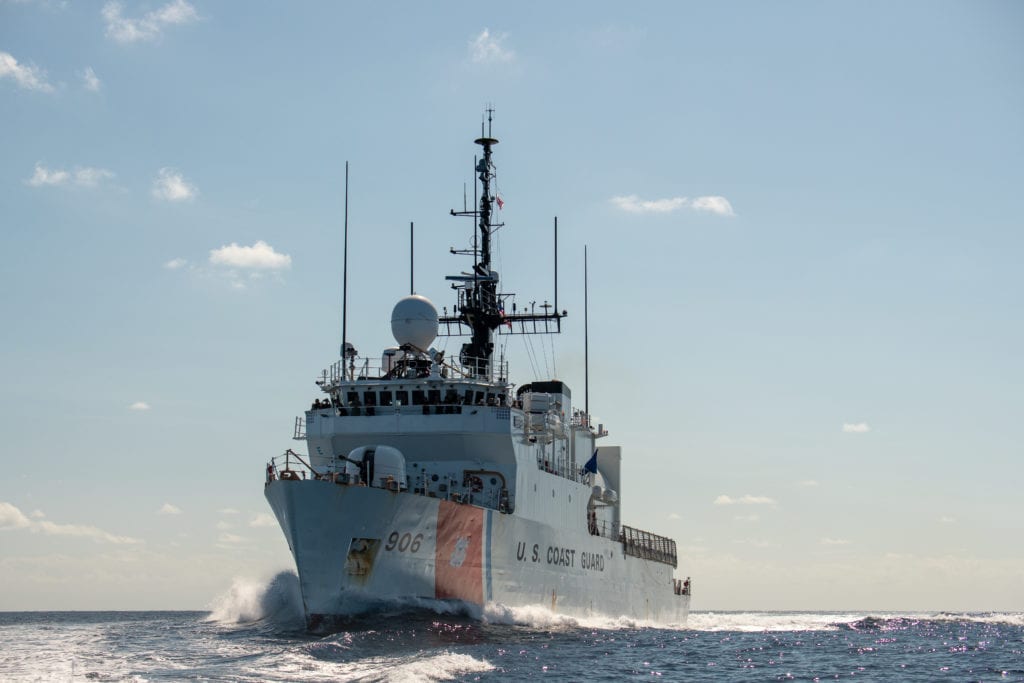
The ex-U.S. Coast Guard cutter Steadfast arriving at the National Hydrographic Centre, Port Klang on November 4, 2025 (U.S. Embassy Kuala Lumpur)

Naval News reports,

“The former United States Coast Guard cutter Steadfast arrived in Malaysia on 4 November, completing a 10,600 nautical mile journey from Baltimore to begin its service with Malaysia’s coast guard, the Malaysian Maritime Enforcement Agency.”

Look at the picture. This ship, the former USCGC Steadfast was commissioned 7 October,  1968. She is over 57 years old and her Malaysian crew has just completed a voyage from Baltimore, across the Atlantic, through the Straits of Gibraltar, across the Mediterranean, through the Suez Canal, down the length of the Red Sea, through the Gulf of Aden, across the Indian Ocean, and through the Strait of Malacca.

How did that happen? The Coast Guard has been recapitalizing its fleet and as a result a lot of vessels became excess property. Rather than incur the cost of scrapping these now over age ships, the Coast Guard has set up a command at Curtis Bay that works with the Coast Guard Yard to prepare these ships for transfer to the navies and coast guards of friendly nations making sure the ships are seaworthy and the crews are adequately trained.

The twelve Hamilton class cutters have been transferred to five different nations.

Two 210 foot Medium Endurance Cutters, Courageous and Durable, were decommissioned in September 2001. Courageous was transferred to Sri Lanka in 2004 and Durable was transferred to Colombia in 2003. Since March 2023 five more WMEC210s have been decommissioned or placed in “in commission, special” status. Steadfast is the first of these five to be transferred to another user.

“The United States announced at the end of October that it plans to provide another retired cutter to the Malaysian Maritime Enforcement Agency.”

22 of the Island class WPBs have been transferred to eight different nations including five to Ukraine where at least one was sunk in combat.

9 of the Marine Protector class 87 foot WPBs have been transferred to Lebanon (2), Uraguay (3), Malta (2), and Yemen (2).

I visited the Coast Guard Yard in August 2024 with the intention of writing a post. I was very impressed, but other priorities got in the way. I have regretted not telling their story ever since.

I was told that from March to July 2024 a decommissioned arrived at the yard every nine days.

This is an important story and it deserves more attention.
“Coast Guard cutters mark SLEP milestones for ISVS Program” –CG-9

U.S. Coast Guard Cutter Seneca prior to prototype SLEP

Below is an Acquisitions Directorate (CG-9) report on a couple of “In Service Vessel Sustainment” (ISVS) projects. This talks about the Polar Star, but we already knew about that. This is the first report on the WMEC270 SLEP that I can recall. It corrects my previous impression that Harriet Lane was to be the first. Seneca was the first. It also says,

Six more of the 13 in-service WMECs will undergo SLEP work, with production work starting in 2023.

I was under the impression that only six total were to be SLEPed. Does “production work starting in 2023,” mean what was done to Seneca and will be done to Harriet Lane is not a full-fledged SLEP?

If work on these two ships is “prototyping” and not “production,” it may be significant that these two cutters were built by different builders, Harriet Lane having been one of the four built by Tacoma Boat and Seneca one of the nine built by Robert Derecktor Shipyard. There may be some differences within the class.

It was anticipated that the 76mm Mk75 gun was to be removed, along with, presumably, the Mk92 fire control system, to be replaced with a Mk38 gun mount.  There is no mention of this.


Coast Guard cutters mark SLEP milestones for ISVS Program

April 21, 2022

Two Coast Guard service life extension programs (SLEP) reached milestones in early April – prototype work was completed on a 270-foot medium endurance cutter (WMEC) and Coast Guard Cutter Polar Star commenced the second phase of its SLEP work.

SLEPs address specific systems and major maintenance to extend the service life of the vessel to meet cost, schedule and performance requirements. They are part of the In-Service Vessel Sustainment Program, which conducts strategic major maintenance and recapitalization as vessels age and critical systems become obsolete, improving the reliability of Coast Guard vessels, helping control maintenance costs and increasing time spent underway.

For the WMEC SLEP, Coast Guard Cutter Seneca recently departed Coast Guard Yard April 4 for its homeport in Portsmouth, Virginia. Seneca served as a prototype for the SLEP work on the WMECs, which is a renewal of several mission-critical systems including electrical updates with new generators, switchboards and Coast Guard machinery control system software updates.

“This wraps up a successful nine-month project at Coast Guard Yard that began in July 2021 totaling over $6.4 million,” said Lt. Charles Lortz, the Project Residence Office Baltimore 270-foot WMEC SLEP section chief. “Beyond the difficulties inherent to a prototype project, the Seneca project followed an expedited planning process to more quickly deliver a more capable asset to the fleet. It was certainly noted, by all involved, that this project was charting new territory.”

Coast Guard Cutter Harriet Lane arrived at Coast Guard Yard March 28 and will undergo prototype refinements. Six more of the 13 in-service WMECs will undergo SLEP work, with production work starting in 2023. The WMEC SLEP will sustain capabilities to meet mission needs until they are replaced by offshore patrol cutters.

As Seneca was heading to its homeport, Polar Star transited from the San Francisco Bay to Mare Island Dry Dock LLC in Vallejo, California. On April 8, it commenced the second phase of SLEP work items and recurring maintenance, which is taking place over a five-year, annually phased production schedule that runs through 2025. During the second phase, Polar Star SLEP will recapitalize two engineering control systems: one will operate and control the cutter’s 75,000 shaft horsepower gas turbines and auxiliary systems while the other control system is dedicated to the diesel electric propulsion plant. When completed, Polar Star’s SLEP will have replaced a number of major systems and extended the service life of the Coast Guard’s only operational heavy icebreaker.

The Coast Guard is also investing in a new fleet of polar security cutters (PSC) that will sustain the service’s capabilities to meet mission needs in both the Arctic and Antarctic regions. The first PSC is on contract for delivery in 2025. Polar Star will stay in service until the second PSC is operational.

For more information: In-Service Vessel Sustainment Program page