
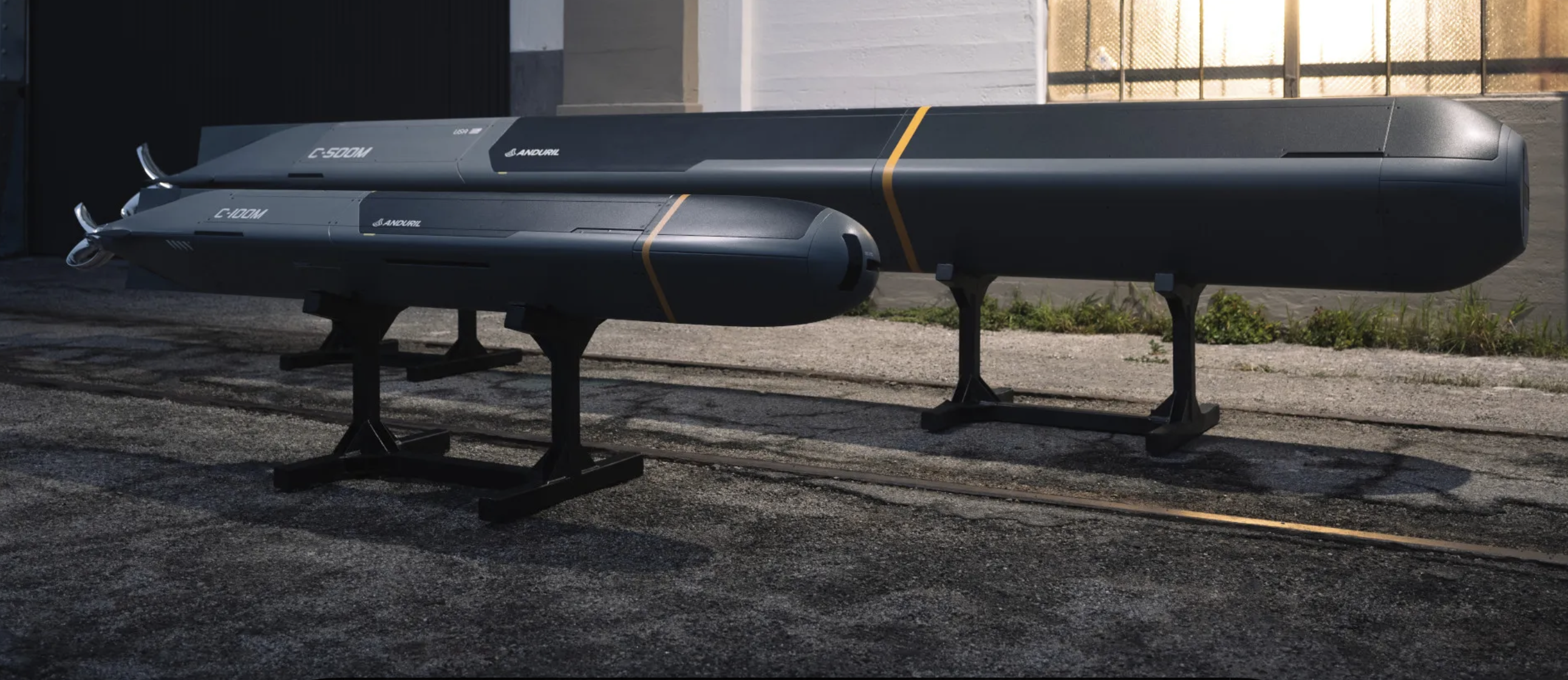
Copperhead torpedo like UUV
If you are a regular reader, you know, the Coast Guard has a requirement implicit in its missions to be able to forcibly stop any vessel, regardless of size, particularly in response to unconventional maritime attacks. This ability needs to be widely and readily available. The Coast Guard does not have that ability with regard to larger ships. Torpedoes can fill this requirement reliably and economically. The Coast Guard might logically also be called upon to enforce blockades in wartime and would require a similar capability.
Unfortunately, the only torpedoes in the US inventory are designed for much more demanding missions than the Coast Guard requires for its peacetime missions–attacking high speed submarines that move in three dimensions at great depths. This has made them much more expensive than they need to be for the Coast Guard missions.
It now appears, we may have a low cost alternative.
Anduril has rolled out a new family of modular torpedo-like uncrewed underwater vehicles (UUV) called Copperhead. This includes kamikaze types…The Copperhead family of UUVs, which Anduril also refers to as autonomous undersea vehicles (AUV), currently consists of the 100 and 500-pound-class types, as well as “M” munition subvariants of each. The Copperhead-100 has an overall length of just under nine feet (approximately 2.7 meters) and is 12.75 inches in diameter, while the Copperhead-500 is just over 13 and a half feet (just over four meters) long and 21 inches wide…. the company says they can both reach top speeds in excess of 30 knots.
While there are probably other ways to launch, these systems are clearly designed to fit in existing torpedo tubes. Existing torpedoes have been autonomous Unmanned Underwater Vehicles (UUV) all along. Anduril is taking the basic torpedo form and broadening its application, while retaining the option of employing the UUV as a weapon.
The 500 and 100 designations refer to the approximate payload weight, not the weight of the device.
Copperhead 100 is 12.75″ “in diameter” and 106″ in length. These outer dimensions are essentially identical to that of the Mk54 but the diamond (square cross section) shape and the need to maintain near neutral buoyancy suggests it will be lighter, probably about 450 pounds.
Copperhead 500 with a 21-inch diameter and 163-inch length is short for a heavy weight torpedo. It probably weighs about 1700 pounds, a bit less than the USN air launched Mk13 Mod 0 (1,949 lbs. or 884 kg) and about half that of the 288 inch long surface launched Mk15 Mod3 (3,841 lbs. or 1,742 kg) torpedoes of WWII.
The speed for both systems is reported as greater than 30 knots. That is slow for a modern torpedo, but faster than nearly all commercial ships, military auxiliaries, and offshore patrol vessels.
As reusable systems, I would assume these are powered by rechargeable batteries like the SAAB Torped 47. Torped 47 is larger than Copperhead 100 but substantially smaller than Copperhead 500. Torped 47 as a reported range of at least 20 km so I would expect the 100 to have a bit shorter range and the 500 to have a longer range.
Among other things, Copperhead 500 UUVs could be used as a mobile mine. At slow speed it could go at least ten miles on its own, based on the old tech Mk37 based Mk67 mobile mine, so probably substantially further.
They might also be able to do Q-route surveys, checking port approach and departure routes for mines.
The Coast Guard might want to employ these systems as scientific or surveillance assets as well as weapons.

Coast Guard manned Destroyer Escort USS Menges, victim of a German Acoustic Homing Torpedo, May, 1944
Copperhead 100M would probably be adequate to immobilize most ships if the warhead exploded below the propeller(s) and rudder(s), but if the target managed to limp along after the first hit, a second might be necessary. If it is necessary to sink a target of over 1000 tons, then you would probably need the larger warhead of the 500M and/or multiple hits.
Equipping FRCs and larger cutters to support two Copperhead 100s and one Copperhead 500 might both answer the need for an effective ship stopper and also provide options for otherwise employing UUVs.
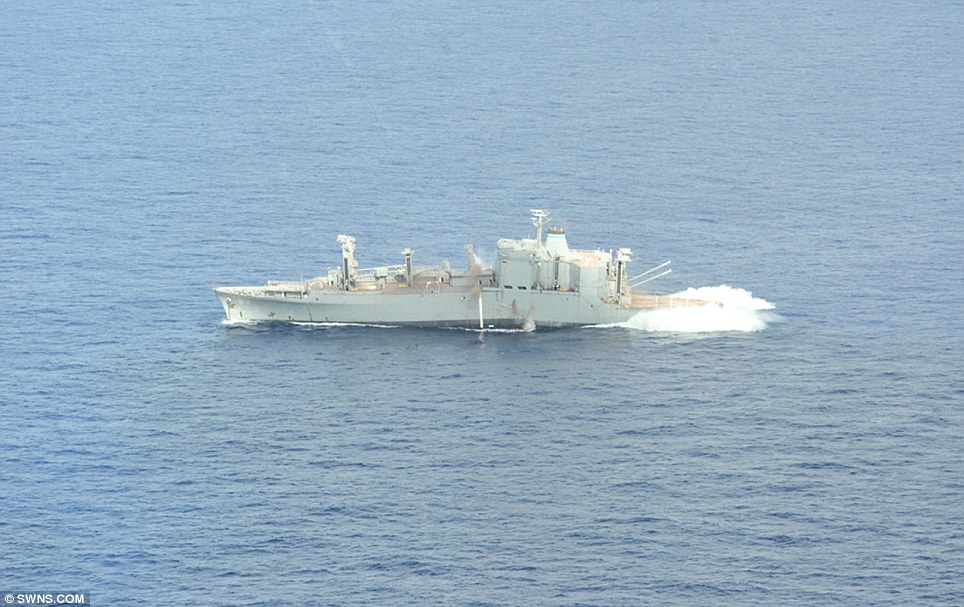
USNS Kilauea breaks in half after being hit by the torpedo.
 Chuck Hill's CG Blog