
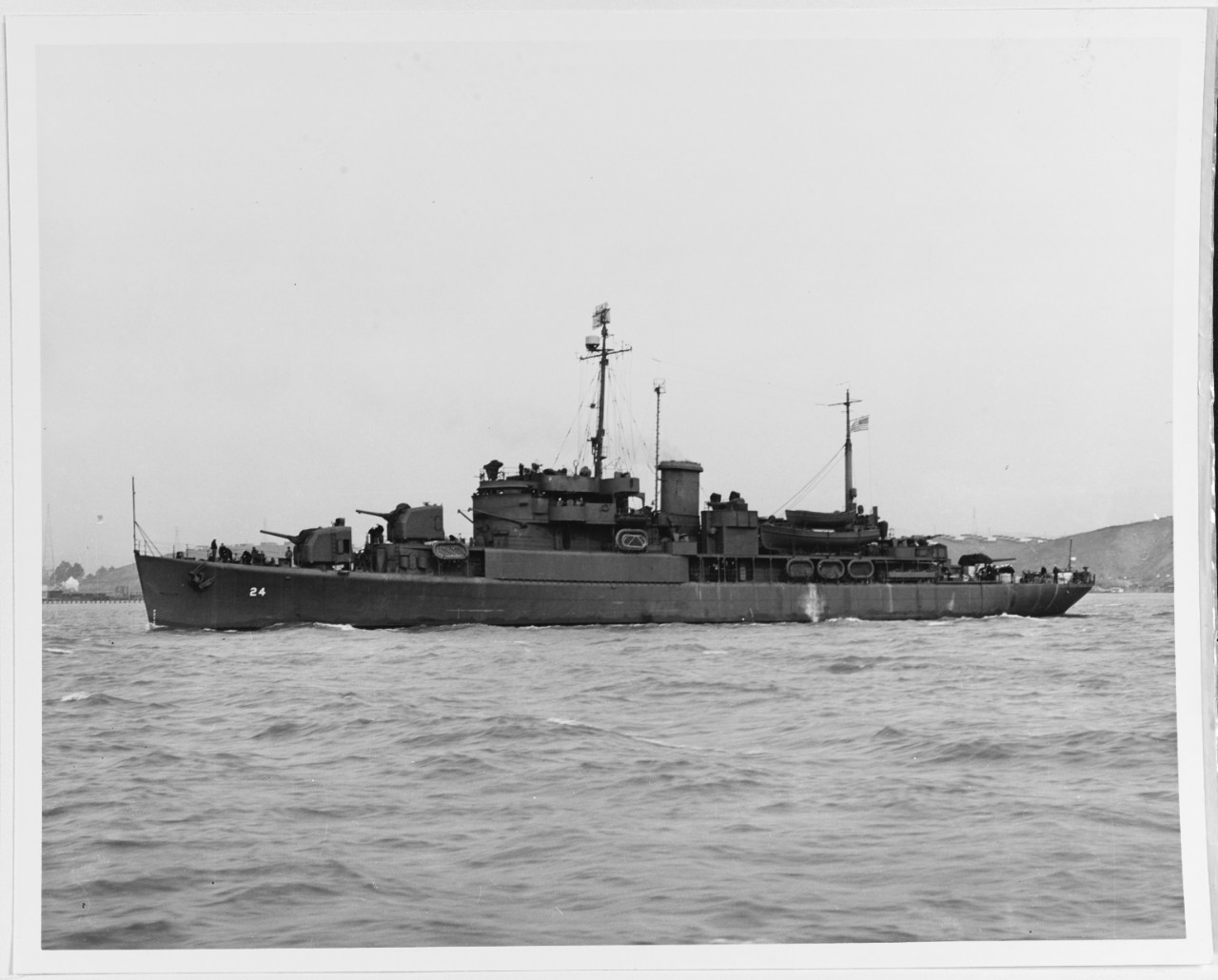
Title: USS Chincoteague (AVP-24) Photographed on 27 December 1943 off the Mare Island Navy Yard following repairs to severe battle damage incurred in July 1943. One of the four 5/38 guns in her original armament has been replaced by a quadruple 40mm mount. Photograph from the Bureau of Ships Collection in the U.S. National Archives. Catalog #: 19-N-57482
Recently finished reading “USS Chincoteague the Ship That Wouldn’t Sink” by Frank D. Murphy. It is a small, large print book, the first-person story of a young sailor, then 19, and his first ship, a newly commissioned small seaplane tender, USS Chincoteague, that endured eleven air attacks 16-17 July 1943, only three months after she had been commissioned.
I had a personal interest because my first ship, USCGC McCulloch, the former USS Wachapreague, was also Barnegat class ship.
The attacks on Chincoteague were during a period when the US was moving up the Soloman Island Chain. The Allies had invaded New Georgia, but the fighting was heavy, and the Japanese were making a strong effort to push the allies off the island.

Consolidated PBY-5A Catalina. US Navy photo.
USS Chincoteague was anchored in Sabot Bay, Santa Cruz Islands, Southeast of the Soloman Islands, servicing a squadron PBY patrol planes when the attacks began. When an attack was expected she would get underway to maneuver. Between attacks she would return to service her brood of sea planes.
Attacks on the 16th caused only minor fragment damage. During attacks on the 17th, she received two damaging near misses that caused flooding and fires, then a direct bomb hit that wrecked the after engineroom killing ten crew members, followed by another near miss that dented the hull and knocked the remaining engines offline. Dead in the water, having taken on 663 tons of water, she had a negative GM, and was listing 12 to 18 degrees, it looked as if she would be sunk by the eleventh attack when four Marine Corsairs arrived splashing three of the attackers and driving off the fourth.
After repairs to the forward engineroom, which powered the starboard shaft, the ship got underway at 2350, but at 0245 on the 18th one of the engines was overheating. In an attempt to deal with the overheating, control of the engine was lost, and it ran away in spite of a closed throttle, causing a severe fire that forced the crew to abandon the engineroom.
The ship was taken in tow and, after temporary repairs at Espiritu Santo, was towed by to the West Coast where complete repairs were made including addition of eight 40 mm anti-aircraft guns and additional 20 mm guns. Ultimately, she would earn six battle stars.
You can read the full original damage report here.
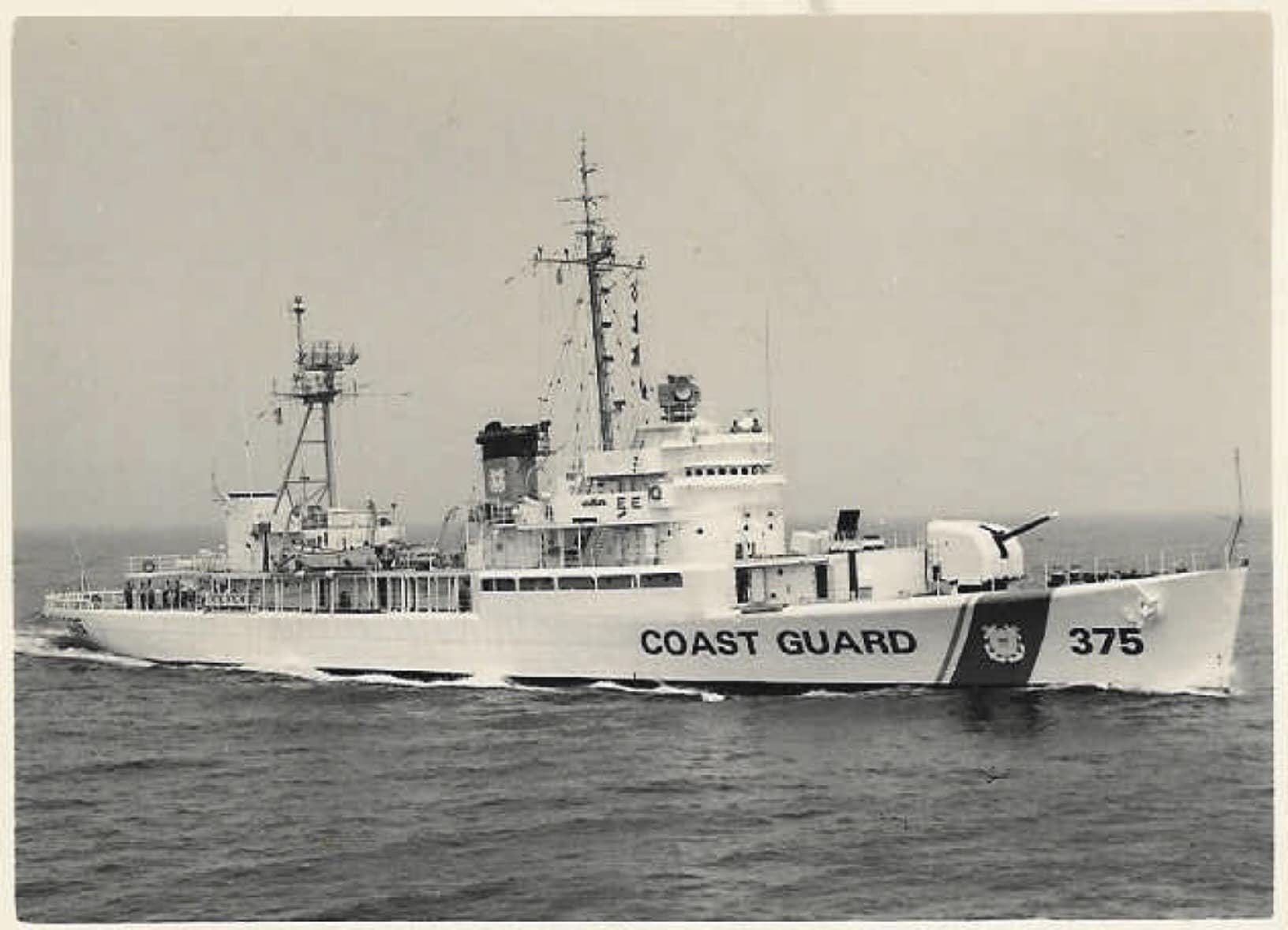
USCGC Chincoteague (WHEC-375) seen here late in her service with the Coast Guard, armed with a single 5″/38, Mk 56 Gun Fire Control System, torpedo tubes for ASW torpedoes, and Hedgehog ASW mortar.
In the 1940s Chincoteague and 17 of here sisters were transferred to the Coast Guard, where they primarily served as weather ships on a number of “Ocean Stations.” In Coast Guard service, these were referred to as the Casco Class. 
As part of “Vietnamization” Chincoteague and six of her sister Coast Guard cutters were turned over to the South Vietnamese.
After being turned over to the South Vietnamese, the former Chincoteague, along with another former Coast Guard cutter of her class and two former US Navy ships fought the Chinese Navy in the “Battle of the Paracel Islands,” 16 January 1974.

RVNS Lý Thường Kiệt (HQ-16), the former USCGC Chincoteague
As the South Vietnamese government collapsed, the former Chincoteague along with five other ships of the class (the former Yakutat, Bering Strait, Castle Rock, Cook Inlet, and McCulloch) crowded with hundreds of refugees made their way to the Philippines. In 1976 these ships were turned over to the Philippine Navy as the Andrés Bonifacio class, with four of them commissioned and two (the former Yakutat and Cook Inlet) retained to provide spare parts. They remained in service until at least 1985.
The former USS/USCGC Absecon continued in service with the Vietnamese People’s Navy perhaps as late as 2000 and was probably the only Barnegat class ship ever armed with guided missiles, the SS-N-2 Styx and the SA-N-5 Grail.
 Chuck Hill's CG Blog
Thank you for publishing this report, I had never seen it before. I was on the Chincoteague from Feb 69 til Aug 70. Pic 10 shows the port side with ship’s office door to the right, looking at the door going forward to the mess deck. I was in ER #1 while aboard and recognize the area of damage to the inboard engine. I learned a lot, had a fairly good time, but quite thankful I was NOT aboard during war-time. There’s a nice comment about the crew, and the work they did to save the ship, even tho they were a couple months out of San Diego with a brand new boat. One thing I have realized 50 years on, was that bootcamp did a huge job of getting us to function during an emergency, and it has carried thru my life without hardly ever thinking about it. I rather enjoyed going to sea, it was rather relaxing in it’s own way. Very little to worry about shore-side problems when you are 1000 miles out to sea. Thanks again for posting. Daniel Grinnell En2, USCG