
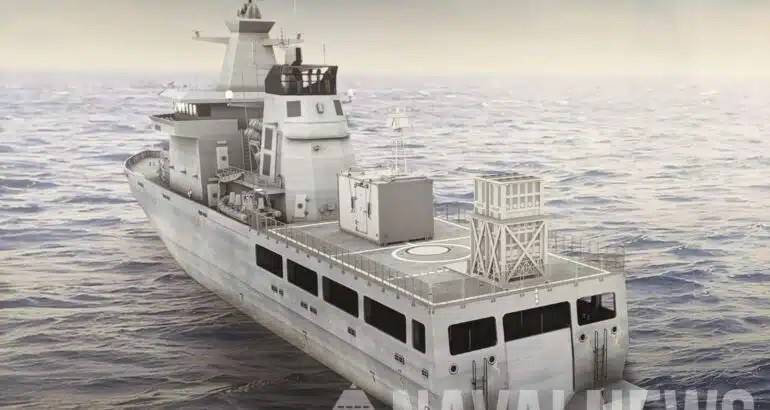
Australia Considering Modular C-Dome For Arafura OPVs
Illustration of Arafura-class OPV fitted with C-DOME
“Normally when a navy acquires a new ship, they want it to be as capable as possible. Not so the Royal Australian Navy, which has down-designed the Arafura class Offshore Patrol Vessels (OPVs) so that they can no longer support the weight of a helicopter on the large rear deck.”
The article goes on to criticize this and other decisions regarding the ship, but there may be method to this madness.
I would assume the Australian Navy is putting some thought into these decisions and it may be related to my observations in a post only two days ago, “When is a Flight Deck Not a Flight Deck?”
The intention may be to save topside weight so that an additional load or loads, heavier than an 11 ton helicopter, can be placed high on the ship.
A helicopter deck must be very strong everywhere, because it may be required to take high dynamic loads concentrated on just a few square inches, that may occur unpredictably, almost anywhere on the deck. By contrast even a large load like SURTASS-E, that spreads the load over a much larger area, requires less deck strength.
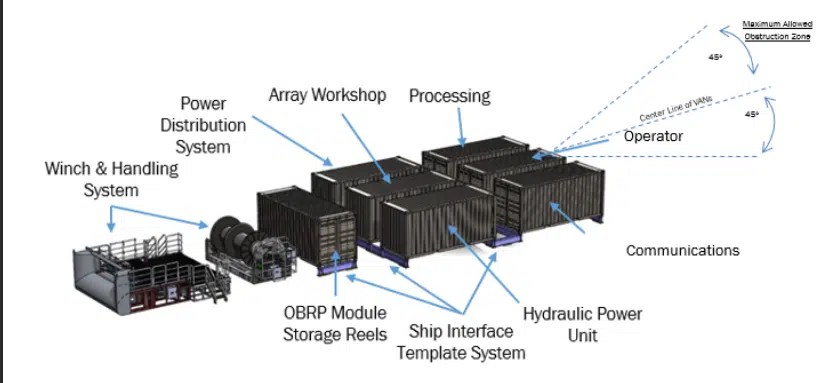
SURTASS-E. (U.S Department of Defense)
It may be that the Australian Navy has decided to use the “flight deck” as a mission load area where they anticipate placing heavy loads. The weight savings from weakening the flight deck may also permit additional topside weight for other systems, like weapons, if it is not required for loads on the flight deck.
 Chuck Hill's CG Blog
I’m guessing that in the near future the Australian’s maybe using the Flight deck for their UAV’s
SURTASS-E should be usable from the area under the flight deck, as it is designed for multiple container options. Unless they’re adding anti-ship missiles in front of the stack (as depicted), a VL SAM system should be able to be positioned there, leaving the flight deck available. If not there, swap out the forward gun for the VL SAM system, or just position a SeaRam or Phalanx forward similar to some Israeli Navy missile boats.
The helideck doesn’t have the necessary reinforcement removed anymore, they’ve been instructed to leave it alone. So, what do they do? They remove the necessary helicopter electronics and guidance equipment to allow ops to proceed!
The realisation is there, that these are ineffective POS vessels more suited to Border Force and CG civil-oriented roles. How many they actually build is open to question, and part of a government/DoD review that is on-going.
Rumour says that they will be replaced by 12 x “Corvettes” in the 3,000 – 4,000+ ton category (which isn’t a corvette but a light frigate in current parlance). Various manufacturers are hovering, and have displayed candidates including Fincantieri, the current Arafura designer, Babcocks with their Type 31/32 derivatives (my favourite) and BAE with the Adaptable Frigate design.
Whether this all proceeds is up to the current Labor government to decide (not renowned for spending money on defence).
Pingback: “US Navy LCS Successfully Fires SM-6 From MK 70 Payload Delivery System” –Naval News | Chuck Hill's CG Blog
Australia: First Arafura-class OPV delivered (PHOTOS) – Naval Today
https://www.navaltoday.com/2025/01/30/australia-first-arafura-class-opv-delivered-photos/?branch=premiumarticle&utm_placeholder_value=&utm_source=newsletter&utm_medium=email&utm_campaign=NavalToday_Newsletter&cdmwt=QQEIAAIckAACQYVBtDmUsg7cIWZimBcMvFh0Lg
https://www.armyrecognition.com/news/navy-news/2025/australias-naval-power-grows-as-nuship-eyre-begins-sea-trials-for-strategic-patrol-operations
third ship of class launched.
https://www.navalnews.com/event-news/indo-pacific-2025/2025/11/civmec-launches-nuship-pilbara-for-royal-australian-navy/