
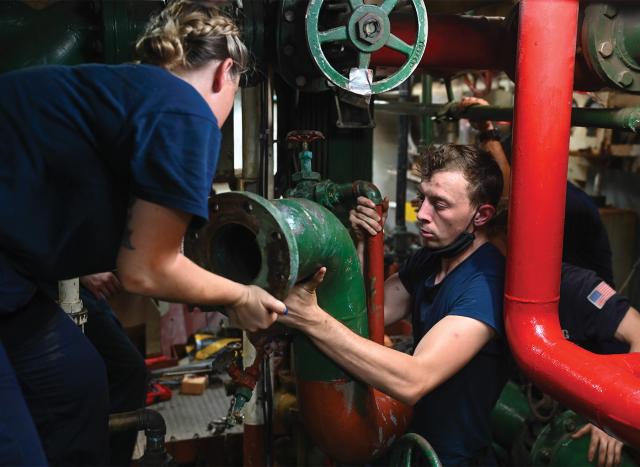
Engineers on board the USCGC Thetis (WMEC-910) work to replace a seawater pump to get the cutter fully mission capable. One way to increase skills and knowledge in the engine room would be platform specialization—having mechanics trained on specific engine models and continuing to work on those models in subsequent tours. U.S. Coast Guard (John Hightower)
The US Naval Institute Proceedings for August 2023 has what appears to be an important discussion of current problems with the way Coast Guard engineers are trained and treated. It was the first prize winner in this year’s Coast Guard essay contest.
The Coast Guard is aware that the surface asset classes coming online have roughly four times as many pieces of equipment installed as the classes they are replacing. The service is beginning to understand the effects of four times as many shipboard points of failure and orders-of-magnitude-more logistics support requirements. Senior leaders are hesitantly embracing the reality that the new ships also are more technically complex, with industrial IT systems connecting every pump, purifier, compressor, and propulsion component.
Some changes are proposed. I would only add that, maintainability and redundancy should be important considerations in ship design, and in regard to this,
“Cutter crews avoid performing substantial planned maintenance on individual pieces of equipment while underway for fear of being anything less than fully mission capable when tasked with a new and urgent case.”
Most of our ships have redundancies. We need to keep maintenance current even if it means doing it underway and perhaps losing a few knots max speed. These limitations should of course be reported, but they should be expected. National security cutters for instance can take still make 22 to 24 knots even if their gas turbine is taken out of service. They are probably still capable of 26 knots if one of their diesels is down. The OPCs should still be capable of 18 knots if one of their diesels is down.
 Chuck Hill's CG Blog