
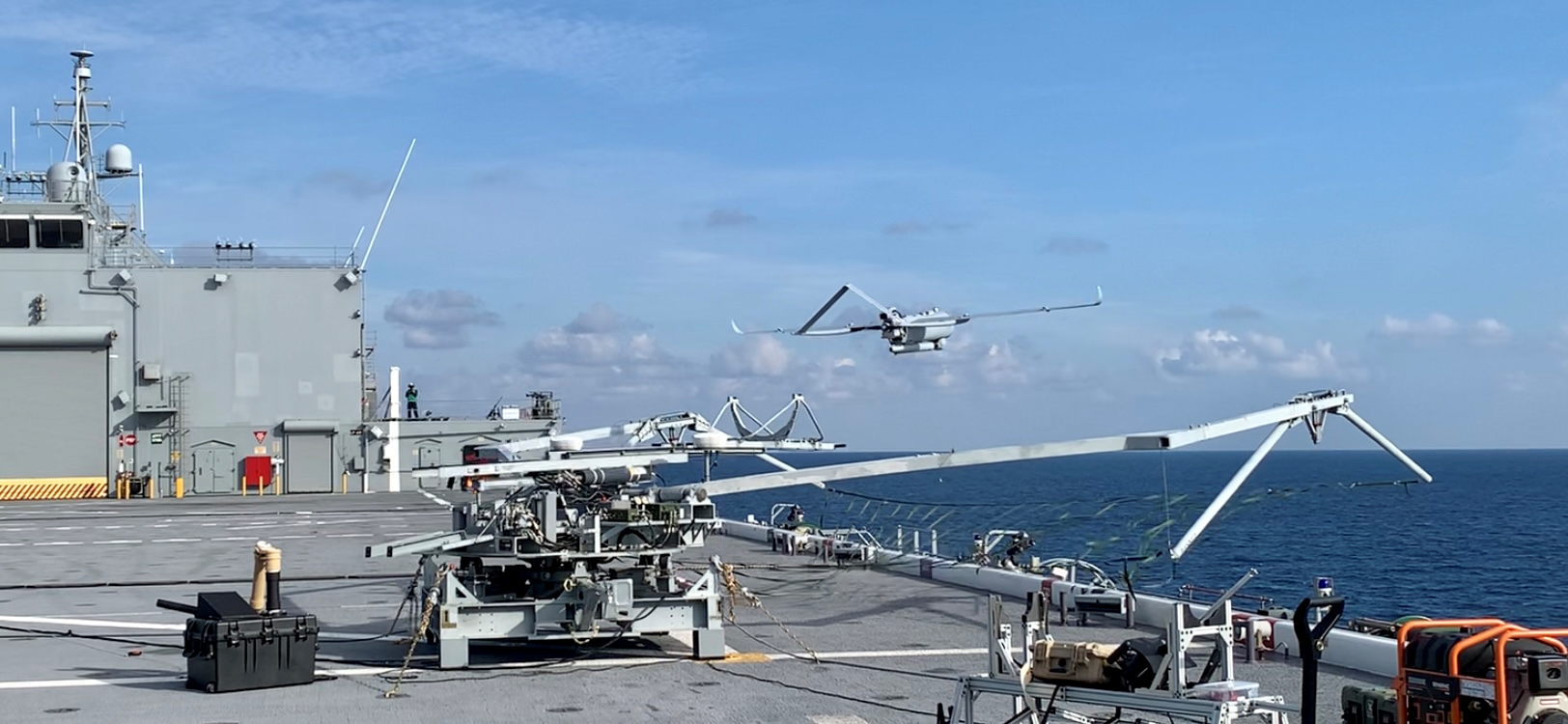
Aerosonde launch from USS Miguel Keith (ESB-5)
Below is a news release from Textron Systems.
It is not clear which version of Aerosonde is to be deployed on the LCSs. There are now hybrid quad versions that can take off and land vertically (see the video) without the supporting catapult and capture gear (top photo), but those with VTOL capability do sacrifice some endurance, speed, and payload as a result of greater weight and increased drag. It is likely the catapult launched version, which we know is on ESB-5, will also be used on the LCSs. Why did the Navy choose the Aerosonde over the Scan Eagle chosen by the Coast Guard? Let’s compare the two catapult launched UAS:
- Type Aerosonde Fixed Wing Scan Eagle
- Max Payload (pounds/kg): 20/9 11/5
- Endurance (hours) 14+ 20+
- Air Speed (knots) 45-65 60-80
- Power (HP) 4 1.5
The Aerosonde’s only immediately apparent advantage is the greater payload. Perhaps the Navy has a sensor, or sensors that may be more capable but heavier that those included in the Coast Guard’s Scan Eagles, but if so, I can’t tell you what they are.
Incidentally, the payload capacity for the vertical takeoff and landing Hybrid Quad version of Aerosonde is 15 pounds, so it could presumably use the same sensor suite used on Coast Guard Scan Eagles.
AEROSONDE® UNCREWED AIRCRAFT SYSTEM (UAS) SUPPORTING SEVENTH U.S. NAVY SHIP WITH EXTENDED RANGE ISR SERVICES
Hunt Valley, Maryland, AUGUST 9, 2023 – Textron Systems Corporation, a Textron Inc. (NYSE:TXT) company, announced today that it has been awarded an initial contract valued at up to $19.5 million by the U.S. Navy’s Naval Air Systems Command (NAVAIR) to provide UAS operational support to two Independence Class LCS and one Freedom Class LCS variants. This award joins the Expeditionary Sea Base (ESB)-4 and ESB-5, as well as two DDG- class ships, bringing the total number of U.S. Navy ships supported by the Aerosonde® UAS system to seven.
Textron Systems will deploy its Aerosonde UAS to provide mission overwatch and extended intelligence, surveillance and reconnaissance (ISR) services with enhanced mission payloads as seen aboard the ESB-5.
“Contractor-owned/contractor-operated contracts like this support the Navy’s continued investments in uncrewed assets for their ships,” said Wayne Prender, Senior Vice President, Air Systems. “We’ve seen the benefits of our Aerosonde UAS for DDG and ESB- class ships already, and we’re honored to be expanding into this new ship class, allowing us to continue supporting maritime domain awareness and missions while delivering operational and logistical capabilities.”
The Aerosonde system continues to set the standard for mission readiness and ease of use, amassing more than 600,000 flight hours serving multiple U.S. customers and allies. It is designed for expeditionary land- and sea-based operations with both fixed-wing and vertical takeoff and landing (VTOL) options. Textron Systems has provided turnkey, UAS operations for customers around the world for more than 10 years.
NAVAIR Public Release 2023-538 Distribution Statement A – “Approved for public release; distribution is unlimited”
 Chuck Hill's CG Blog
Amazing. $20 million on 3 UAS systems for ships the Navy has already decided to decommission… 🙄
At least these can cross-deck to DDGs or future FFGs, so it’s not a total waste of money.
Like the Coast Guard, so far, they are not buying the systems, they are contacting for services including operators and maintainers who will deploy on the ships. For how long was not clear to me.
It did not say which LCSs specifically and the Navy is planning on retaining some of both LCS classes.