

USS Newcomb (DD-586), named after Revenue Cutter Service officer Frank H. Newcomb, who captained the cutter Hudson during the Spanish American War, was awarded eight battlestars, was struck by five Kamikazes off Okinawa, but survived.
Forbes has a recent post by Craig Hooper, about a topic close to my heart,
While small ships jostle in the South China Sea, the U.S. Navy is celebrating their departure from the messy business of managing small combatants. After shedding fourteen long-unloved Cyclone class (PC-1) coastal patrol ships, the Navy has effectively handed the responsibility for managing small ship operations, engagement and training to the already overtasked and poorly-funded U.S. Coast Guard.
I will interject here that while the Cyclone class were largely seen by “Big Navy,” which tends to be run by aviators (mostly fighter and attack aircraft types) and submariners, to be irrelevant, they were not unloved by those that sailed them. I have communicated with several former PC sailors, and they all loved them. They were also the busiest ships in the US Navy, being underway more than larger Navy ships, so apparently the fleet commanders found them useful.
Hooper says the Navy sees small ships as Unsurvivable. The US Navy has no surface combatants between the 44 foot patrol boats and the 3500 ton Littoral Combat Ships, and they are not really happy with the survivability of the LCS. I think the Navy knows they need a lot more ships and that some of them can be small. Not every ship needs to be able to do everything. They are talking about building more small ships, but mostly they will be unmanned.
A 2015 post addressed small warship survivability, but it appears we need to look at this again.
If the Navy thinks all small ships need to be unmanned because they are not survivable, I will point out that that reasoning is not supported by history. In fact, they have been misled by looking at only part of the survivability question, passive survivability.
Why was this?
Because the enemy gets a vote. They will expend much more effort looking for and attacking the major units. Yes, big combatants can take more hits, but they are also more likely to be hit, and can also expect to be hit more often.
No ship, no matter how large, is unsinkable, especially when the enemy sees it as their primary threat. Carriers in particular have a huge bullseye painted on their flight decks. Given the opportunity, every weapon will be pointed at them until they are all eliminated.
Whether a unit will survive depends on in part on its passive survivability, but also on its self-defense capability, the area defense capability of assets with them, where and how the asset is used, and particularly on how the enemy sees the asset. Is it an immediate threat? Is destroying it key to success?
Historic Context:
Looking at the figures I found researching for my earlier post.
The US fleet at the beginning of the war (WWII), it included 233 major surface combatants of which 46 or 19.7% were sunk by enemy action during the course of the war. If we break it down by type it looks like this:
- Type: Number in Commission, Dec. 7, 1941 / Number sunk / % lost to enemy action
- Aircraft Carriers (CV): 7 / 4 / 57.1%
- Escort Carrier (CVE): 1 / 0 / 0%
- Battleships (BB): 17 / 5 / 29.4% (of the 5 sunk, all were at Pearl Harbor, 3 were salvaged)
- Cruisers (CA/CL): 37 / 8 / 21.6%
- Destroyers (DD): 171 / 29 / 17%
Notably, Carriers had the highest loss rate. Battleships, surface combatants that should have been the most “survivable,” were the second most likely type to be sunk.
I don’t have similar figures across all major types like this for the Royal Navy and the Japanese Navy but a look at only their largest ships shows similar or higher loss rates.
Of the ships that the Royal Navy had in commission when they declared war on Germany in September 1939, four of 15 battleships and battlecruisers were sunk (26.7%), five of seven aircraft carriers were sunk (71.4%).
Of the ships that the Imperial Japanese Navy had in commission at the time of the Attack on Pearl Harbor in December 1941, 8 of 10 Battleships were sunk by enemy action (80%) (one was destroyed by a non-combat related magazine explosion) and nine of ten aircraft carriers (90%) were sunk. Their only surviving aircraft carrier was their oldest and smallest (probably least “survivable”) that had been used only as a training carrier.
Certainly, the British and Japanese experience offers nothing to suggest that larger, supposedly, more “survivable” ships are more likely to survive.
Small ships may not be priority targets.
As I noted in the earlier post, I will add a bit of anecdotal evidence. As part of Operation Overlord, the Normandy Invasion, 60 US Coast Guard 83 foot patrol boats were assigned to rescue those unlucky enough to find themselves in the water or sinking. 30 went to the American beachheads and 30 went to the British and Canadian beachheads. Being wooden hulled and gasoline powered, they certainly would not have been considered “survivable.” Apparently, they were in the thick of it, because they rescued 1438 men from the water and sinking craft. In spite of all the fire from shore, not a single boat was sunk and not a single crewman was killed. Apparently, the German gunners were too busy with the landing craft hitting the beach and the warships that were shelling them. They simply were not a priority target.
Some of the USN’s least survivable ships, 450 and 850 ton subchasers also suffered few losses. Combat losses for the PC-461 class built 1941-44 were miniscule (8 of 343, 2.3%—here). For the PCE-842 class, all commissioned between 1943 and the end of the war, losses were non-existent (none of the 68 completed was lost, 0%—here).
Generally small ships don’t confront major of enemy forces alone. They are part of a fleet. Before the LCS got the Mine Counter Measures (MCM) mission, the US Navy’s MCM ships were the Avenger class. Some are still in commission. They had a wood and fiberglass hull and were armed with four .50 caliber machine guns. There was no great cry that they were not survivable. Fleet commanders are not stupid. If ships that are needed to do a job cannot defend themselves, then, crewed or uncrewed, they will be escorted and defended.
Not sunk but damaged:
Damage gets much less attention than sinkings, but many of the “more survivable” ships suffered serious but survivable damage that reduced their capabilities or took them out of the fight.
The two pre-war built fleet carriers that spent the War in the Pacific and survived were both seriously damaged more than once. Saratoga was torpedoed on two occasions and took four kamikaze hits and two bombs on another. Enterprise was hit by bombs four different times and by kamikazes on two others.
Because they are more likely to survive the many hits they are likely to take, the larger, “more survivable” ships are more likely to be out of the fight having their damage repaired, even if they do not sink.
Looking at the Essex class carriers, none of which were lost, only Essex was in commission by the end of 1942, but even she did not reach the Pacific until May 1943. Only seven were commissioned before 1944. Only 14 before 1945. In spite of this, ten ships of the class (CVs 9,10,11,13,14,15,16, 17,18, and 19) were hit on a total of 22 different occasions, CV-11 and CV-13 each five times. In most cases the damage was minor, but it does demonstrate the high priority the enemy placed on neutralizing them. At least in some cases the ships had to terminate combat to address the damage. USS Franklin (CV-13) and USS Bunkerhill (CV-17) had to return to the states to address extensive damage. It is a tribute to the mobile support provided at advanced bases that more time was not lost.
All four USN fleet aircraft carriers that were sunk were hit by multiple torpedoes. Only two torpedoes hit Essex class carriers, only a single torpedo in each case, USS Lexington, in Dec 1943, that kept her out of action for three months, and USS Intrepid, in Feb 1944, that kept her out of action for seven months.
It appears that the difference between the loss rate of aircraft carriers sunk in the first year of the war (57.1%) and the Essex class during the last two years of the war (0%) had much more to do with improved defensive capabilities (radar, CICs, fighter direction, anti-aircraft guns and firecontrol, proximity fuses, etc.) than improvements in passive survivability.
All the Essex class carriers survived the war, but so did most of the less survivable ships, particularly if they did not see action until the last two years of the war as the Essex class did.
How about now?
In WWII the Navy had an extensive mobile repair and support team that allowed most damage to be corrected close to the scene of action without the long transits to and from yards in the continental US. They could drydock carriers and battleships in advanced bases like Ulithi.
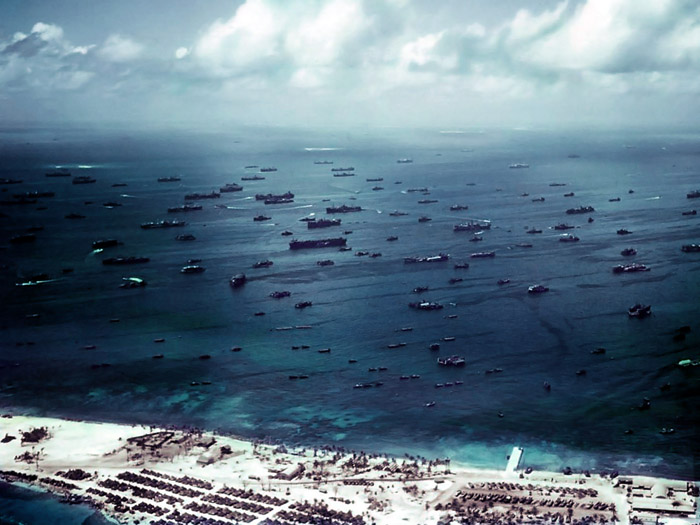
Ulithi Atoll north anchorage and Sorlen Island, late 1944.
Given our current shortage of major ship repair facilities in the US and the near total lack of the capability to quickly establish advanced bases, it is unlikely we would be able to return damaged ships, particularly large ones, to service as quickly as we did during WWII.
In short, smaller, less “survivable” ships that are less likely to be targeted and sunk or damaged and are more easily supported, are more likely to be available for combat operations than larger ships.
 Chuck Hill's CG Blog
This analysis wins the internet for the day. Yes, the big, decisive engagements feature these large ships, but the guts of the logistics battle, the unseen victory, was the achievement of the smaller ship types and patrol aircraft. The WWII naval war still had many aspects of a land war on water. Small, useful, many, and some more specialized assets.
Israel’s Sa’ar 6 seems like an extremely capable vessel for under 2,000 tons, much moreso than the LCS
I like it for a slightly larger than what Chuck wants Cutter X. I am up for a combatant with 2 big diesels though. Vard 115 and Vard NGOPV 125 get close to it.
Those numbers show some impressive research and paint a very clear picture. However, as we’ve seen, the U.S. Navy does not (usually as of late) make sound ship building decisions and sadly, I have little hope that is going to change anytime soon.