
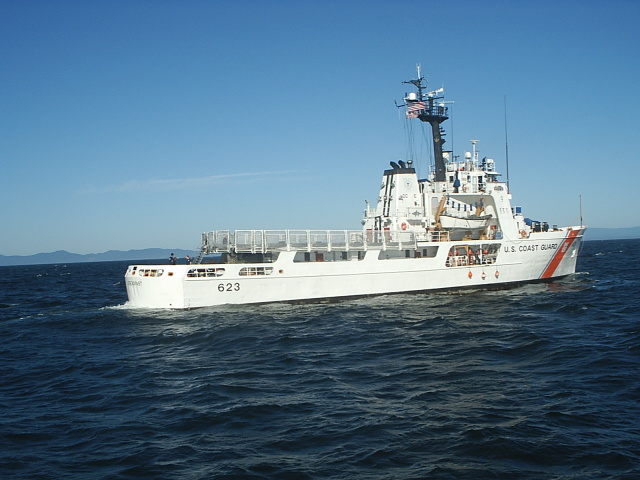
USCGC Steadfast is the next WMEC to be decommissioned. The 55 year old cutter is homported in Astoria, Ore.
The Coast Guard is acting decisively to deal with the current personnel shortage. I have reproduced the announcement below. The result will significantly affect the cutter fleet. Three 210s will be placed in layup pending decommissioning and seven 87 foot WPBs will be placed in layup pending reactivation.
The choice to decommission Steadfast rather than another 210 may have been influenced by the fact that the first two OPCs are to be homeport on the West Coast (San Pedro) and two Webber class cutters (WPC-1156 and 1157) are expected to be based in Astoria. Both WPCs will probably arrive in the next six to eight months.
Not surprisingly cutters are being decommissioned before their replacements come on line. This situation is likely to get worse before the last OPC is delivered (planned for 2038).
Of the sixteen 210 foot Reliance class cutters, three are no longer in Coast Guard service. USCGC Decisive was decommissioned on 2 March 2023. USCGC Courageous was donated to Sri Lanka in 2004, and USCGC Durable was decommissioned in 2001 and commissioned into the Colombian Navy in 2003.
Oct. 31, 2023
Coast Guard adjusts operations plan to mitigate 2024 workforce shortage
By AJ Pulkkinen, MyCG writer
Coast Guard mission demands are growing while our Service faces a significant workforce shortage. The Coast Guard is short nearly 10% of the entire enlisted workforce and cannot continue to operate as we have historically with fewer people.
To mitigate the workforce challenge risk in a deliberative and strategic fashion, the Vice Commandant, Adm. Steven Poulin, has provided specific temporary operational guidance to adapt our operations while prioritizing lifesaving missions, national security and protection of the marine transportation system.
There will be no loss of search and rescue (SAR) capabilities. However, we will temporarily adjust operations to prioritize our lifesaving missions, national security and protection of the Marine transportation System.
The Commandant and Master Chief Petty Officer of the Coast Guard (MCPOCG) today e-mailed the workforce to outline the service’s mitigation strategy.
“The Coast Guard cannot maintain the same level of operations with our current shortfall – we cannot do the same with less. Conducting our missions is often inherently dangerous, and doing so without enough crew puts our members and the American public at increased risk,” wrote Adm. Linda Fagan and MCPOCG Heath Jones.
What does this mean for you?
The Commandant has given Assignment Officers unprecedented flexibility this assignment season to work with members impacted by these force alignment changes.
Enlisted Personnel Management (EPM) and Officer Personnel Management (OPM) staff will start visiting the impacted units this week. They’ll answer questions and address members’ individual concerns. Some visits will be in person, others virtual.
“We understand the extra stress and anxiety these unforeseen changes create for our members and their families,” said Rear Adm. Rusty Dash, Commander of Personnel Service Center. “EPM and OPM will directly engage with each affected command to discuss individual situations and concerns.”
EPM’s priority is to assign affected members to the same geographic area (if possible and if that is what the member desires) while keeping their original tour completion dates. If that’s not possible, EPM will increase the member’s assignment priority and reassign the member based on their desire and service needs.
OPM will offer officers one-on-one counseling prior to eResume submission. OPM will work to tailor assignments to best meet officers’ professional and personal needs.
With your CAC, you can access the AY 2024 Force Alignment Initiative SharePoint site for full details.
Detailed Changes
As cutter crews are not scalable, the only way to reduce the workforce of the cutter fleet is to reduce the number of operating cutters.
Previously planned cutter decommissionings will continue, including the Coast Guard Cutter Steadfast.
Some cutters will be placed in a special status awaiting either decommissioning or future reactivation. In some cases, the crews will do a hull swap to layup the cutter with the largest pending maintenance requirement.
- Three 210′ Medium Endurance Cutters (WMEC) will be placed in layup, pending decommissioning.
- Seven 87′ Patrol Boats (WPB) will be placed in layup, pending reactivation.
- Five 65′ Harbor Tugs (WYTL) will temporarily not be continuously manned but will be kept in a ready status in case icebreaking is needed.
- Two 154′ Patrol Crafts (WPC) will commence uncrewed Recurring Depot Availability Program (RDAP) at the Coast Guard Yard in Baltimore, Maryland. The next 154′ Patrol Craft (WPC) scheduled for RDAP will deliver the hull to the Coast Guard Yard and swap hulls with a cutter that has completed drydock.
Shoreside changes are also necessary. There are 44 stations and 36 aids to navigation teams (ANTs) that currently have more billets than their staffing standards allow in the activity-based staffing model (ABSM). The stations will be reduced to their staffing standards and the ANTs to one billet below their staffing standards. Other shoreside changes include, but are not limited to:
- Crews at all 23 seasonal station smalls will transfer to their parent command.
- The six non-response units (boat forces units without SAR responsibilities) will suspend operations and their crews will be reassigned in assignment year (AY) 2024.
- The identified 19 stations whose SAR response capabilities are redundant will be deemed Scheduled Mission Units. Three of these 19 stations will be ports, waterways and coastal security (PWCS) level one-Scheduled Mission Units.
Mission support units will also be part of the solution.
- In AY 2023, the Deputy Commandant for Mission Support (DCMS) identified positions to go unfilled with minimum disruption in providing customer service. In AY 2024, EPM will continue to not assign members to vacancies identified in AY 2023 at bases and training centers.
- DCMS and EPM will identify additional positions to be left vacant for AY 2024.
What’s Next?
These risk-based adjustments for AY 2024 will mitigate our shortage, but we will still have some gapped positions. More mitigation efforts may be needed as we continue to evaluate Service readiness. This strategic approach to temporarily adjust operations will best position the Coast Guard for future operational capabilities.
And the future is coming quickly. The first offshore patrol cutter, CGC Argus (WMSM-915) was launched just last week.
“The ‘Trackline to 10,000,’ to have ten thousand members assigned to afloat units, is still the goal for our future fleet and we will get there,” said Capt. John Driscoll, the Chief of the Office of Cutter Forces. “We need to adjust our operating capacity now so we can prepare for the future. We will gradually grow fleet capacity back through continued construction of ships with the latest technology and the best crew habitability. Our cutter fleet is in demand globally, and I can see our cuttermen continuing to explore new locations as our ship operations are dedicated to the highest priority missions.”
The Coast Guard has always answered the call when faced with incredible challenges. We will take this challenge head-on and use it as an opportunity to prepare for the future.
Resources
- AY 2024 Force Alignment Initiative SharePoint site (CAC required for access)
- Office of Boat Forces (CG-731) – Station Staffing (sharepoint-mil.us) (CAC required for access)
 Chuck Hill's CG Blog
I think those 23 small boat stations should be handed to the reserves and Auxiliary. Let them run SAR duties with the USCGR handling the law enforcement side. I know the Auxiliary is always hammered for facilities to run patrols and do Boat crew training. It would be a great way to get more aux, boat crew and Coxswain qualified.
Think of it in a way similar to how many fire departments that have a combination of Volunteer fighters and paid fire crews. It would be the same concept at those 23 small boat stations. The paid side would be the US Coast Guard Reserve and the volunteer side would be from the US Coast Guard Auxiliary.
I also think the Coast Guard needs to have a serious talk with the Coast Guard Reserve and Coast Guard Auxiliary to see if they can man those Seven 87′ Patrol Boats (WPB) and the Five 65′ Harbor Tugs (WYTL). It would be a great opportunity for Auxiliarist who want to get cutterman qualified. Many of those billets like Comms and FS could be handled by the Auxiliary such as AUXCA’s
As for the Two 154′ Patrol Crafts (WPC), I say give them to the US Coast Guard Academy for use as a training patrol cutter for 1st and 2nd class Cadets. During their winter, summer and spring breaks from college classes, the cadets can use them to learn patrol cutter operations under the guidance of the US Coast Guard Reserve and academy faculty. They can get real world, hands on training prior to going to the fleet. On top of that the US Coast Guard reserve would have a facility they can use when the cadets aren’t using them.
Auxiliarists cannot “man” a Coast Guard cutter. They cannot serve as an OOD or DWO on the CG cutter, and they certainly cannot command one. The Auxiliary is something that should be disbanded because, it’s comprised of a bunch of old people who are out of shape and a danger to themselves.
As a former USCG Auxiliarist, I resent the statement, “The Auxiliary is something that should be disbanded because, it’s comprised of a bunch of old people who are out of shape and a danger to themselves.” It doesn’t need to be disbanded, although it should be reformed.
There are some young and fit people in the Auxiliary (I was one of them). The problem is that (because the Auxiliary is totally unpaid — we even have to buy our own uniforms at our own expense), all the young and fit Auxiliary members (and all Auxiliary members under 65) have to work full-time jobs to support their families, so we only have a few hours a month to spend on Auxiliary activities. The only people who can afford the time to spend on Auxiliary activities are the retired people, who, as you said, are “a bunch of old people who are out of shape.” Some of them are good boaters, though, so I resent your comment that they’re “a danger to themselves.”
Those of us who work full-time jobs and only have a few hours a month to spend on Auxiliary activities, unfortunately most of those Aux hours seem to be spent in useless meetings, paperwork. and watching mandatory “how-to” videos on sexual harassment even if we didn’t have any women in our Auxiliary flotilla. (The “how-to” part is obviously a joke, but it’s a joke that came up every time we were required to watch those useless videos). We literally spent far more hours sitting in the clubhouse having meetings and watching sexual harassment videos than we spent on the water. There were problems with the training materials, too — for example, in the test for Vessel Examiner, we were forced to answer one of the questions INCORRECTLY in order for our answer to be marked “correct” — I confirmed that with other members of our flotilla. Then having to put in a certain number of hours each year in our position as Vessel Examiner or whatever or be forced to requalify all over again and take the same stupid test where we’re forced to give the INCORRECT answer in order to pass the test.
Do you know what I gave up for the Auxiliary? Not only my time and money (spending hundreds on uniforms), but I missed seeing my son in his elementary school play, because after doing a hard day’s work, I had to drive to the flotilla to do boat crew training in the dark of night to try to get boat crew qualified. But then after missing my son’s school play to try to get boat-crew qualified, I got injured, and due to my injury, I missed the next boat-crew qualification class, so I didn’t get boat-crew qualified, which meant I’d have to wait another year and start all over again. So I missed my son’s school play for nothing, didn’t even get boat-crew qualified that year. Not to mention we don’t get paid, and again, we have to buy our own uniforms, but unlike Active and Reserve Coast Guard, Auxiliarists are not allowed to wear those uniforms anywhere else other than at Auxiliary activities unless we have permission from our Flotilla Commander (and did I mention that we had to pay hundreds of dollars to buy those uniforms? Yeah, I know I did, but it bears repeating). I did get permission from my Flotilla Commander to wear my uniform to my Marine nephew’s graduation from Boot Camp at Parris Island, but it’s sad that I was forced to ask permission (I also wore it to support my Marine nephew at one other event without asking permission from my FC, but that’s a long story, a story for another day).
I quit the Coast Guard Auxiliary because I’m already working two other jobs and raising a family, and I’d rather spend my limited free time with my family rather than for an ungrateful Coast Guard that made me spend my own money on uniforms, miss my son’s school play, not pay me a penny for my time, incorrectly grade my Vessel Examiner test, make me requalify every year if I don’t have time to inspect enough vessels that year, etc. Look up “thankless job” in the dictionary, and you’ll find the definition is “Coast Guard Auxiliary.” All the work with none of the pay, none of the benefits, and none of the thanks. Just endless meetings, useless videos, flawed training materials, and mis-graded tests.
Auxiliarist can Man a cutter. Why do you think we have an Auxiliarist who deploys on the USCGC Barque Eagle. I know a few USCG Auxiliarist who deploy with the USCGC Barque Eagle during the summer months. Even auxiliarists can qualify to get their Auxiliary Cutterman pin. The only requirement is to have Boat crew training. Here’s an example https://www.auxpa.cgaux.org/NAVEX/NAVEXFOURTHQTR2016.pdf
Even, for example, we have auxiliarist who are qualified as Auxiliary Culinary Assistance (AUXCA) who can cook at Coast Guard Stations and even deploy on US Coast Guard Cutters when they are short of a Cook. As long as you meet the standards, you can help cook for the crew on a cutter. Here’s the link to the program. https://wow.uscgaux.info/content.php?unit=H-DEPT&category=auxchef
Also the US Coast Guard and US Coast Guard Auxiliary have the INTERPRETERS CORPS. They provide the USCG and DoD with Language skills. They also can deploy on USCG Cutter and even with the DoD. Only the Senior USCG knows who’s a qualified Interpreter. As long as you meet the DoD’s Foreign language requirements, you can become an Interpreter for the USCG as an Auxiliarist. https://wow.uscgaux.info/content.php?unit=I-DEPT
And we even now have Chaplin support as a mission for the US Coast Guard Auxiliary. As long as the Chaplin meets the US Navy Chaplin Corps standard, they can qualify as a CG Chaplin. Here’s the link: https://wow.uscgaux.info/content.php?unit=g-dept
Here’s an example;https://www.youtube.com/watch?v=olHmFnmLR9g
Also, we have Auxiliary public Affairs staff who also deploy on Cutters as long as you are Public Affairs Qualified. So that means as long as you Public Affairs qualified, you can work with CG Public Affairs. https://wow.uscgaux.info/content.php?unit=a-dept
I’m curious about this “The ‘Trackline to 10,000,’ to have ten thousand members assigned to afloat units, is still the goal for our future fleet and we will get there,” said Capt. John Driscoll, the Chief of the Office of Cutter Forces. “We need to adjust our operating capacity now so we can prepare for the future. We will gradually grow fleet capacity back through continued construction of ships with the latest technology and the best crew habitability. Our cutter fleet is in demand globally, and I can see our cuttermen continuing to explore new locations as our ship operations are dedicated to the highest priority missions.”
My nephew just graduated from Cape May a couple weeks ago. I learned at the family meet and greet that the CG only has 300 recruiters nationwide. My nephew came from Mid Coast Maine and yet never knew anything about the Coast Guard until I was talking about it. I’m a retired FSCS and I had to practically pull him out of a Navy recruiting office and show him the way. The recruiting office in S. Portland, Maine is covering an enormous area to include all of Maine, NH, Vermont and parts of Mass. Maine is home to six units and a few cutters and yet so few people know about us, that’s a failure of the Coast Guard for not being more visible in the schools and communities.
Why doesn’t the Coast Guard hire a few of us old retirees, get us up to speed on current CG events and send us out to recruit. As much as I love the Coast Guard, I and many others would be a perfect fit.
We do, it’s called the CG Recruiting Support and the US Coast Guard Auxiliary works with the Recruiting command. They have Auxiliarist who work directly with the USCG recruiters and can go to the same school as Active duty folks. Here’s the link
https://wow.uscgaux.info/content.php?unit=H-DEPT&category=uscg-recruiting
I’m a Coast Guard Auxiliarist and an FSO VE/DV and we work hard on recruiting, retention, and work on recruiting in diverse and underserved areas. It’s why Flotillas, Divisions, and Districts work very hard to promote the US Coast Guard in the community. Maybe you can work with one of the Flotillas to help with the USCG in Maine and New Hampshire.
Craig Hooper’s commentary in Forbes https://www.forbes.com/sites/craighooper/2023/11/02/personnel-shortage-at-us-coast-guard-sinks-10-cutters-29-stations/?sh=5ce77e0e648c
Thanks to David for bringing this to my attention.
Pulled this off Facebook, “Three east-coast based Reliance-class cutters, the USCGC Confidence (WMEC-619), the USCGC Dauntless(WMEC-624) and the USCGC Dependable (WMEC-626), will each enter layup in mid 2024…”
So, the three mentioned in the report do not include USCGC Steadfast so we are decommissioning four 210s. This will take us down to nine plus Alex Haley and 13 WMEC 270s for a total of 23 WMECs plus 10 NSCs (including #10 just accepted, with one more building). That gives us 33 large patrol cutters which was the original “Program of Record” (8 NSCs and 25 OPCs). Of courses, operations in the Western Pacific were not included in the original program of record.