
Australia is seeing an urgent need to augment the Strike capability of their Navy. This is reflected in a requirement for light frigate/corvette sized combatants with strong anti-surface (ASuW) and self-defense as well as ASW capability.
The resulting ships are about the size of the latest large US Coast Guard patrol cutters, the 4,600 ton Bertholf class National Security Cutter (NSC) and the 4,500 ton Argus class Offshore Patrol Cutter (OPC), in fact two are smaller. While this may not be an exhaustive list of potential competitors, all three proposals I have seen, are discussed in the video above and outlined below. Each includes 16 to 32 vertical launch system (VLS) cells for a variety of missile types and 16 to 24 deck launchers for Anti-Ship Cruise Missiles (ASCM, presumably Naval Strike Missiles). (As these designs are about a decade newer than the OPC, the winning design might form the basis for a future cutter class.)
Navatia’s offer, the Tasman class corvette, is the same length as the Argus class Offshore Patrol Cutters (110 meters / 360′), but considerably lighter at 3,600 tons full load (vs 4500 tons). This class is to be based on a class built for Saudi Arabia, which is in turned based on a class of Offshore Patrol Vessels built for Venezuela. The proposal includes 16 VLS and 16 ASCM launch tubes. Presumably they will be diesel powered with a speed about the same as the parent designs, 25 knots.
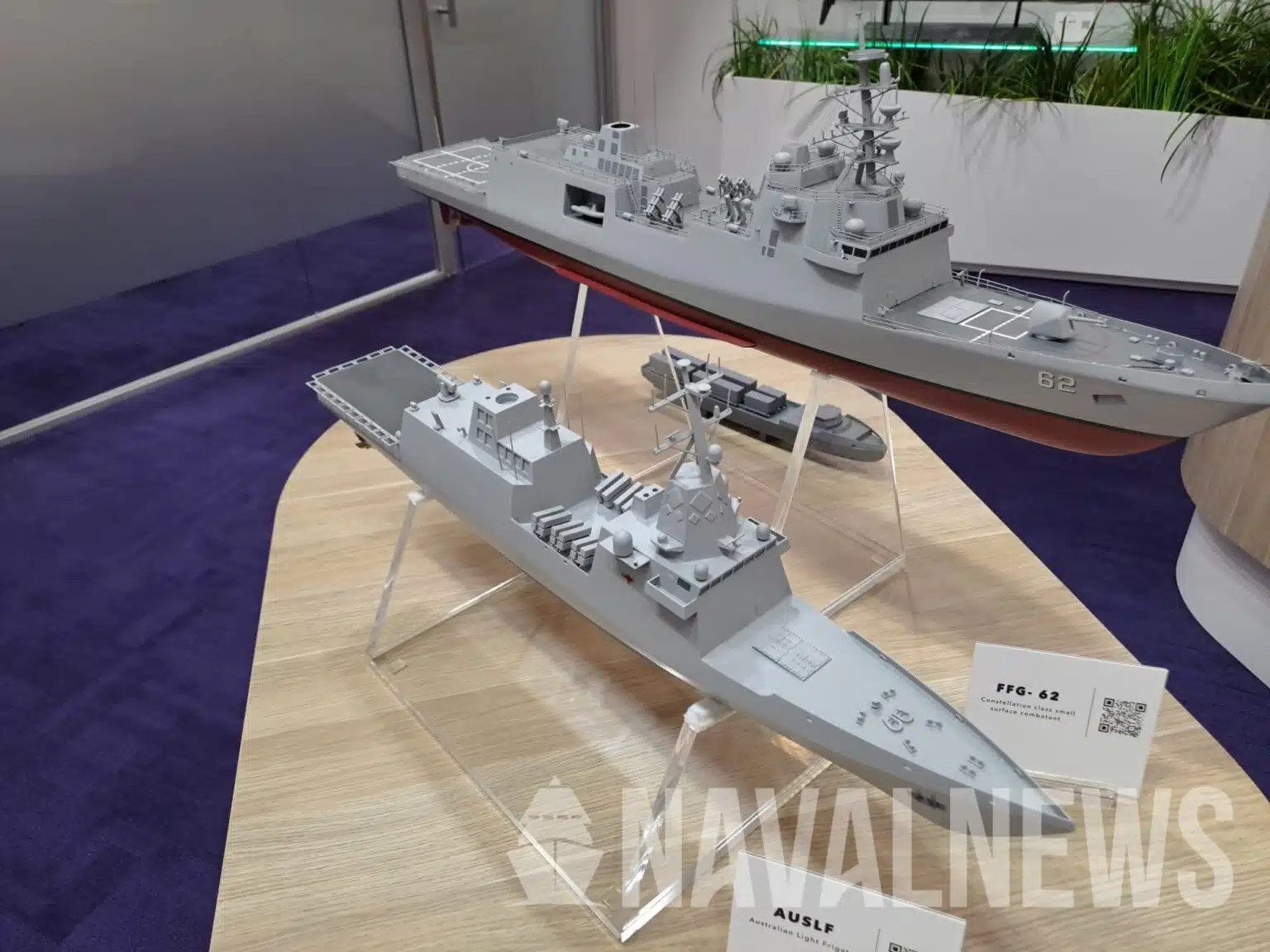
The Australian Light Frigate (foreground) and Constellation class (background) on the Gibbs and Cox stand during Indo Pacific 2023.
Gibbs and Cox proposal (pictured above), at 117 meters in length and 3,800 tons, this design is also smaller than the OPC by 700 tons. It takes the novel approach of deleting the usual main gun entirely in favor of 32 VLS and 24 ASCM launch tubes. CIWS would be provided by Phalanx or SeaRAM and close-in anti-surface and “shot across the bow” signaling would be provided by Mk38 gun mount or equivalent. (This may be taking the trend to smaller main guns to its logical conclusion.) Speed will be at least 30 knots using CODELAG GE LM2500+ propulsion.
TKMS offers MEKO A210 Frigate. This is a bit larger, at 4700 tons, 200 tons larger than the OPC and 100 tons larger than the National Security Cutter. The proposal includes 32 VLS and 16 ASCM. It is powered, like the earlier A200 frigates, by two diesels each driving conventional propellers and a gas turbine driving a central water jet, a system TKMS calls CODAG-WARP (WAter jet and Refined Propellers). Speed is likely 28-29 knots.
 Chuck Hill's CG Blog
In some circles I get laughed at for saying this, but Oz’s problem defence wise isn’t China but Indonesia. And a handful of first rate frigates and SSN’s won’t be enough. They need to provide a patrol line across their north for sea denial back by well armed F35a’s and supported by Oz’s considerable intel sensor network.
Going smaller only makes sense if the tonnage of larger hulls is matched. So if there was one large frigate or a destroyer you would need say 3 hulls to match. Three hulls acting in mutual support could in theory dominate more water than one large hull. This is the way perhaps the USN should have gone with LCS, that is simple steel smaller hulls in numbers.
Seems WordPress has updated some stuff, sorry if the comment is duplicate.
The G&C proposal sharing the guts with Connie is good. My bet is they would pick 12V versions of Connie’s genset and possibly have the electric motor if they double up the motor on Connie which I suspect they will. Basically this is a CODELAG version of a Korean FFX Batch II/III.
I would observe that the three are all much lighter than the FFG-62. Though No costs are given, they are elsewhere online.
So how about using an existing design, such as the Gibbs and Cox, for a US Navy corvette nee light frigate?
I think that may be there ultimate idea.
No, the US Navy will never go for a ship unless it’s tremendously expensive, overpriced, so complicated to build that it will be years behind schedule, with non-functional weapons, and/or with critical structural defects that render it inoperable above Sea State 3. For example, see the Zumwalt-class destroyers and the Littoral Combat Ships.
If the Gibbs and Cox design is a success, the Coast Guard could buy the design and put it out for bid. The VLS and ASCMs might not be installed, fitted for but not with. The space where the ASCMs are mounted might be used for containerized mission modules like holding cells, disaster relief supplies, additional medical facilities, classrooms, etc. depending on mission.
The lack of a visible large gun would make them look even more inoffensive than existing cutters even if they had VLS.
The lack of a gun gave me pause too as these would be ships that would be pushed forward to provide NGS and for constabulary work too where the ‘threat’ of a few rounds zooming of the bow could be useful.
@X, you may have missed it, but apparently, they will have something like our Mk38 that is sufficient for the warning shot across the bow.
Being sensible I suppose that is all that is needed.
A ‘Junk Buster’ as they used to be called.
If you want to sink something bigger, you have all those ASCMs.
The US needs to buy several dozen Tasman corvettes right now assuming range is sufficient for the pacific. Seems like a perfect escort and would fill the light frigate role. Now find us a mine sweeper/hunter we can buy a couple of dozen of and we might be able to (assuming everything else shows up) meet the demands that the PRC is placing on us.
The ship the US should have bought in stead of LCS was the Danish Iver Huitfeldt class. Robust large diesel ships built to carry American weaponry.
At 6,600 tons the Iver Huitfeldt seems rather large and it is over armed. More like a destroyer than a frigate. But I agree, anything would be better Thant the LCS science experiment.
There’s no such thing in naval warfare as “over-armed.”
The Moskva seemed “over-armed,” but considering how easily it was sunk, it turned out to be under-armed (or more likely, had an incompetent crew and/or malfunctioning weapons systems for missile defense).
I think the ship the US should have bought instead of the LCS is the Swedish Visby-class corvette. It’s a stealth ship, super stealthy because instead of being made of aluminum or steel, it’s made of a composite: The hull is constructed with a sandwich design consisting of a PVC core with a carbon fiber and vinyl laminate. Despite being 239 feet long, the composite hull makes it incredibly light — only 640 tons!!! — with a very shallow draft (only 7.9 feet) and fast (35 knots), better specs than the LCS. The Visby is also a proven design (unlike the LCS or Zumwalt “science experiments”). Visby crew size is very small, only 43. The Visby-class is 239 feet long, but Sweden was also considering a Visby Generation 2 corvette, which would have been larger, more heavily armed, larger crew, and longer range.
Instead of building the Generation 2 Visby, though, Sweden decided they’re going to build a brand-new design, the Luleå-class corvette, which will be > 100 meters (330 feet) long.
See See https://en.wikipedia.org/wiki/Visby-class_corvette
Totally not CG related, but that Meko A210 is an intriguing design. Finally, someone taking into consideration redundancy and isolation of battle damage.
@ Don
The whole concept of LCS was wrong.
The US needed, needs, a cheap long range frigate in numbers. Not a toy for paddling about just off the beach. You need a 6000 tonner to keep up with the numerous large USN platforms.
That isn’t to say the Visby isn’t a good design for its purpose.
@ David H Watson
I see Visby for as a possible Cyclone replacement if the USN wanted such a thing.
That’s the direction all this littoral nonsense should have headed and left the blue water navy out of it.
Looks like Australia will go with ships considerably larger than the NSC or OPC.