
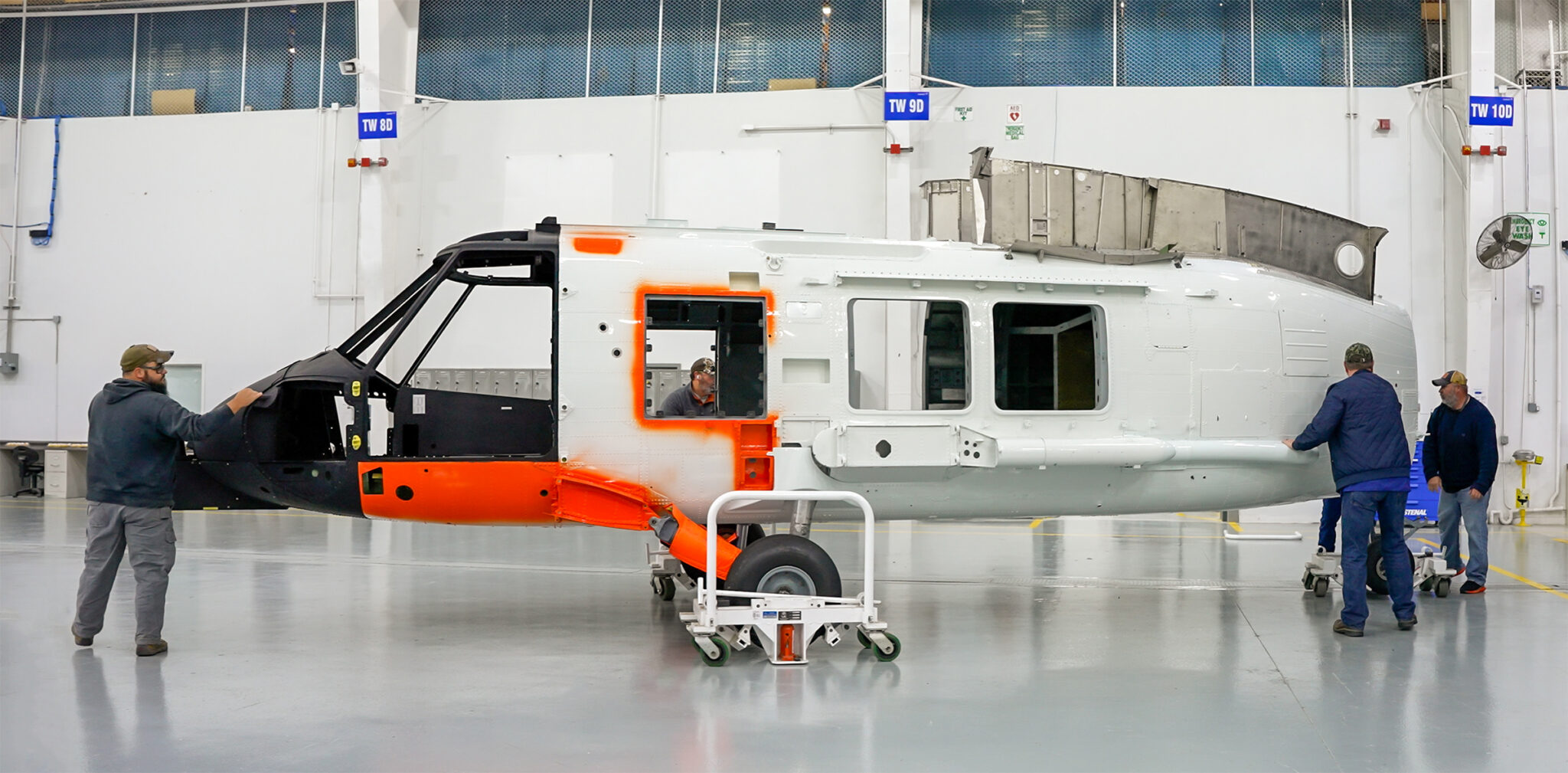
Coast Guard to SLEP, Expand MH-60T Helicopter Fleet as Sikorsky Delivers First New Airframe
Below is news from the Acquistions Directorate (CG-9). This is big, but it is going to take a long time. H-65s will be with us until the early 2040s. The Coast Guard intends to increase its H-60 fleet to at least 127, up from 45. Currently the Coast Guard has 98 H-65s or a total 143 rotary wing aircraft. We may be looking at 16 fewer total aircraft, but that is in the distant future and not really a reason for concern. Somehow, I doubt the plan will remain unchanged for 20 years, nor should it
The Coast Guard received approval from the Department of Homeland Security on Oct. 31, 2023, to proceed with acquisition program activities that will continue to extend the service life of the existing MH-60T fleet as well as begin the Coast Guard’s transition to a rotary wing fleet consisting of all MH-60T aircraft. The MH-60T Acquisition/Sustainment Program is authorized to:
- Move to full rate production of newly manufactured hulls as part of the service life extension program (SLEP) for the existing MH-60T fleet.
- Conduct Obtain Phase activities and execute low rate initial production of 12 aircraft that will transition three Coast Guard air stations currently operating with the MH-65 to the MH-60T.
- Begin Obtain Phase activities for aircraft that will transition the remaining Coast Guard air stations to the MH-60T from the MH-65.
Consolidation of the Coast Guard’s rotary wing fleet to a single MH-60T airframe is necessary to mitigate sustainability challenges with the MH-65 short range recovery helicopter and maintain the service’s rotary wing capability until recapitalization in line with the Department of Defense’s Future Vertical Lift program.
The SLEP, now known as Increment 1 of the program, was established in 2017 to extend the service life of the 45 MH-60T aircraft currently in the fleet. These helicopters have been in service since 1990; without the SLEP, 90% of the MH-60T fleet would reach the end of its service life by 2028. To date, two aircraft have already completed SLEP activities.
The SLEP is extending the service life of the existing Jayhawk fleet through replacement of life-limited structural hulls, dynamic components and electrical wiring. All work is being completed by the Coast Guard Aviation Logistics Center (ALC). Because of specialized maintenance completed by ALC approximately every four years, the MH-60Ts that complete the SLEP will have between 12,000 and 20,000 hours of available service life once fielded.
The Coast Guard’s plan to organically grow the MH-60T fleet to at least 127 aircraft, referred to as fleet growth, will occur in two phases, using the same production activities completed in the SLEP. The first fleet growth phase, known as Increment 2 of the program, will organically produce 36 aircraft to convert eight air stations from MH-65 to MH-60T operations. The program has been authorized to produce the first 12 aircraft for this increment and will seek authorization from DHS to produce the remaining aircraft at a later date. Transition of the first air station under Increment 2 is expected to occur in summer 2024.
The air stations not transitioned to MH-60Ts under Increment 2 will be converted as part of Increment 3 of the program. The final air station transition is anticipated to occur in the early 2040s.
Hulls for the MH-60T Jayhawks for both SLEP and fleet growth will come from two sources, either newly manufactured hulls from the original equipment manufacturer, Sikorsky, or conversion of retired Navy hulls to the MH-60T configuration. On Nov. 30, the first newly manufactured MH-60T hull for the SLEP was accepted by the Coast Guard at the Sikorsky plant in Troy, Alabama. Delivery of hulls 2 and 3 is scheduled for early 2024. During full rate production, which starts with hull 4, deliveries should occur monthly. Forty-five new hulls are currently under contract.
The MH-60T is an all-weather medium range recovery helicopter capable of supporting multiple Coast Guard missions requiring rapid response and an extended on-scene presence. It also supports training and transporting cargo and personnel along with search and rescue, law enforcement, and environmental protection missions. It can reach speeds of around 200 mph and can be outfitted with a 7.62 mm machine gun and .50-caliber rifle designed to disable engines on noncompliant vessels as well as armor to protect crews from small-arms fire.
 Chuck Hill's CG Blog
I think the key to this succeeding is good development of UAV ISR capability so the manned platform is flying its most useful hours.
The FVL program choosing the Bell V-280 for its medium-lift platform is going to create great challenges for USCG Aviation in the future. My prediction is the Sikorsky-Boeing Raider X in a size/weight to fit the “FVL’s “Medium-Light” class will be the next CG helicopter, somewhere around 2060. 🙄
Let’s hope it does not take that long for the Coast Guard to benefit from the FVL program.
Unless the CG goes to “no shipboard operations,” and operates only from CGAS, I do not see the V-280 as capable of operating from small decks. The Navy destroyers are going to struggle with this as well. This is where the McNamara-esque “force everyone to join a joint program” causes more problems than it solves.
@ Bill, that is not the only way to benefit from the program. There is both the smaller aircraft (given a different fuselage) and the V-280’s competitor which the Navy is likely to buy for the reason you pointed out. There is a good possibility all four prototypes may be produce in some form.
I hope so. I’m extremely un-impressed in the decision chain they’ve used to get where they are at.
The FVL program was supposed to replace 25 different helicopters in US service with five. Then they said there were 5 categories and there may be more than one type for each category. A little farther down the timeline now, and four of the 25 already have replacements ordered which have nothing to do with the FVL program, because it was taking too long.
Back up a bit time-wise, and we see the Army divested itself of the OH-58 without a replacement, so of course, the number one priority of the FVL program was the “JMR-Light” to replace the OH-58, right? No, it was the JMR-Medium, the largest (number-wise) program, and thus the riskiest.
Given the two contenders and the five sizes, the obvious answer, even to a non-aviator, was to pick the Raider-X for the Light, and the Bell tilt-rotor for the Heavy and Ultra categories, and see how each company and each technology performed in their ideal categories, before selecting the most difficult to differentiate between platforms, and the riskiest: the medium/assault.
Hopefully, the military will use their back-pedaling statement and buy BOTH the V-280 and the SB>1 for the Medium size. This will allow the Navy and CG the ability to still do the vertical missions off small flight decks. We’ll see…
Interesting. “…the first newly manufactured MH-60T hull for the SLEP was accepted by the Coast Guard at the Sikorsky plant in Troy, Alabama.” I thought all new H-60 airframes were being built in Poland, by Sikorsky subsidiary PZL Mielec. But then again, it didn’t say the hulls were manufactured in Alabama, just accepted by the CG at the plant in Alabama.
I live fairly close to the Troy plant, but I don’t know what they have going on inside. It’s a big place. Definitely enough room for multiple production lines.
Using AI, I got this: “So, while the primary manufacturing of H-60 airframes takes place in the United States, there is also significant production activity in Poland.”
Apparently PZL is building non-US S-70i helicopters.
Before WWII they built bombers and fighters for the Polish Air Force.
https://en.wikipedia.org/wiki/Sikorsky_S-70#Specifications_(S-70i)
https://en.wikipedia.org/wiki/PZL_Mielec
https://en.wikipedia.org/wiki/Pa%C5%84stwowe_Zak%C5%82ady_Lotnicze#PZL_(1928-1939)
Coast Guard accepts second new hull for MH-60T sustainment program > United States Coast Guard > Latest Acquisition News (uscg.mil)
June 28, 2024 —
U.S. Coast Guard photo.
The Coast Guard accepted the second newly manufactured MH-60T hull from Sikorsky Aircraft Corporation on June 3 at the Aviation Logistics Center (ALC) in Elizabeth City, North Carolina. The new hulls are key components in the service life extension program (SLEP) for the existing MH-60T Jayhawk medium range recovery helicopter fleet and will also be used for future MH-60T fleet growth as the Coast Guard transitions to a single platform for rotary wing capability. In addition to hull replacement, the sustainment effort as part of SLEP will include replacing critical dynamic components such as main rotor blades and electrical wire harnesses, with all work completed by ALC. Forty-five new hulls are currently under contract with Sikorsky.
For more information: MH-60T Acquisition/Sustainment Program page
Coast Guard accepts first article wire harness kit from U.S. Army PIF
Oct. 4, 2024 —
Air Station Traverse City, Michigan, aircrews conduct vertical surface hoisting with the MH-60T medium range recovery helicopter, which is used to accomplish rescues from steep, inland surfaces. U.S. Coast Guard photo.
The Coast Guard accepted the first article MH-60T wire harness kit from the U.S. Army Prototype Integration Facility (PIF) on July 12 at the Aviation Logistics Center (ALC) in Elizabeth City, North Carolina. The Coast Guard has ordered 16 additional kits from PIF in its capacity as full-rate production manufacturer.
The wire harness kits consist of 79 individual, interconnected wire harnesses that provide electrical power and transmit signals for nearly all the aircraft’s systems and subsystems. Each will be installed on MH-60T hulls and will serve as key components in the service life extension program (SLEP) for the existing MH-60T Jayhawk medium range recovery helicopter fleet and may also be used to support fleet growth as the Coast Guard transitions to a single platform rotary wing capability. Tyonek Machining and Fabrication completed the initial non-recurring engineering and delivered 15 kits under previous contracts.
As part of the SLEP, the Coast Guard is replacing the hulls of the legacy airframes with hulls from two sources: retired U.S. Navy H-60 aircraft and newly manufactured hulls procured from the original equipment manufacturer, Lockheed Martin/Sikorsky. All hulls, regardless of the manufacturer, will receive new wire harness kits.
All conversion activities will be completed at ALC.
For more information: MH-60T Acquisition/Sustainment Program page.