
The War Zone has an article including the video above that appears to be a wake homing torpedo exploding under the stern of a small (800 tons, 191′) LST (Landing Ship Tank).
It also includes a discussion of wake homing torpedoes and their capabilities. This is assumed to be a typical heavy weight (21″/533mm) torpedo. Russia and China also have much larger 25.6″/650mm torpedoes. Of course, they have or have had smaller (450, 400, 355, and 330mm) torpedoes too.
Wake homing torpedoes are problematic for the defense because decoys and acoustic countermeasures like Nixie don’t work against wake homing torpedoes. The Navy has been working on developing a hard kill countermeasure.
How is this related to the Coast Guard?
As I have contended the Coast Guard’s missions, particularly counter terrorism, require the ability to forcibly stop any ship regardless of size. For medium to large ships, getting a “mobility kill” with a gun is very difficult since most of the propulsion machinery is below the waterline and large marine diesels are extremely tough.
A torpedo that destroys the propellers and/or rudder may be the answer. It could be either wake or acoustic homing, as long as it blows up under the stern, like the one in the video above.
It is not like the Coast Guard is going to use a lot of torpedoes. A marine terrorist attack is an unlikely event, but the consequences of a successful attack could be catastrophic, perhaps leading to a war as happened after 9/11.
By my calculations, we have 31 individual ports or port complexes that might be targeted. The Webber class WPCs appear the most appropriate asset to arm for the purpose of protecting those ports, since they, are most likely to be underway or at least ready to move, and near the ports that might be threatened. We expect to build a total of at least 67. Assuming two torpedoes per WPC, that would be 134 torpedoes and probably less, since some cutters will not be in a position to use them, and some will be in maintenance status.
This is important.
The Navy does not have to buy torpedoes for the Coast Guard, they just need to loan the Coast Guard torpedoes from war reserve stock, and if a war starts the Navy can have their torpedoes back.
We don’t need the most expensive torpedoes.
The standard US Navy heavy weight torpedo, the Mk 48, is very large, heavy, and extremely expensive, and the Navy can’t make enough of them, but we don’t necessarily need a large warhead or great range, nor do we need a torpedo that can operate at great depth against submarines.
There are three possibilities for torpedoes that the Coast Guard might use, existing light weight torpedoes, new very light weight torpedoes, or new heavy weight torpedoes.
New Heavy Weight Torpedo: Reportedly the Navy is fast tracking a new heavy weight torpedo with a target price of $500,000, much less than the cost of the Mk48 ($4.2M) and even less than the cost of the Mk54 light weight torpedo ($839,320 in 2014). They don’t say so, but this may be explicitly a wake homing anti-surface vessel torpedo. It might also be smaller than the Mk48. If the torpedo is made significantly shorter than the Mk 48, it might permit Submarines to carry more torpedoes. More war shots would be an advantage.
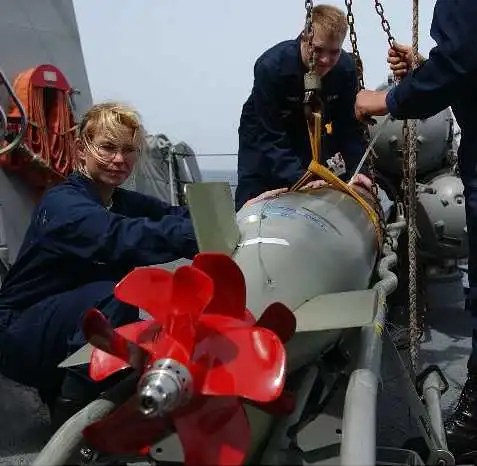
Mk 46 Light Weight Torpedo
Light Weight Torpedo: For at least three decades as many as 36 US Coast Guard WHECs (aka WPGs) were equipped with light weight torpedoes. Throughout their lives, the 378s had two sets of triple light weight torpedo tubes and a torpedo magazine in the superstructure for additional torpedoes, so the Coast Guard has had these in the past. At least some Light Weight ASW torpedoes, beginning with the Mk46 Mod5 (1984), still a NATO standard, are reported to have an anti-surface capability. Reportedly 26,000 Mk46 torpedoes, including more than 6000 Mod 5s have been produced. The Navy has also produced more capable Mk50 and Mk54 light weight torpedoes, but for the counter terrorism mission the Coast Guard does not need their additional ASW capabilities.
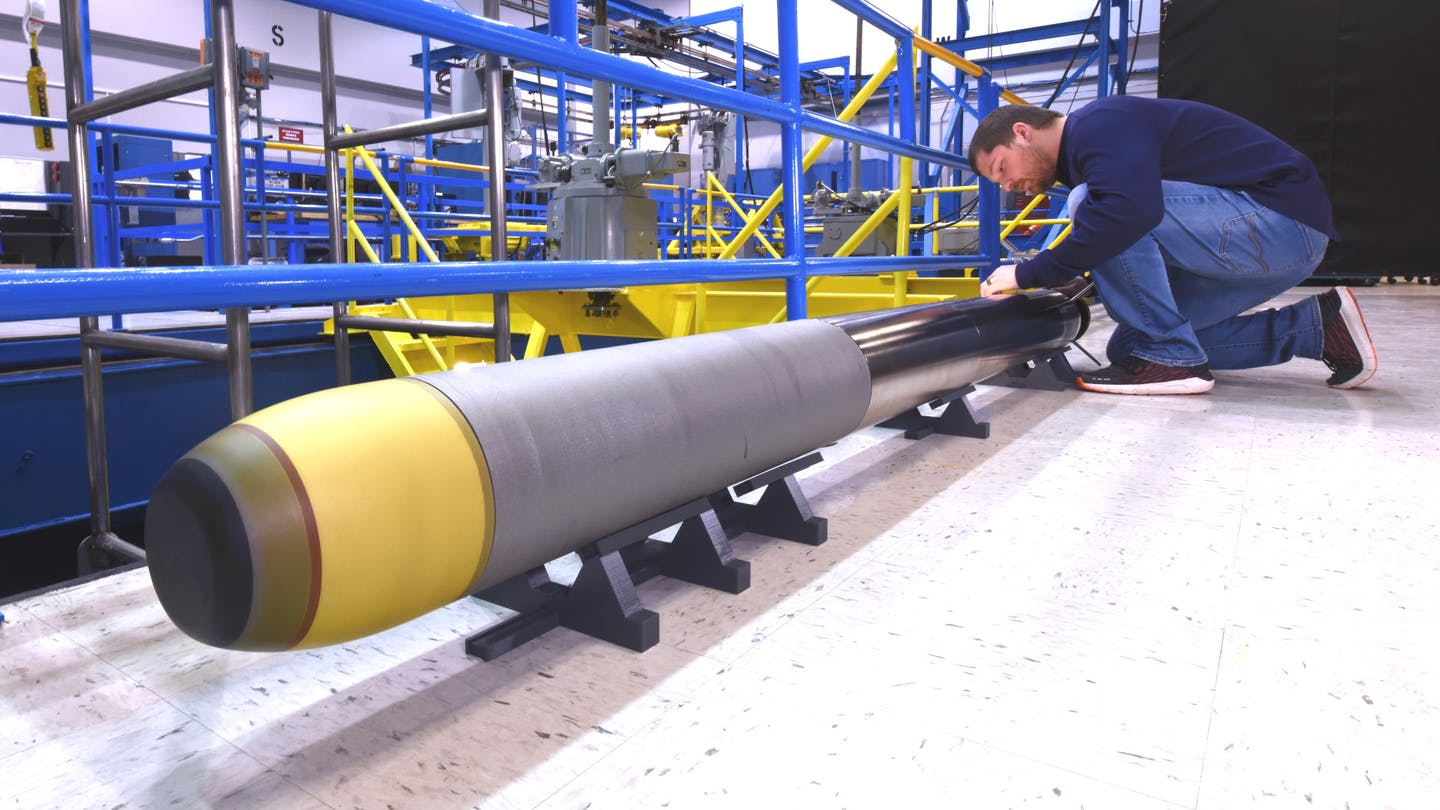
Very Light Weight Torpedo
Very Light Weight Torpedo:
The Navy has contracted Raytheon for a new class of torpedo, 6.75″ in diameter (171.45mm), about 85″ in length, and weighing about 220 pounds (100 kilos). More here.
While this Common Very Light Weight Torpedo (CVLWT), also known as Compact Rapid Attack Weapon (CRAW), is reportedly effective in both defense (as an anti-torpedo torpedo) and offense against both surface and subsurface targets, by submarines, surface vessels, and aircraft, the initial purchase is only for US submarines.
We may see additional applications for this weapon. There may be good arguments for increasing the production to include defense for surface vessels and offensive use by ASW helicopters and Unmanned surface and subsurface systems.
While the warhead is only half the size of that for the Mk46 and about one twelfth that of the Mk48, it is probably enough to disable even large ships and its small size means more can be carried in the same space.

A Navy briefing slide showing the internal components and describing the various features of the Penn State University’s Applied Research Lab (PSU/ARL) Common Very Light Weight Torpedo (CVLWT) design
It seems the Navy, after a long period of apparently coasting, is showing renewed interest in developing torpedoes and torpedo countermeasures. In addition to the Common Very Light Weight Torpedo, and the new Heavy Weight Torpedo, the Navy is also developing an improved Light Weight ASW torpedo, the Mk54 Mod2.
New weapons may provide an opportunity to repurpose older weapons.
 Chuck Hill's CG Blog
I suspect the new heavy torpedo will be a “dumbed down” Mk. 48. Maybe completely lacking in guidance, just fire at or ahead of the target. Old school.
Pretty sure it will have a different propulsion system and some sort of guidance. Wake homing is pretty easy. It gets cheaper fast if you accept a slower speed (40-45 knots), shorter range, and you don’t need to chase very deep diving submarines.
They may do without wire guidance as well.
The new generation of torpedoes seem to be using SCEPS (Stored Chemical Energy Propulsion System) rather than monopropellant (otto fuel). 15921 (psu.edu)
If it is an Anti surface only torpedo, the new heavy weight could probably get away with auto industry quality batteries and electric motors.