
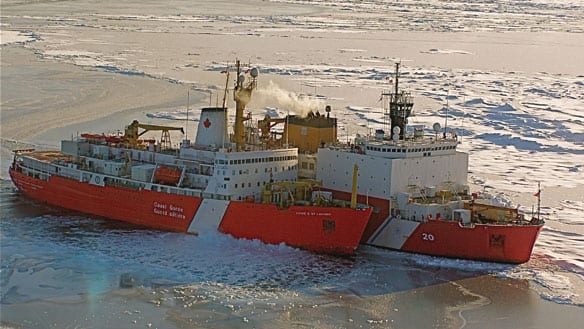
USCGC Healy and CCGS Louis S St.Laurent
BreakingDefense has an article reviewing the Geopolitical situation in the Arctic and the rationale behind the Icebreaker Collaboration Effort Pact, or ICE Pact.
Notably missing from the article was any suggestion of the greater aims of the PACT. Apparently, there is much more to this than the currently planned icebreakers for the US and Canadian Coast Guards.

Several of Finland’s icebreaker vessels moored in the South Harbour at the port of Helsinki in Helsinki, Finland, May 3, 2023. Finland is among the most active builders of icebreakers. (Andrey Rudakov/Bloomberg via Getty Images)
From an earlier The War Zone report,
In an ambitious effort to counter Chinese and Russian influence in the High North, the U.S., Canada and Finland have created a resource-pooling plan to help meet a projected demand for as many as 90 icebreakers among allied nations over the next decade. These vessels offer a critical capability in a region with increasing strategic significance.
:…if we look at Allied nations that are trying to purchase icebreakers over the next decade, it’s 70 to 90 vessels.”
I don’t really see a market for 90 icebreakers that only break ice for other ships to follow. Neither report talked about potential changes in Antarctica, but both poles may see more research followed by mineral extraction and possible over-fishing. The ships building now will still be relatively young when the Antarctic Treaty is up for renegotiations in 2048, if it lasts that long, and establishing a strong negotiating position requires commitment between now and then. Allies in South America, Australia, and New Zealand will certainly be concerned about developments in Antarctica.
There may be a market for large numbers of ships that can safely transit the margins of the Arctic Ocean either as a short cut between the Atlantic and Pacific or for access to minerals in the Arctic.
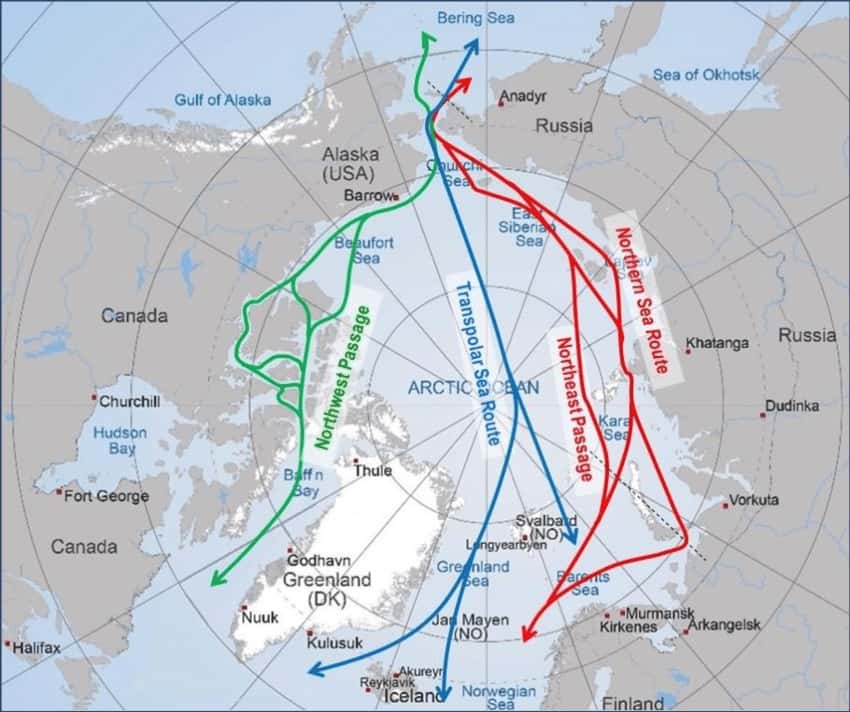
Theoretically there are three possible shipping routes through the Arctic. Only the Northern Sea Route is seeing significant commercial exploitation.
“The distance from Shanghai to German ports is over 4,600km (about 2,900 miles) shorter via the Northern Route than via the Suez Canal.”
Russia sees the Northern Sea Route as a money maker charging fees for Russian pilots and Russian icebreaker support.
Naturally potential users may hope to avoid Russian fees by transiting areas just North of the Northern Sea Route. Icebreaking hulls might make that possible, but as long as they are transiting Russia’s EEZ, Russia is likely to demand use of their services and payment of the fees under the pretext of protecting the environment.
This is likely to result in raised tensions in the Arctic.
Other icebreakers might be warships, patrol vessels, tankers or container ships. They might be support vessels for mineral extraction industry. I doubt that many will be full-time heavy icebreakers.
Russia needs lots of icebreakers partly because they have ports serving a large mineral extraction industry in the Arctic. The US is already extracting oil from the North Slope but has not needed a lot of icebreakers to support that industry, because they built the pipeline to Valdez. Drilling for oil in the Arctic Ocean is going to be challenging for a very long time because of icefloes, but Canada has a lot of land area including many islands, in the Arctic where minerals might be found, so we might see development in the Canadian high north, similar to what we see in the Russian Arctic.
There is more here, Canadian Shipbuilder Davie Wants to Invest in the U.S.
 Chuck Hill's CG Blog
Canada, Finland and U.S. announce ICE Pact – The Watch (thewatch-journal.com)
“If we can make this work — and I believe we can make it work — then it becomes a model for other forms of shipbuilding as we go forward, other types of capabilities that we can partner with democracies on. And it becomes a new model for how the United States can both rebuild its own shipbuilding industry and also ensure that we have the industrial base, as the West, to be able to produce the necessary types of every kind of ship,” he said, according to Defense One.
Like maybe Offshore Patrol Vessels/Corvettes?