
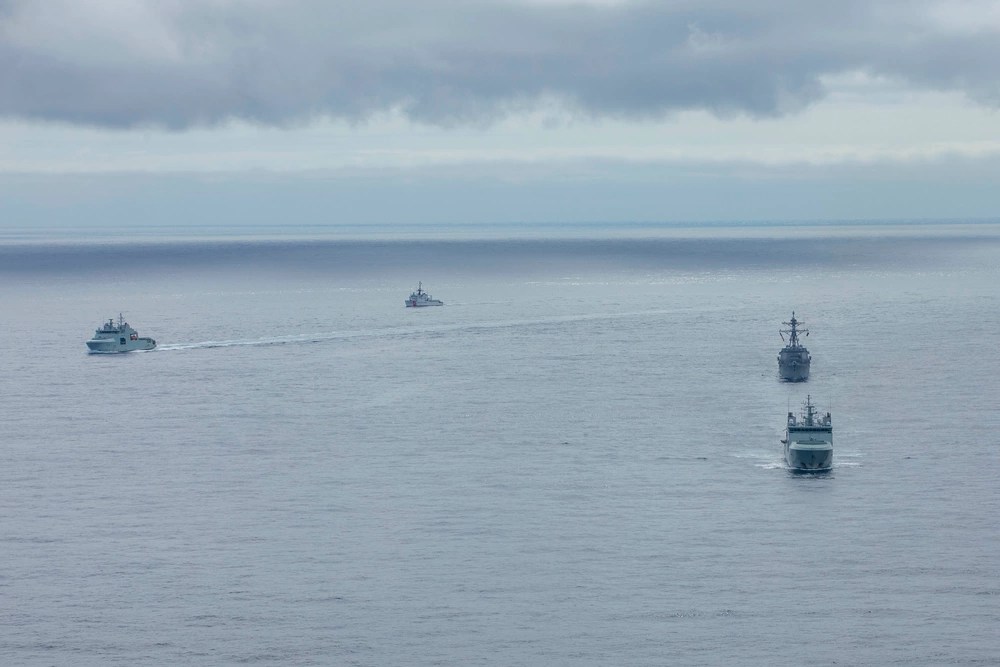
The Arleigh Burke-class guided-missile destroyer USS Delbert D. Black (DDG 119) sails alongside the U.S. Coast Guard Cutter Northland (WMEC 904) and the Royal Canadian Navy offshore patrol vessels HMCS Margaret Brooke (AOPV 431) and HMCS Harry DeWolf (AOPV 430) during Operation NANOOK, Aug. 18, 2024. OP NANOOK is the Canadian Armed Forces’ annual series of Arctic exercises designed to enhance defense capabilities, ensure the security of northern regions, and improve interoperability with Allied forces. (U.S. Navy Photo by Mass Communication Specialist 3rd Class Rylin Paul)
Below is a 2nd Fleet news release regarding the Canadian lead NANOOK exercise.
The Coast Guard has been participating in Operation NANOOK since at least 2010 initially with a buoy tender, but since 2020 with WMEC270s like Northland, and in 2021 with both a WHEC270 and a Fast Response Cutter.
Of the five ships that participated in the exercise, USS Delbert D. Black (DDG 119), Royal Canadian Navy’s Harry DeWolf-Class Offshore Patrol Vessels, HMCS Margaret Brooke (AOPV 431) and HMCS Harry DeWolf (AOPV 430); the Royal Danish Navy’s Knud Rasmussen-Class Patrol Vessel, HDMS Lauge Koch (P572); the U.S. Coast Guard Cutter, USCGC Northland (WMEC 904), all were offshore patrol vessels except the DDG. The Canadian and Danish ships were ice strengthened. The US ships were not.
Since the exercise took place in August the weather was probably about as mild as it gets at these high latitudes. It is not clear if the exercise included operations above the Arctic Circle.
NORFOLK, VIRGINIA, UNITED STATES
08.27.2024
Story by Petty Officer 2nd Class Anderson W Branch
Operation NANOOK 2024, an annual exercise led by the Canadian Armed Forces (CAF) and supported by the U.S. 2nd Fleet and U.S. Coast Guard, successfully concluded on August 26, 2024.
The exercise, which is the largest of its kind in the Arctic, highlighted the ability of multinational forces to interoperate effectively in the challenging northern environment, further strengthening the long-standing partnership between Canada and the United States.
Vice Adm. Doug Perry, Commander of U.S. 2nd Fleet, emphasized the importance of this partnership, stating, “Our partnership with Canada is built on a foundation of mutual respect and shared interests, particularly when it comes to securing the Arctic region. OP NANOOK demonstrated the strength of our collaboration and our shared commitment to maintaining stability in these strategic waters.”
Perry added, “The challenges posed by the Arctic environment require us to be adaptable and resilient. This year’s exercise has shown that our combined forces are more than capable of meeting those challenges head-on.”
OP NANOOK has consistently served as a critical platform for enhancing polar interoperability among Allied forces, and this year was no different. The exercise saw participation from the Royal Canadian Navy, the U.S. Coast Guard, the U.S. Navy, and the Royal Danish Navy. These forces engaged in a variety of complex maritime operations, including Maritime Interdiction Operations, gunnery exercises, search and rescue simulations, and fleet maneuver drills in the frigid waters near Nuuk, Greenland.
“This exercise is a testament to the strength and unity of our alliances,” said Perry. “Each year, OP NANOOK brings our nations closer together, enhancing our ability to operate effectively in the Arctic and ensuring that we are prepared for any contingency.”
The participation of the U.S. 2nd Fleet in OP NANOOK underscores the fleet’s commitment to Arctic operations as part of a broader strategy to ensure homeland defense and security in the northern regions. Earlier this year, the 2nd Fleet demonstrated its global readiness during Arctic operations in Steadfast Defender 2024, further solidifying its role as a key player in Arctic defense.
“Training in the North is particularly crucial as it increases our understanding of the unique operational and sustainment challenges experienced in the Arctic. By seizing every opportunity to train in this environment, we also further solidify our partnership among NATO allies while ensuring our readiness for future operations” emphasized Royal Canadian Rear Adm. David Patchell, Vice Commander of U.S. 2nd Fleet. “The importance of interoperability and shared experiences between NATO countries cannot be overstated. Through regular joint exercises in the Atlantic and Arctic regions, we continuously enhance our capabilities and strengthen our bond.”
As the Arctic continues to gain strategic importance, the U.S. Navy remains committed to working closely with its Arctic allies to ensure environmental stewardship and maintain stability in the region. The completion of OP NANOOK 2024 has provided participating forces with invaluable experience and has further reinforced the collective deterrence capability of allied and partner nations.
Participating units included the Royal Canadian Navy’s Harry DeWolf-Class Offshore Patrol Vessels, HMCS Margaret Brooke (AOPV 431) and HMCS Harry DeWolf (AOPV 430); the Royal Danish Navy’s Knud Rasmussen-Class Patrol Vessel, HDMS Lauge Koch (P572); the U.S. Coast Guard Cutter, USCGC Northland (WMEC 904); and the U.S. Navy’s USS Delbert D. Black (DDG 119).
With the conclusion of OP NANOOK 2024, participating units have returned to their respective homeports, better equipped to face the evolving challenges of the Arctic and to continue protecting shared interests in this increasingly vital region.
U.S. 2nd Fleet, reestablished in 2018 in response to the changing global security environment, develops and employs maritime forces ready to fight across multiple domains in the Atlantic and Arctic in order to ensure access, deter aggression and defend U.S., allied, and partner interests.
 Chuck Hill's CG Blog