
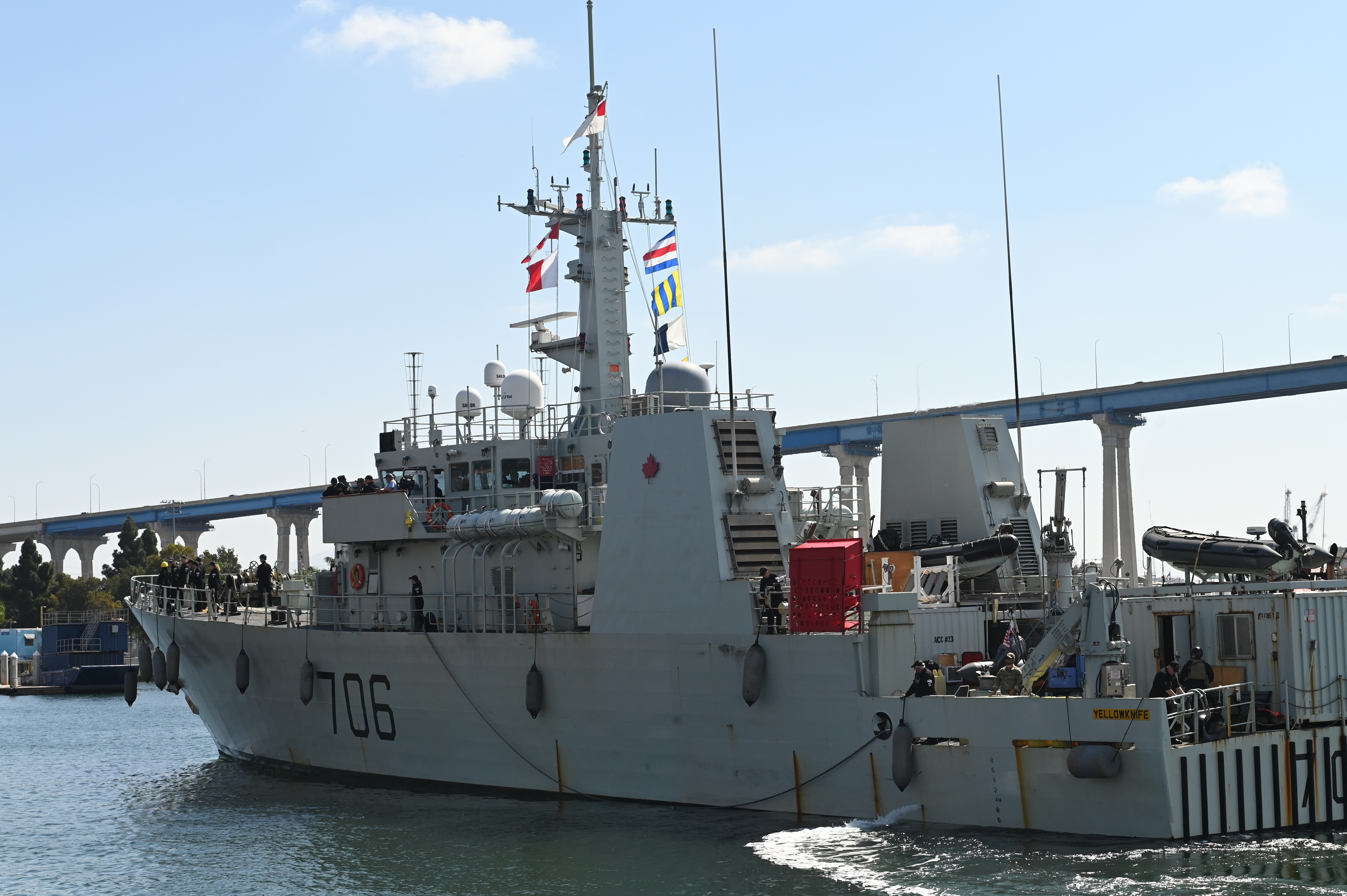
His Majesty’s Canadian Ship Yellowknife (HMCS-706) pulls into the Port of San Diego to offload $44.2 million worth of cocaine, Sept. 12, 2024. The Yellowknife’s crew interdicted a panga-style boat 430 miles southwest of Acapulco, Mexico, September 5 during an Eastern Pacific counter-narcotics patrol under the direction of U.S. Coast Guard District 11 and Joint Inter-Agency Task Force South. (U.S. Coast Guard photo by Chief Petty Officer Levi Read/Released)
Below is an Eleventh District news release.
The Canadians have been helping with drug interdiction since at least 2006.
HMCS Nanaimo, a Royal Canadian Navy maritime coastal defense vessel operating in support of Operation Martillo
The twelve 970 ton, 55.31 m (181 ft 6 in), Kingston class ships like Yellowknife are smaller and slower (15 knots) than the WMEC210s and has a smaller crew but are about 30 years younger, all having been commissioned 1996-99.

Courtesy Photo | USCGC Escanaba (WMEC 907) and USCGC Richard Snyder (WPC 1127) practice maneuvering with the Royal Canadian Navy’s HMCS Goose Bay (MM 707) in the Davis Strait on Aug. 13, 2021. In Operation Nanook, the U.S. Coast Guard seeks to work collaboratively with other international partners to enhance collective abilities to respond to safety and security issues in the High North through the air and maritime presence activities, maritime domain defense, and security exercises. (Photo courtesy Royal Canadian Navy)
A larger, but still relatively small Offshore Patrol Vessel, has been proposed as a replacement for the class, the Vigilance project. No decision has been made as yet.
Photo Release: Coast Guard, Royal Canadian Navy offload $44.2 million worth of drugs in San Diego
U.S. Coast Guard District 11
SAN DIEGO — The Coast Guard and the Royal Canadian Navy offloaded $44.2 million worth of cocaine in San Diego, Thursday morning.
The crew aboard His Majesty’s Canadian Ship Yellowknife (HMCS-706) and a U.S. Coast Guard Law Enforcement Detachment team interdicted more than 3,100 lbs. of cocaine approximately 430 miles southwest of Acapulco, Mexico, September 5.
“I congratulate the entire crew of the Yellowknife for their successful patrol in the Eastern Pacific, and I thank them for their dedicated service,” said Capt. Tim Lavier, Eleventh Coast Guard District chief of response. “Deploying a Coast Guard law enforcement team aboard a Canadian Navy ship in the Eastern Pacific is a significant showcase of the strong relationship we have built with our Canadian partners.”
Multiple U.S. agencies, including the Departments of Defense, Justice, and Homeland Security, collaborate in the effort to combat transnational organized crime. The Coast Guard, Navy, Customs and Border Protection, FBI, Drug Enforcement Administration, and Immigration and Customs Enforcement, along with allied and international partner agencies, all play a role in counter-narcotic operations.
“I would like to thank our crew onboard HMCS Yellowknife and our partners with the U.S. Coast Guard Law Enforcement Detachment team, who worked together to support the interdiction of 3,100 lbs. of cocaine,” said Lt. Cmdr. Tyson Babcock, commanding officer HMCS Yellowknife. “We are proud to contribute to the multinational efforts to address illegal trafficking through Operation CARIBBE, Canada’s contribution to U.S.-led enhanced counternarcotics operations under Joint Interagency Task Force South, to impede the flow of illicit drugs and improve the safety and security of North America, the Caribbean and South America.
The fight against drug cartels in the Eastern Pacific Ocean requires unity of effort in all phases, from detection, monitoring and interdictions to criminal prosecutions by international partners and U.S. Attorneys’ Offices in districts across the nation. The law enforcement phase of counter-smuggling operations in the Eastern Pacific Ocean is conducted under the authority of the Eleventh Coast Guard District, headquartered in Alameda, Calif. The interdictions, including the actual boardings, are led and conducted by members of the U.S. Coast Guard.
These interdictions relate to Organized Crime Drug Enforcement Task Forces (OCDETF) designated investigations. OCDETF identifies, disrupts, and dismantles the highest-level criminal organizations that threaten the United States using a prosecutor-led, intelligence-driven, multi-agency approach. Additional information about the OCDETF program can be found at https://www.justice.gov/OCDETF.
The HMCS Yellowknife (706) is a Kingston-class Coastal Defence Vessel and is one of 12 maritime coastal defence vessels, and is homeported in Esquimalt, British Columbia. It was accepted into the Royal Canadian Navy in 1997 and commissioned, January 30, 1998.
 Chuck Hill's CG Blog
Chuck HMCS, His Majesty Canadian Ship. Not Her Majesty Canadian Ship.
That was a Coast Guard caption, but right, I will change it.