
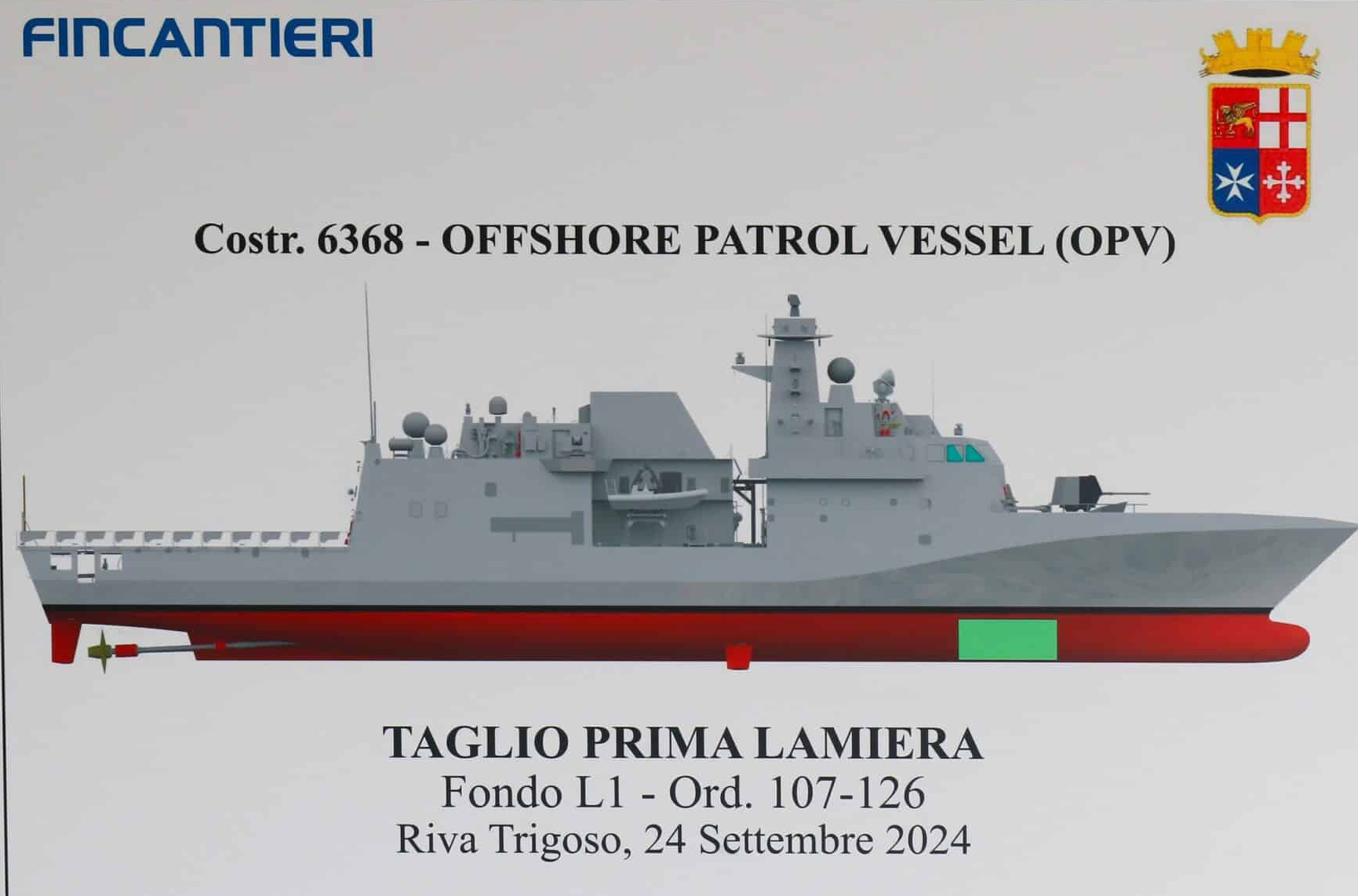
Below is a Fincantieri news release reporting steel has been cut for the first of a new class of Offshore Patrol Vessels for the Italian Navy.
Unlike the US, France, and the UK, Italy has no overseas territories. Their Exclusive Economic Zone is less than 1/22 the size of that of that of the US or France. Even so, they have 13 ships they classify as Offshore Patrol Vessels. Three of them are large at over 5,800 tons full load. (Seven more of these are planned.) In most navies they would be classified as frigates. The other ten are very different, about 1500 tons full load, and 80 (262′) to 89 meters (291′) in length, displacing about 300 tons less than a WMEC270.
Global data reports, “These four new OPVs will replace numerous warships still in service; some, such as the Lerici-class minehunters, have been in use for nearly 40 years…” There are twelve Lerici class, divided into two groups. The first four were commissioned in 1985, about seven years earlier than the remaining eight. Two of the first four were placed in reserve in 2012. Are the minehunters being used as patrol vessels or will the new ships have a minehunting capability? It is not clear if the new OPVs have provision for a stern ramp or for containerized mission modules.
The new ships are 2,400 tons full load and about 95 meters (312′), in length overall, so about 60% larger than what we might see as their existing medium endurance OPVs. Army Recognition’s Navy News reports that the new class is “equipped with a CODLAD (Combined Diesel-electric and Diesel) propulsion system, enabling speeds over 24 knots, with a range of 3,500 nautical miles at 14 knots.”
The range is short by US Coast Guard standards, but Italian vessels don’t have the long transits US Coast Guard cutters have going to Alaska, the Eastern Pacific drug transit zone, or to the Western Pacific, and it might not be that bad after all. The Coast Guard gets a lot of long distance work out of the 154 foot fast response cutters that have a range of only 2,500 miles. 3500 miles at 14 knots suggests a 5,000 mile range at ten knots. A CODLAD power plant means these ships are likely to be very fuel efficient at slow speeds.

These ships, like the much larger Thaon di Revel class will have an “Integrated Naval Cockpit” in which the pilot and copilot (I think that means Officer of the Decky and Quartermaster of the Watch) have seated positions from which to control helm, throttles, and other systems including some forms of radar, navigation, communications and combat system functions. The captain will have a similar position behind the pilot and copilot.

Naval Cockpit, Commander sits behind the Pilot and Copilot. Source: Leonardo.
Notably, this class is being built by Fincantieri, owner of Fincantieri Marinette Marine which is currently building the new Constellation class FFGs for the Navy. They also built the Freedom class LCSs, the Juniper class WLBs, the Keeper class WLMs, and USCGC Mackinaw.
Fincantieri: works start on the first next-generation Offshore Patrol Vessel for the Italian Navy
24 September 2024
The steel cutting ceremony for the first of four next-generation Offshore Patrol Vessels (OPVs) that Fincantieri will build for the Italian Navy took place today at the Riva Trigoso shipyard (Genoa).
The ceremony was attended, among others, by the General Manager of Fincantieri’s Naval Vessels Division, Dario Deste, the Director of the Naval Armaments Directorate – NAVARM, Admiral Chief Inspector Giuseppe Abbamonte, and the CEO of Orizzonte Sistemi Navali, Giovanni Sorrentino.
This program, put in place to contribute to the modernization and renewal of the Italian Navy’s units, envisages the construction of four vessels, with an option for additional two, with the first delivery scheduled for 2027. The overall value of the first four ships, contracted by Orizzonte Sistemi Navali (OSN), a joint venture owned by Fincantieri (51%) and Leonardo (49%), is approximately 1.2 billion euros, including the related logistical support.
The OPV program responds to the need to ensure adequate capabilities for presence and surveillance, maritime patrolling, merchant traffic control, protection of lines of communication and the exclusive economic zone, as well as operations to protect against threats derived from marine pollution, such as toxic liquid spills.
With a length of about 95 meters long, a displacement of 2,400 tons and the capacity to accommodate 97 crew members on board, these new patrol vessels will be marked by a package of technological solutions, as well as standards of excellence in automation and maneuverability, that will make them suitable for operating in a wide range of tactical scenarios and weather conditions.
Among the most innovative features is the integrated naval cockpit, developed for the Italian Navy’s Multipurpose Offshore Patrol Vessels (PPAs), co-produced by Fincantieri NexTech and Leonardo. This represents a generational leap, allowing the control of engines, rudders, and platform systems, as well as some combat system functions, by just two operators – pilot and co-pilot – thus optimizing efficiency and safety.
The OPV program marks a major achievement for Fincantieri, further strengthening its position as a global leader in naval defense with its FCX product range, which includes these new patrol vessels. This project not only reinforces the company’s strategic role as a partner of the Italian Navy, but also deepens its collaboration with Leonardo through Orizzonte Sistemi Navali, showcasing Italy’s expertise in defense and in advanced naval integration.
 Chuck Hill's CG Blog
I’ll say this, Someone in the Commandant’s inner circle should get her on a plane to Italy and make her tour this OPV. An OPV like that could be great for Guam and American Samoa