

Based on the Coast Guard Historian’s timeline, https://www.history.uscg.mil/research/chronology/
With inspiration from Mike Kelso
1898 The American steamer, Toledo with the barge Shawnee in tow, became water-logged 25 miles southwest of the station at Ship Canal, Michigan. Her crew boarded Shawnee and sailed to the canal. There they engaged the steamer D. F. Rose to tow Toledo in and the surfmen assisted to lay her on the beach near the piers. The keeper then telephoned for a tug and lighter, and upon their arrival all hands set to work until 11 p.m. saving about 1,000 feet of lumber. At this hour the wind came out west and the work had to be abandoned. Toledo broke up and became a total wreck on the 30th.
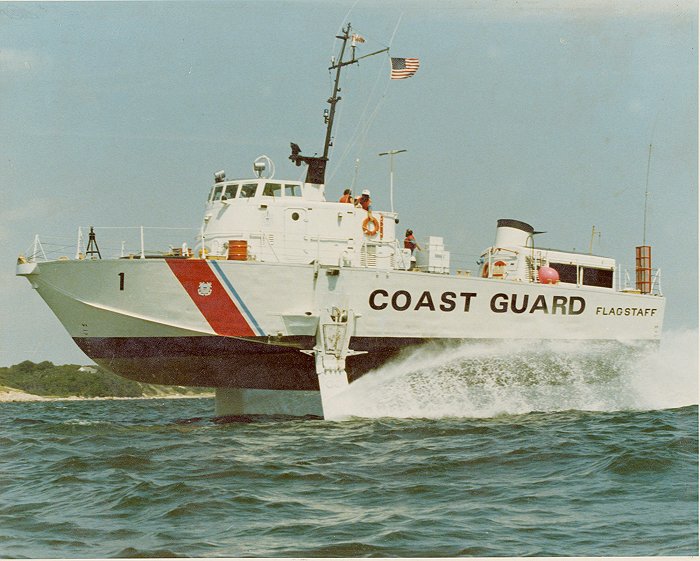
USCGC Flagstaff (WPBH 1) Undergoing Coast Guard evaluations. U.S. Coast Guard photo
1976 The Coast Guard accepted the hydrofoil USS Flagstaff from the U.S. Navy on this date in 1976 for operational testing. The hydrofoil was based out of Station Woods Hole during the testing. It was capable of speeds in excess of 45-knots and carried a crew of 13.
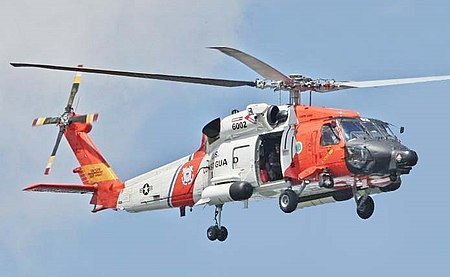
HH-60J Air Station Astoria
1986 Coast Guard officials signed the contract papers to acquire the Sikorsky H-60 series helicopter to replace the venerable HH-3F Pelicans.
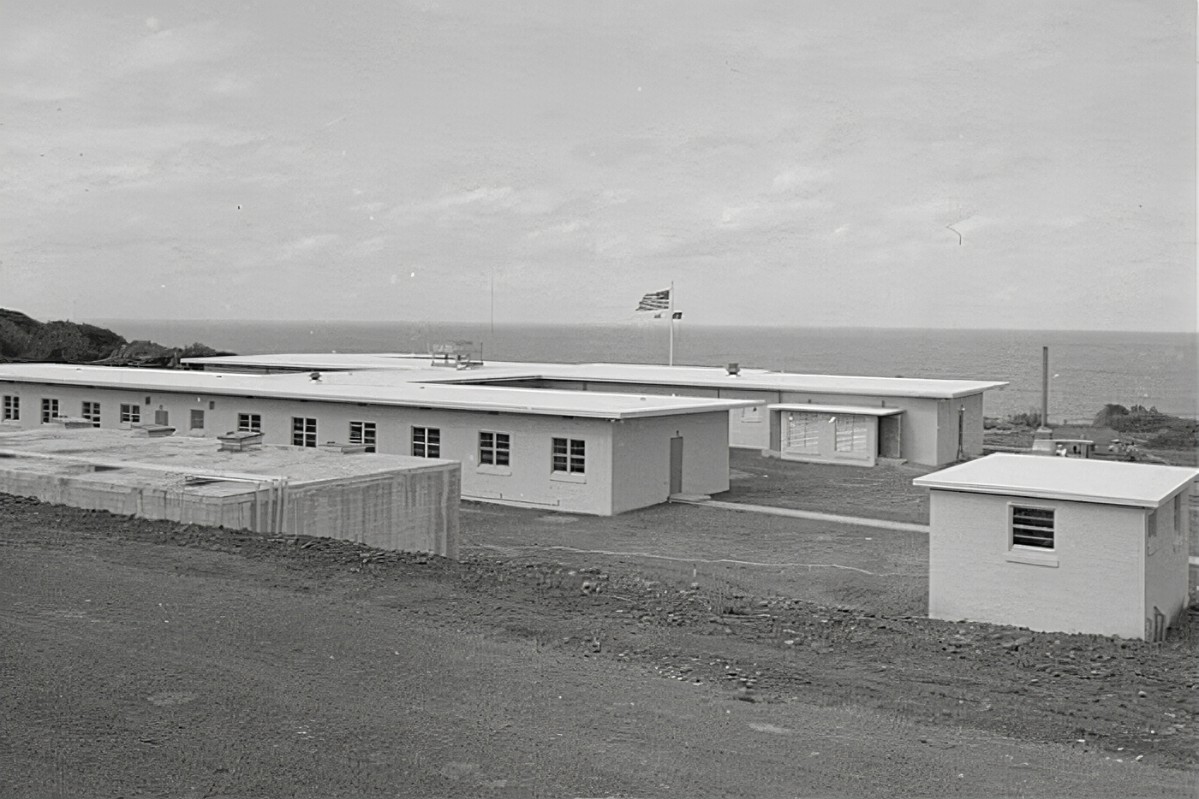
LORAN STATION IWO JIMA
1994 The crew of Coast Guard LORAN Station Iwo Jima decommissioned their station and turned it over to a crew from the Japanese Maritime Safety Agency. The turnover of all of the Northwest Pacific LORAN chain stations was arranged under a 1992 agreement between the U.S. and Japan.

2014 CGC Rush returned to its homeport of Honolulu, Hawaii, following a successful 72-day deployment in the Central and Western Pacific. Rush departed in July 2014 and spent two months conducting operations in the Central and Western Pacific. During the deployment, Rush’s crew coordinated with multiple countries and partner agencies to conduct fisheries boardings in support of the Coast Guard’s living marine resources mission. Rush also participated in international engagement activities in American Samoa, the Republic of the Marshall Islands, Palau, and the Federated States of Micronesia. To enhance detection of fishing vessels, Rush embarked a helicopter and aviation detachment from Coast Guard Air Station Barbers Point. Rush’s crew participated in several community outreach and volunteer events during their patrol that included delivering hygiene and first aid supplies, in support of the U.S. Navy’s Project Handclasp, to several Pacific Island Nations. Rush’s crew also built a garden to support an abused children’s shelter in Samoa and played sports and games with disabled children in Majuro, Republic of the Marshall Islands.

160730-N-KM939-031 PACIFIC OCEAN (July 30, 2016) – Coast Guardsmen, assigned to U.S. Coast Guard cutter Stratton (WMSL 752), make their way to the guided-missile destroyer USS Stockdale (DDG 106) for a rescue and assistance exercise during Rim of the Pacific 2016. Twenty-six nations, 40 ships and submarines, more than 200 aircraft and 25,000 personnel are participating in RIMPAC from June 30 to Aug. 4, in and around the Hawaiian Islands and Southern California. The world’s largest international maritime exercise, RIMPAC provides a unique training opportunity that helps participants foster and sustain the cooperative relationships that are critical to ensuring the safety of sea lanes and security on the world’s oceans. RIMPAC 2016 is the 25th exercise in the series that began in 1971. (U.S. Navy photo by Mass Communication Specialist 3rd Class David A. Cox)
2016 CGC Stratton returned to its homeport of Alameda after a 114-day deployment spanning the Pacific Ocean from Hawaii to the Arctic. “Our crew logged more than 19,500 miles during this deployment,” said U.S. Coast Guard Captain Nate Moore, the Commanding Officer of Stratton. “Their participation in a major international military exercise, support of the Coast Guard’s expanding role in the Arctic domain, and commitment to pursue excellence in mission execution has made this an extremely successful deployment.” The crew of Stratton participated in two high profile exercises during this deployment: the Rim of the Pacific 2016 (RIMPAC) military exercises and Operation Arctic Shield 2016. Stratton was the third consecutive National Security Cutter to serve as commander of the Combined Task Force 175, a multinational task force comprised of nine ships and 13 aircraft from the United States, China, France, and Indonesia. Participation in RIMPAC 2016 highlighted the Coast Guard’s unique capabilities and partnerships with Department of Defense entities and international partners along the Pacific Rim. Stratton participated in training evolutions that included complex ship formations, joint flight operations with the U.S. Navy MH-60S Helicopter Sea Combat Squadron (HSC-21), an aviation detachment from San Diego; live fire exercises; personnel and logistics transfers, and maritime interdiction operations. Successfully completing this integrated training with HSC-21 and deploying together for RIMPAC 2016 represent the first extended Navy aviation deployment aboard a Coast Guard cutter. As part of Arctic Shield 2016, the Coast Guard deployed cutters, aircraft, and personnel to northern Alaska to engage in operations encompassing a variety of Coast Guard missions across the North Slope.

A response boat crew member steers toward the Coast Guard Cutter Reliance during a 52-day patrol in the Atlantic Ocean, Jan. 13, 2021. During the patrol, the crew traveled over approximately 8,631 miles, assisted in the transference of more than 12,564 lbs. of narcotics with an estimated combined street value of $250 million, intercepted 157 undocumented migrants and transferred eight suspected narcotics smugglers from other U.S. Coast Guard cutters operating in the region. (U.S. Coast Guard courtesy photo)
2021 The crew of CGC Reliance (WMEC 615) returned to homeport in Pensacola 29 September, after a 63-day Caribbean Sea patrol. Reliance crew supported the U.S. Coast Guard 7th District throughout their patrol, aiding in missions to interdict and disrupt the flow of illegal drugs and migrant trafficking while supporting national security and strengthening relationships with regional partners throughout the Caribbean. “I am extremely proud of our crew for their adaptability and professionalism throughout the patrol. Regardless of the mission set, whether that was responding immediately to the aftermath of the devastating earthquake in Haiti by conducting critical port assessments or stopping the flow of illegal narcotics, Reliance was always ready to respond to the needs of our Service and our Nation,” said CDR Robert Hill, commanding officer. Significantly, the crew supported the relief efforts in response to the earthquake in Haiti in August, conducting two separate port assessments on Haitian ports to ensure the harbors were safe for vessels to deliver vital aid and assistance to the region following the disaster. During the patrol, Reliance’s crew intercepted one vessel attempting to smuggle approximately 1,132 lbs. of cocaine and detained a total of four suspected smugglers. Additionally, Reliance received more than 4,291 lbs. of cocaine, ten suspected smugglers, and 96 migrants from other U.S. Coast Guard cutters operating in the region. The crew also rescued 50 Dominican nationals from an unseaworthy vessel off the coast of Puerto Rico and repatriated 158 migrants to the Dominican Republic’s navy. The 63-day patrol was critical in allowing the cutter crew to work on shipboard training, qualifications, and proficiency to maintain operational readiness. This training enabled Reliance’s team to complete a five-day major shipboard training exercise in Mayport, which tested their readiness in all aspects of damage control, seamanship, and navigational procedure.
 Chuck Hill's CG Blog
Thanks Chuck, this is all “Good Stuff.”