
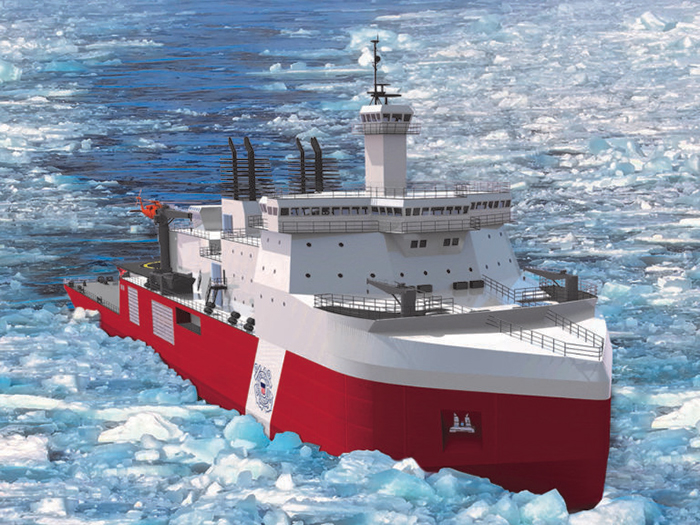
USCG Polar Security Cutter [Image courtesy Halter Marine / Technology Associates, Inc.]
I have reproduced the summary below.
The news here is that there is so little news.
- Polar Security Cutter, “The Coast Guard’s proposed FY2025 budget requests no procurement funding for the PSC program.”
- Commercially available Polar Icebreaker, “The Coast Guard’s proposed FY2025 budget requests no procurement funding for the CAPI program.”
- Great Lakes Icebreaker, “The Coast Guard’s proposed FY2025 budget requests no procurement funding for the program.”
- Arctic Security Cutter (the Medium Icebreaker), the PSC is “to be followed at some later point (emphasis applied–Chuck) by the acquisition of new Arctic Security Cutters (ASCs)…“
GAO has been saying the Coast Guard cannot possibly build the Polar Security Cutters for the price currently contracted. The shipyard has been building some sample sections. I suspect that part of the reason is to find a more realistic estimate of how much they will cost. “If substantial cost growth occurs in the PSC program, it could raise a question regarding whether to grant some form of contract relief to the PSC shipbuilder.”
Note, there is still no publicly available information from the 2023 Fleet Mix study, other than the required number of icebreakers. Why not?
SUMMARY
Required number of polar icebreakers. A 2023 Coast Guard fleet mix analysis concluded that the service will require a total of eight to nine polar icebreakers, including four to five heavy polar icebreakers and four to five medium polar icebreakers, to perform its polar (i.e., Arctic and Antarctic) missions in coming years.
Current operational polar icebreaker fleet. The operational U.S. polar icebreaking fleet currently consists of one heavy polar icebreaker, Polar Star, and one medium polar icebreaker, Healy. A second Coast Guard heavy polar icebreaker, Polar Sea, suffered an engine casualty in June 2010 and has been nonoperational since then. Polar Star and Polar Sea entered service in 1976 and 1977, respectively, and are now well beyond their originally intended 30-year service lives. The Coast Guard plans to extend Polar Star’s service life until the delivery of at least the second Polar Security Cutter (PSC; see next paragraph).
Polar Security Cutter (PSC). The Coast Guard Polar Security Cutter (PSC) program aims to acquire four or five new PSCs (i.e., heavy polar icebreakers), to be followed at some later point by the acquisition of new Arctic Security Cutters (ASCs) (i.e., medium polar icebreakers). The Coast Guard in 2021 estimated PSC procurement costs in then-year dollars as $1,297 million (i.e., about $1.3 billion) for the first ship, $921 million for the second ship, and $1,017 million (i.e., about $1.0 billion) for the third ship, for a combined estimated cost of $3,235 million (i.e., about $3.2 billion). The PSC program has received a total of about $1,731.8 million in procurement funding through FY2024. The Coast Guard’s proposed FY2025 budget requests no procurement funding for the PSC program. One oversight issue concerns the accuracy of the PSC’s estimated procurement cost, given the PSC’s size and internal complexity as well as cost growth in other Navy and Coast Guard shipbuilding programs. If substantial cost growth occurs in the PSC program, it could raise a question regarding whether to grant some form of contract relief to the PSC shipbuilder. Another oversight issue concerns the delivery date for the first PSC: the Coast Guard originally aimed to have the first PSC delivered in 2024, but the ship’s estimated delivery date has been delayed repeatedly and may now occur no earlier than 2029.
Commercially available polar icebreaker (CAPI). The Coast Guard’s proposed FY2024 budget requested, and the FY2024 Department of Homeland Security (DHS) Appropriations Act (Division C of H.R. 2882/P.L. 118-47 of March 23, 2024) provided, $125.0 million in procurement funding for the purchase of an existing commercially available polar icebreaker (CAPI) that would be modified to become a Coast Guard medium polar icebreaker. The ship the Coast Guard intends to purchase and modify is Aiviq, a U.S.-registered ship that was originally built to serve as an Arctic oil-exploration support ship, and which has an icebreaking capability sufficient for the ship to serve following modification as a Coast Guard medium polar icebreaker. The Coast Guard’s proposed FY2025 budget requests no procurement funding for the CAPI program. The Coast Guard’s FY2025 Unfunded Priorities List (UPL) includes an item for $25.0 million in procurement funding for the ship.
Great Lakes icebreaker (GLIB). The Coast Guard’s FY2024 budget initiated a program for procuring a new Great Lakes icebreaker (GLIB) that would have capabilities similar to those of Mackinaw, the Coast Guard’s existing heavy GLIB. The FY2024 DHS Appropriations Act (Division C of H.R. 2882/P.L. 118-47 of March 23, 2024) provided $20.0 million in procurement funding for the GLIB program. The Coast Guard’s proposed FY2025 budget requests no procurement funding for the program. The Coast Guard’s FY2025 UPL includes an item for $25.0 million in procurement funding for the program.
 Chuck Hill's CG Blog
Can you explain why the Coast Guard is requesting no procurement funding for these three below, especially after the Commandant had previously said the PSC was the Coast Guard’s highest priority after the OPC? I’m not sure what “no procurement funding” means in government-contract-speak, but to most of us, “no procurement funding” sounds like it means exactly what it says, “no procurement funding,” meaning they stopped funding icebreakers entirely! I’m sure it can’t really mean that, so can you explain what “no procurement funding” means in government-contract-speak?
@David, it is that money has already been appropriated for at least parts of the programs, the first two PSCs for instance, but progress has been so slow, previous allocations have not been used up and so no additional money is expected to be needed in FY2025.
In the case of Arctic Security Cutter (medium icebreaker), it is that the Coast Guard has not begun the procurement process even though there is a documented requirement.