

Based on the Coast Guard Historian’s timeline, https://www.history.uscg.mil/research/chronology/
With inspiration from Mike Kelso
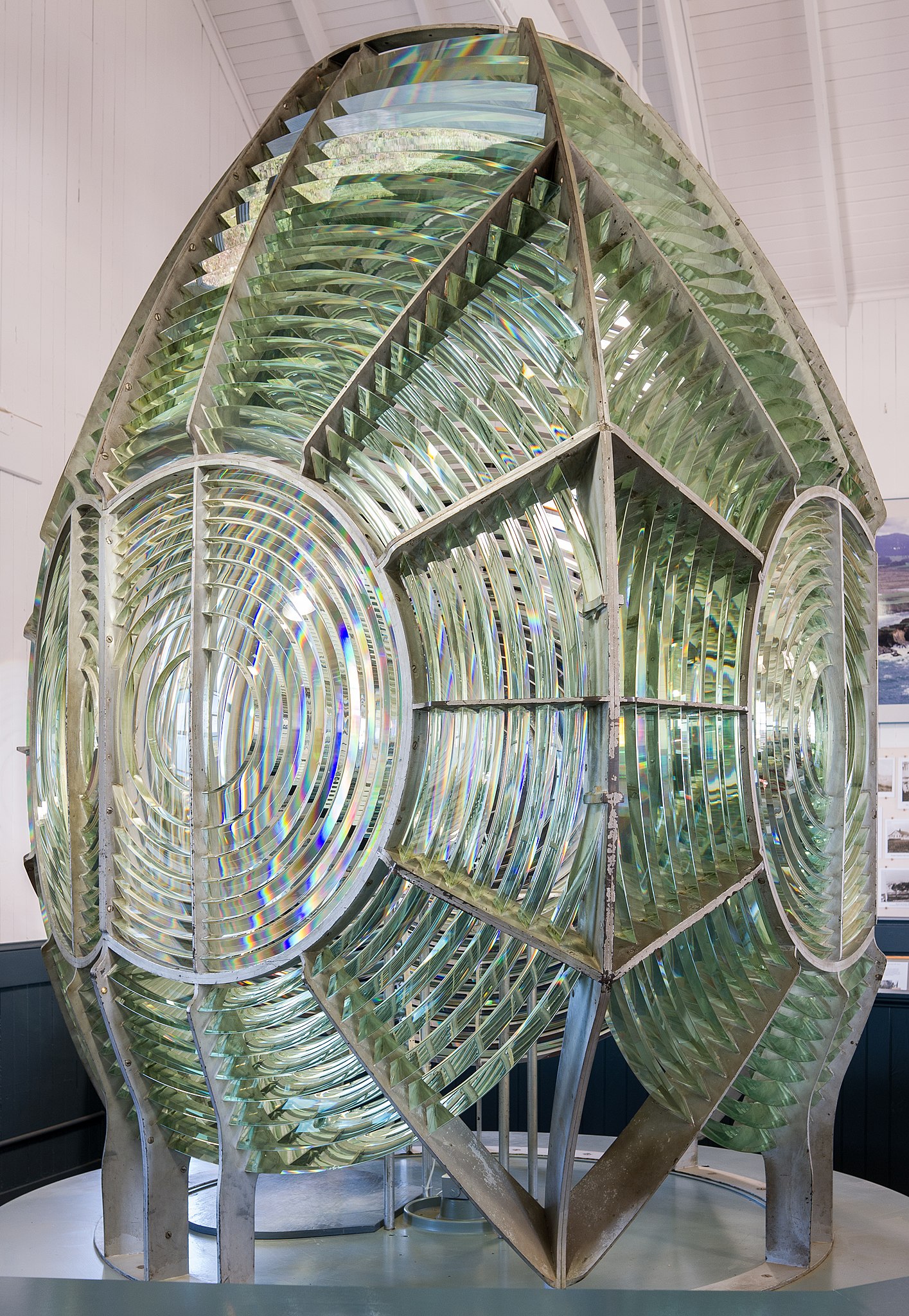
Fresnel Lens at Point Arena Lighthouse Museum, Point Arena Lighthouse, Mendocino County, California. Taken on 25 March 2012 by Frank Schulenburg
1852 The Lighthouse Board, which administered the lighthouse system until July 1, 1910, was organized. “This Board was composed of two officers of the Navy, two officers of the Engineer Corps, and two civilians of high scientific attainments whose services were at the disposal of the President, and an officer of the Navy and of the, Engineers as secretaries. It was empowered under the Secretary of the Treasury to “discharge all the administrative duties” relative to lighthouses and other aids to navigation. The Secretary of the Treasury was president of the Board, and it was authorized to elect a chairman and to divide the coast of the United States into twelve lighthouse districts, to each of which the President was to assign an army or navy officer as lighthouse inspector.” (The Lighthouse Board revolutionized coastal navigation.)
1858 The Secretary of the Treasury appointed a three-man board of U.S. Revenue Marine officers to consider a lifeboat design best adapted for life-saving work.

PC-590 Sea Trials. Source, Bob Daly/PC-1181/NavSource.
1945 Coast Guard manned patrol vessel USS PC-590 grounded and sank in typhoon off Okinawa. All hands were rescued.

Okinawa, 9 October 1945. PC-590 breaking up in Typhoon Louise. Source: CDR John B. Payne, USNR, Ret. and NavSourcce.
1982 The first rescue using COSPAS/SARSAT occurred on this date when the trimaran Gonzo capsized 300 miles east of Cape Cod. Gonzo’s ELT distress transmission was picked up by the Soviet COSPAS satellite and the sailing ship’s coordinates were transmitted to the U.S. A Coast Guard HC-130 and a Canadian Air Force aircraft were directed to the scene and USCGC Vigorous safely rescued the three crewmen. The new “space-age” satellite search-and-rescue system was a joint U.S., Canadian, French and Soviet project that at this time utilized a single Soviet satellite.

The components and operation of the Cospas-Sarsat system
1993 Crews from seven 8th District units and several civilian vessels joined forces in response to an explosion and fire aboard the 660-foot bulk-liquid carrier OMI Charger near the Houston Ship Channel. She had no fuel aboard when the explosion occurred the night of October 9. CGC Point Spencer served as the command platform and personnel and boats from ATON Team Galveston joined the response effort, which included fire-fighting, SAR, and pollution response assistance. The fire was extinguished five hours after the initial explosion. Two of the tanker’s crewmen were killed in the blast. Personnel from the Gulf Strike Team arrive on scene on October 10 and determined that the vessel’s fuel was still all aboard. It was removed prior to the vessel being towed to port where it was declared a total loss. A joint Coast Guard and National Transportation Safety Board met to investigate the explosion.

OMI Charger. From Wikipedia: “On October 9, 1993, while the tanker was anchored at Boliver Roads near Galveston, Texas, work began on sealing a previously discovered leak in a cargo tank. When a crew member lit an arc welder inside a tank, it ignited gasoline vapors, causing a tremendous explosion which killed three crew members and injured seven. The subsequent fire burned for five hours, and the ship was a total loss.”
 Chuck Hill's CG Blog
Hello, My dad, Walter A. Balser served aboard the PC-590. However, he was not aboard when the typhoon struck.
Thanks for posting these great photos.