

Based on the Coast Guard Historian’s timeline, https://www.history.uscg.mil/research/chronology/
With inspiration from Mike Kelso

The U.S. Coast Guard Cutter Eagle (WIX 327) passes USS Constitution, one of the six frigates ordered in 1794, in Boston Harbor during the ship’s July Fourth turnaround cruise as part of Boston Navy Week. Boston Navy Week is one of 15 signature events planned across America in 2012. The eight-day event commemorates the bicentennial of the War of 1812, hosting service members from the U.S. Navy, Marine Corps and Coast Guard and coalition ships from around the world. (U.S. Navy photo by Sonar Technician (Submarine) 2nd Class Thomas Rooney/Released)
1775 This is the date that the Navy recognizes as it’s official birthday. The United States Navy traces its origins to the Continental Navy, which the Continental Congress established on October 13, 1775, by authorizing the procurement, fitting out, manning, and dispatch of two armed vessels to cruise in search of munitions ships supplying the British Army in North America. The legislation also established a Naval Committee to supervise the work. Altogether, the Continental Navy numbered some fifty ships over the course of the war, with approximately twenty warships active at its maximum strength. After the American War for Independence, Congress sold the surviving ships of the Continental Navy and released the seamen and officers. The Constitution of the United States, ratified in 1789, empowered Congress “to provide and maintain a navy.” Acting on this authority, Congress ordered the construction and manning of six frigates in 1794, and the War Department administered naval affairs from that year until Congress established the Department of the Navy on April 30, 1798. In 1972, however, Chief of Naval Operations (CNO) Admiral Elmo R. Zumwalt authorized recognition of October 13, 1775 as the Navy’s official birthday. There is no official motto for the U.S. Navy. However “Non sibi sed patriae” (Not Self But Country) is often cited as the Navy’s unofficial motto.
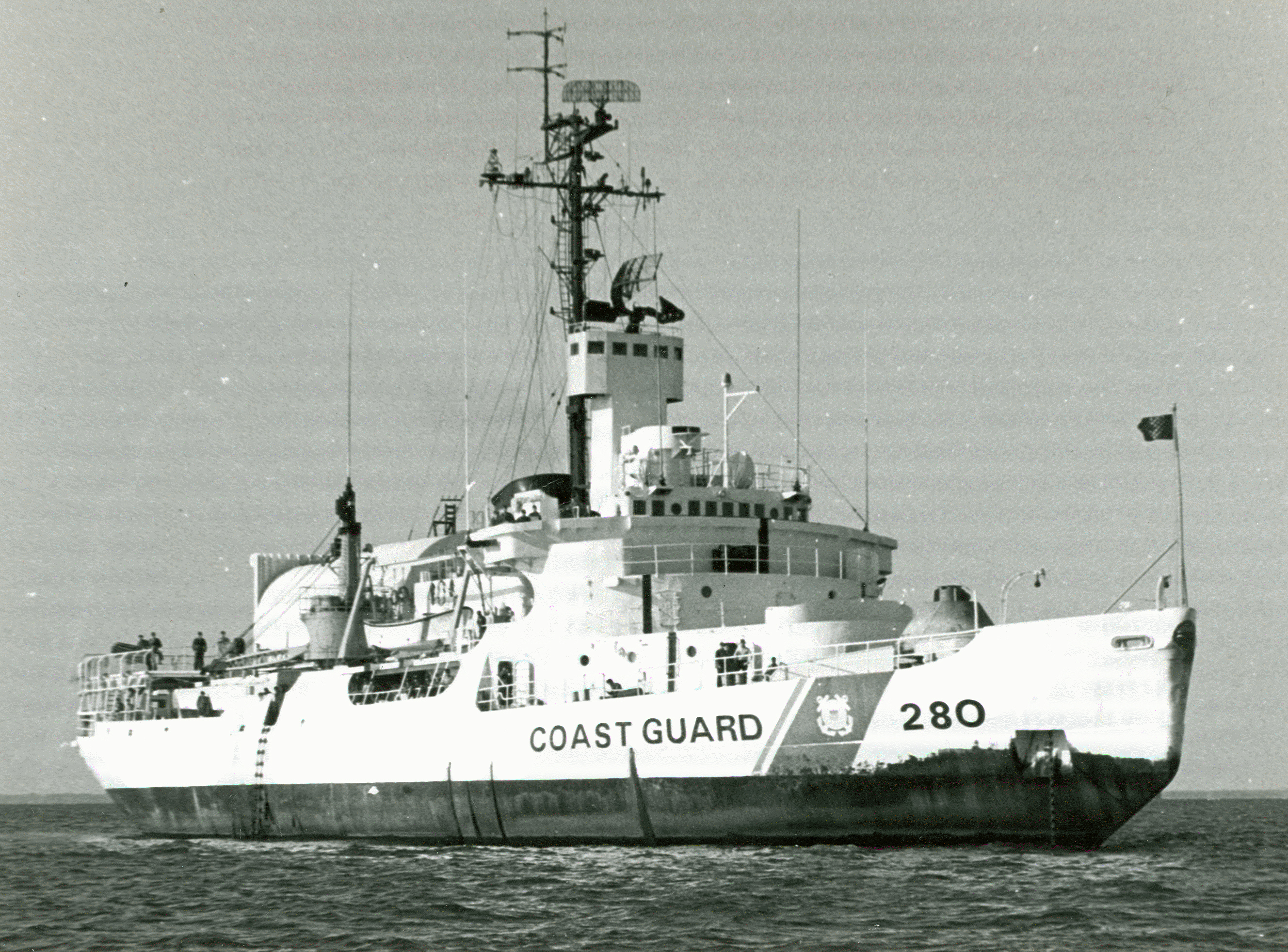
USCGC Southwind near port of USCG Base Berkley, after returning from a 27,000 mile tour of the Arctic.
1968 CGC Southwind departed Baltimore, Maryland for a seven-month deployment to Antarctica and other world-wide destinations. By the time she returned to Baltimore on May 7, 1969 she had become only the second cutter in Coast Guard history to circumnavigate the globe.
Southwind had a varied carrier. From Wikipedia,
USCGC Southwind (WAGB-280) was a Wind-class icebreaker that served in the United States Coast Guard as USCGC Southwind (WAG-280), the Soviet Navy as the Admiral Makarov, the United States Navy as USS Atka (AGB-3) and again in the U.S. Coast Guard as USCGC Southwind (WAGB-280).
1988 The first U.S. merchant marine World War II veterans received their Coast Guard-issued discharge certificates. Congress gave the merchant mariners veterans’ status and tasked the Coast Guard with administering the discharges.

USCGC IDA LEWIS
1995 CGC Ida Lewis was launched, the first of the new 175-foot Keeper class buoy tenders.
 Chuck Hill's CG Blog