

Based on the Coast Guard Historian’s timeline, https://www.history.uscg.mil/research/chronology/
With inspiration from Mike Kelso

SS Puerto Rican under tow October 31, 1984, about ten-thirty in the morning, in position approximately 15.5 miles southwest of Point Bonita. US Coast Guard Photo.
1984 The tanker Puerto Rican exploded outside of San Francisco Bay. Coast Guard units responded.
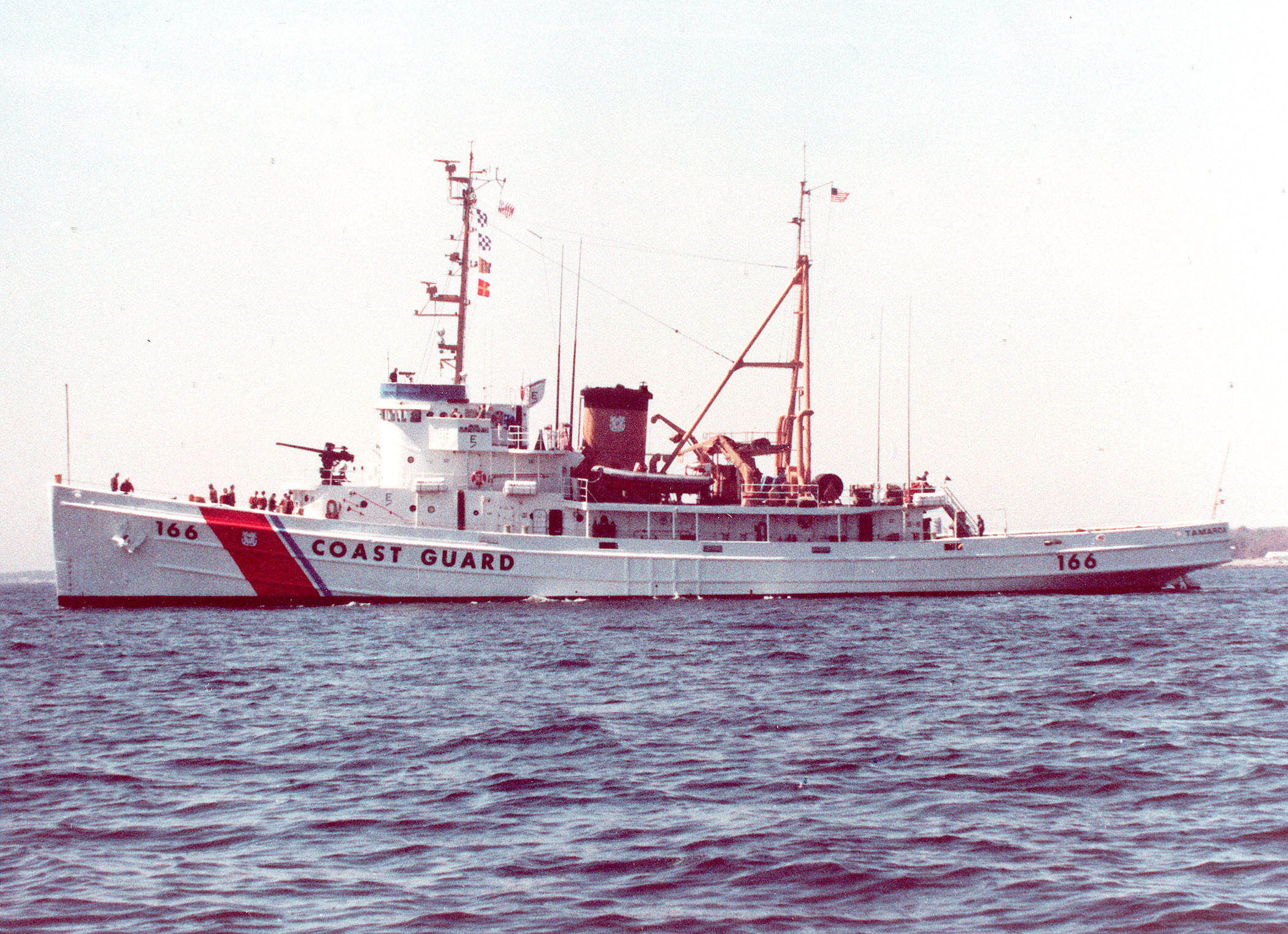
Boston, MA (May 1)–The Coast Guard Cutter Tamaroa (WUEC 166), played a major role in the rescue of an Air National Guard helicopter crew, deployed from Suffolk County, Long Island to assist Coast Guard search and rescue assets. The helicopter was forced to ditch in heavy seas. Tamaroa rescued four and searched vainly for a fifth crewman. U.S. COAST GUARD PHOTO
1991 During an extremely severe winter storm CGC Tamaroa rescued four of five Air National Guard crewmen from an ANG H-60 that had ditched south of Long Island due to fuel exhaustion (the fifth crewman, a pararescue jumper, was never found). Tamaroa had been attempting to rescue the crew of the sailing vessel Satori the previous day (the three on board Satori were rescued safely by HH-3F CG-1493–see October 30 entry above) when the cutter was diverted to assist the Air National Guard air crew. Tamaroa was awarded the Coast Guard Unit Commendation, and the events were chronicled in the best-selling book and movie “The Perfect Storm.”
Two USCG cutters (Monomoy (foreground) and Spencer) searching for survivors from EgyptAir Flight 990.
1999 Egypt Air Flight 990 crashed about 60 miles southeast of Nantucket. Coast Guard units, including CGCs Monomoy, Spencer, Reliance, Bainbridge Island, Juniper, Point Highland, Hammerhead, a HC-130 from Air Station Elizabeth City, and an HH-60 from Air Station Cape Cod searched unsuccessfully for any survivors. All 217 persons on board were killed in the crash. Coast Guard units then assisted in the recovery effort.

2012 The Coast Guard completed Arctic Shield 2012 after a summer season of sustained operations and outreach efforts in the Arctic. Arctic Shield 2012 focused on operations, outreach and an assessment of the Coast Guard’s capabilities above the Arctic Circle. The forward operating location in Barrow consisted of two Kodiak-based MH-60 Jayhawk helicopters with supporting air, ground and communications crews. The Coast Guard deployed several surface assets to the Arctic including the CGC Bertholf, that provided a persistent operational presence and command and control capability in an area where the Coast Guard lacked the permanent infrastructure of a coastal sector. Also deployed were two light-ice capable 225-foot sea-going buoy tenders, a 282-foot medium endurance cutter, and a 378-foot high endurance cutter were also deployed to the region to increase offshore operational capability, ensure the safety of mariners, patrol international borders and provide additional search and rescue capabilities.

USCGC Stratton off Unalaska
2014 The Coast Guard concluded Arctic Shield 2014 after a successful season that included deployments of personnel and assets to the Seward Peninsula, Bering Strait, and the Northern Alaska Continental Shelf to conduct a broad range of Coast Guard statutory missions. Arctic Shield 2014 included deployments by CGCs Stratton, Healy, SPAR, Alex Haley, and MH-60 Jayhawk helicopters deployed to a forward operating location in Barrow, tribal engagements and assistance, and a range of marine safety activities in many Arctic communities. Arctic Shield efforts included a first-ever MH-60T Jayhawk helicopter deployment to Stratton in the Arctic Ocean. The Arctic Shield team executed several challenging and high-visibility search and rescue cases, such as the dynamic rescue of the sailing vessel master aboard the Altan Girl beset in ice northeast of Barrow, and the medevac of a crewmember from the Korean polar research vessel Araon. Operation Gold Nugget prevention and enforcement activities included 54 at-sea boardings and 36 safety inspections. The Coast Guard Research and Development Center tested pollution response capabilities and successfully celebrated the first landing of a UAV on a Coast Guard ice breaker. The Coast Guard National Ice Rescue School provided critical ice rescue training to the three largest Arctic communities. Prevention activities and outreach spanned 29 villages, training over 2800 children in Kids Don’t Float programs and three mass rescue exercises.
 Chuck Hill's CG Blog
