
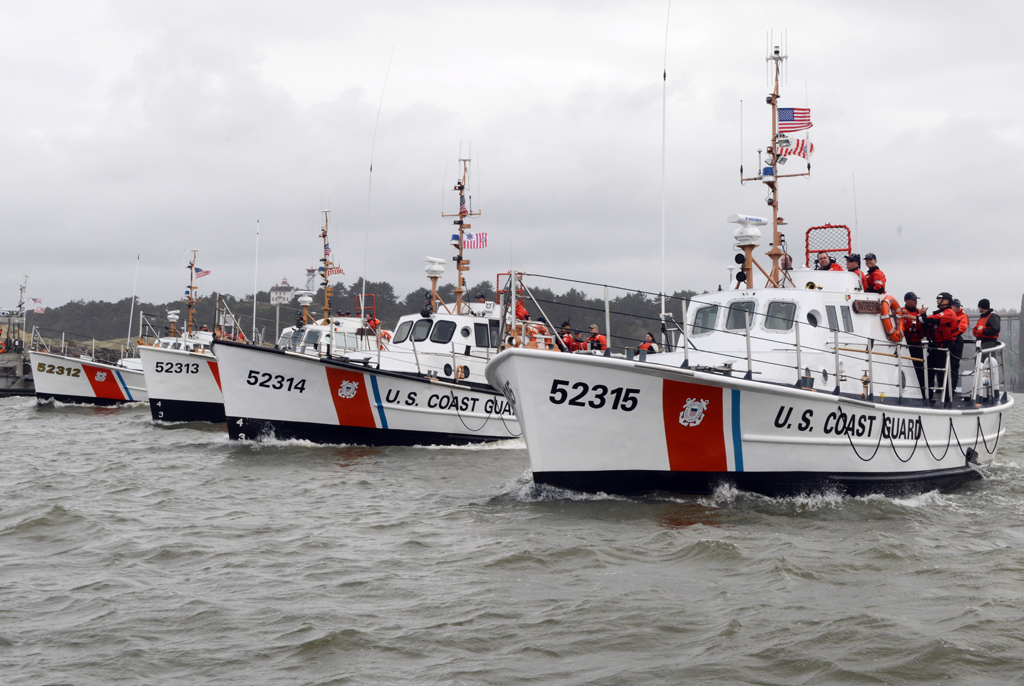
Being Replaced: Coast Guard crew members aboard four 52-foot Motor Life Boats and one 47-foot Motor Life Boat transit in formation outbound of Yaquina Bay, Ore., April 9, 2019. The four 52-foot MLBs are the only active vessels of their kind and the crews are assigned to different units across the Pacific Northwest, which is why having all four together for the roundup was a rare occurrence. (U.S. Coast Guard photo by Petty Officer 3rd Class Trevor Lilburn)
The Acquisitions Directorate has announced the release of a request for proposal for six boats to replace the 52 foot MLBs which were taken out of service more than three years ago. You can find the RFP here.
The proposal should give the Coast Guard some very capable craft. I did not read the entire 196 pages front to back, but I did manage to find out some of the capabilities included in the specifications.
First some limits:
- Length 64 feet or less
- Beam 22 feet or less
- Draft 7 feet or less
Other characteristics:
- Speed: at least 20 knots
- Cruise Speed: 16 knots
- Minimum Speed: 5 knots or less
- Range: 500 nautical miles
- Crew: Minimum 4
Missions:
- SAR is number one, but also
- Marine Safety
- Law Enforcement
- Ports Waterways and Coastal Security
- Marine Environmental Protection
- plus, anything else they might use it for.
Capabilities:
They are expected to operate in 35′ seas, 60 knot winds, and 25′ surf.
The boats will support a relief crew of four for missions that last more than 10 hours in calm waters or more than six hours in more demanding conditions. There is also seating for five survivors for a total of 13 seats. Berthing is limited to four.
The boats will have both open and enclosed bridges. It will be equipped with a bow thruster, recovery wells on either side and a powered towline reel.
Communications include satellite phone, and if I understand correctly, encrypted voice and data.
In addition to radar, sensors will include Electro Optics and Infra-Red (EO/IR).
Maybe We Need More than Six:
As I have noted before, such vessels could replace 87 foot WPBs that are approaching the end useful life in at least some ports and do it with a smaller crew and probably better seakeeping. They might not encounter 25 foot surf as frequently as the those in the Pacific Northwest, but the capability to deal with heavy weather will be there when needed. They don’t have the endurance of WPBs but when cases extend beyond their endurance, FRCs should take over. I do hope they are a bit faster than 20 knots, after all the 47 footers can do 25 knots.
 Chuck Hill's CG Blog
From reading the RFP it sounds like all six would be in the Pacific Northwest. If we assume that four will be stationed where the 52 footers were located that leaves two more locations. Maybe one at Station Golden Gate and another at Port Angeles WA? I also hope they keep tradition and name these boats after their predecessors.
The less than 65 feet requirement seems arbitrary and intended only to keep them from being considered cutters. That would mean they would not be named.
The type could be very useful in Alaska too and perhaps in the NE as well.
The emphasis on the ability to tow seems like a return to the days when the CG functioned as AAA on the water.
Victory.
Intrepid.
Triumph.
Invincible.
I could imagine a “spare” hull at NMLBS at Cape D for training and a maintenance spare for the other stations in the area.
Neah Bay to the North might be more appropriate than Port Angeles. Perhaps Noyo River or Humboldt Bay would also be worth considering.
Those places would work if they have larger vessels transiting those harbors. I’m not familiar with those locations. Having one on the Strait of Juan De Fuca makes sense due to the traffic there. These boats could be utilized for oil spill response as well as other missions.
My snapshot experience at Yaquina Bay is just that but I wonder if it matched other stations with their 52’s. We ran 600 plus calls a year and the Victory was involved in maybe 10-15 of those. The big problem back then was lack of qualified coxswains for the 52. The two 44’s ran all the calls and in the summer season would run multiple back to back calls as the 52 stayed tied up.
Maybe a new MLB that would be easier to train and transition to from the 47’s?
64’ is definitely arbitrary, and is certainly tied to the CG’s definition of a “boat” vs. a “Cutter.”
.
I couldn’t get the RFP to open. I’m guessing a self-righting steel hull is clearly called for as well?
.
These could be very useful in Alaska. It seems having such a small inventory of any boat makes training/certification difficult, limited, and basically an OJT evolution for those who are stationed where the boats are. More numbers would make this less of an issue as one could be assigned at the National Lifeboat School.
@Bill, concur, if we are going to develop such a boat, there seem to be a lot of places it would be useful. I have previously suggested that the 87 foot WPBs be replaced by two classes, one an armed high speed interceptor for ports where terrorist attacks or unconventional attacks at the opening of a conflict are more likely and a heavy weather boat like this for other ports where that is not the case. Certainly Alaska has several such ports. Smaller crew and smaller size than the 87 footers means lower operating costs while it should be more useful in truly awful weather.
I wonder if DJT has considered making you the Coast Guard Czar?
.
This is another in a long line of well thought out improvements from you.