
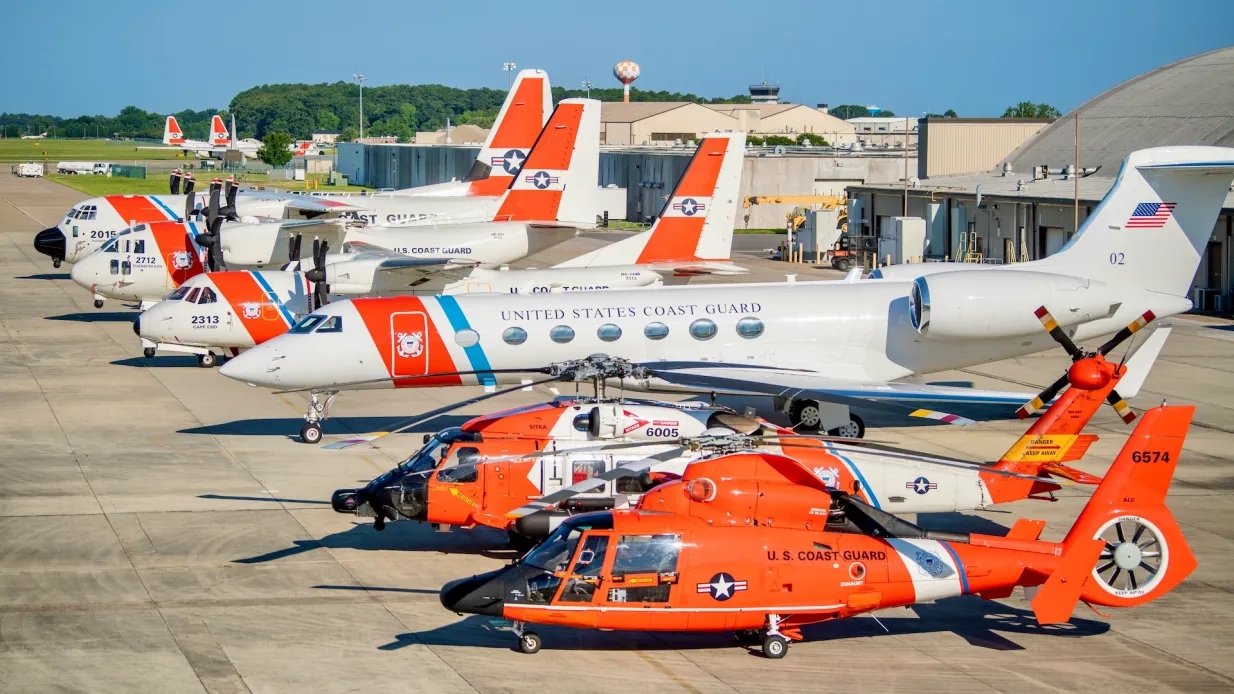
Every Coast Guard Aircraft Type Pictured Together In Rare ‘Family Photo’. Pictured: HC-130J, C-27J, HC-144, C-37B, MH-60T, MH-65E.
The Coast Guard needs to move fast. The crisis in the Coast Guard’s rotary wing community not going away. As of early December, almost 18 percent of the Coast Guard’s 45-strong MH-60T “Jayhawk” medium range recovery fleet is out of service. Eight helicopters with over 19,000 flight hours are, as of now, permanently grounded….If the flight restrictions remain, the Coast Guard aviation—led by the hard-used Jayhawks—will run into serious peril. By late 2023, over 90 percent of the Coast Guard’s MH-60T helicopters were operating with more 16,000 flight hours, so, without a rollback to the Coast Guard’s original 20,000 flight hour target, several more Coast Guard Jayhawks are set to bump up against the new 19,000 flight hour limitation…Coast Guard leadership is finally showing signs of throwing in the towel and recognizing reality. A new aviation strategy is under development. In a December 10th email, a Coast Guard spokesperson wrote, “We are developing a comprehensive strategy for the future of Coast Guard Aviation,” that “will outline aircraft transitions across our rotary and fixed-wing fleets, as well as the potential development of an uncrewed fleet.”–
… it is going to take a long time. H-65s will be with us until the early 2040s. The Coast Guard intends to increase its H-60 fleet to at least 127, up from 45. Currently the Coast Guard has 98 H-65s or a total 143 rotary wing aircraft. We may be looking at 16 fewer total aircraft, but that is in the distant future and not really a reason for concern. Somehow, I doubt the plan will remain unchanged for 20 years, nor should it.
Thanks to David V. for bringing this to my attention.
Medium Range Recovery Helicopter–CG-9
Consolidation of the Coast Guard’s rotary wing fleet to a single MH-60T airframe is necessary to mitigate sustainability challenges with the MH-65 short range recovery helicopter and maintain the service’s rotary wing capability until recapitalization in line with the Department of Defense’s Future Vertical Lift program.
How will the Coast Guard increase and sustain the fleet?
The Coast Guard established a service life extension program (SLEP) in 2017 to extend the service life of the 45 MH-60T aircraft currently in the fleet. These helicopters have been in service since 1990; without the SLEP, 90% of the MH-60T fleet would reach the end of its service life by 2028.
As part of the SLEP, the Coast Guard is replacing the hulls of the legacy airframes with hulls from two sources: retired U.S. Navy H-60 aircraft and newly manufactured hulls procured from the original equipment manufacturer, Lockheed Martin/Sikorsky.
The Navy hulls are being converted to the MH-60T configuration at the Coast Guard Aviation Logistics Center (ALC) in Elizabeth City, North Carolina.
The program awarded an indefinite-delivery, indefinite-quantity contact in January 2021 for the production of new hulls – consisting of three fuselage structure sections: the nose, mid (cabin) and transition – that will be engineered, manufactured and delivered in the MH-60T configuration. Use of new hulls provides an airframe service life of 20,000 flight hours, compared to an average service life of approximately 12,000 flight hours for the previously used Navy hulls.
The remaining production activities – including installation of new dynamic components such as rotors and electrical rewiring – for all hulls will also be completed at ALC.
In October 2023, the Coast Guard received approval from the DHS to proceed with acquisition program activities that expand on the original SLEP to include a component for fleet growth.
The MH-60T Acquisition/Sustainment Program is authorized to:
- Move to full rate production of newly manufactured hulls as part of the SLEP for the existing MH-60T fleet.
- Conduct Obtain Phase activities and execute low-rate initial production of 12 new aircraft that will transition three Coast Guard air stations currently operating with the MH-65 to the MH-60T.
- Begin Obtain Phase activities for aircraft that will transition the remaining Coast Guard air stations to the MH-60T from the MH-65.
The SLEP is now known as Increment 1 of the program. To date, three aircraft have completed SLEP activities. Forty-five new hulls are currently under contract.
The first fleet growth phase, known as Increment 2 of the program, will organically produce 36 aircraft to convert eight air stations from MH-65 to MH-60T operations. The program has been authorized to produce the first 12 aircraft for this increment and will seek authorization from DHS to produce the remaining aircraft at a later date. Transition of the first air station under Increment 2 started in summer 2024.
The air stations not transitioned to MH-60Ts under Increment 2 will be converted as part of Increment 3 of the program. The final air station transition is anticipated to occur in the early 2040s.
The MH-60T Acquisition/Sustainment Program was initially chartered in 2017 to evaluate and implement technical and mechanical solutions for extending MH-60T use through the 2030s. On Oct. 31, 2023, the Department of Homeland Security gave approval to add acquisition program activities to the existing SLEP.
The sustainment effort is being implemented through form, fit and function replacements of the structural hull components, dynamic components such as the rotor, and electrical rewiring. Replacement of the structural hulls will be accomplished either through conversions of retired Navy SH-60F/HH-60H hulls into the MH-60T specification or through the procurement of newly manufactured hulls from the original equipment manufacturer that will be engineered, manufactured and delivered to the Coast Guard in the MH-60T specification.
The acquisition effort will start with the conversion of eight air stations from MH-65 to MH-60T operations through the organic production of 36 aircraft. The program has been authorized to produce the first 12 aircraft for this increment and will seek further authorization from DHS to produce the remaining aircraft.
The existing MH-60T avionics components and software will continue to be used and maintained on the replacement hulls through decommissioning and disposal.
Characteristics
- Length: 64 feet 10 inches
- Rotor Diameter: 53 feet 8 inches
- Height: 17 feet
- Maximum Weight: 21,884 pounds
- Cruise Speed: 170 knots
- Range: 700 nautical miles
- Service Ceiling: 13,000 feet
- Endurance: 6.5 hours
- Crew: four
Features
- Common avionics architecture system of digital glass cockpit instruments similar to those installed on the Coast Guard’s fixed-wing aircraft
- Surface search radar and electro-optical/infrared sensors
- Engines standard with the Department of Defense’s H-60 fleet
- Five multifunction display screens
- Sensor and hoist cameras
- Integrated traffic collision avoidance system
- 7.62 mm machine gun for firing warning shots and a 7.62 mm shoulder-fired weapon for precise targeting, such as disabling engines on noncompliant go-fast vessels, can be installed
- Standardized mission system components complementing capabilities and equipment installed on the Coast Guard’s upgraded MH-65 short range recovery helicopter
 Chuck Hill's CG Blog
The new MH-60T hulls are built at Sikorsky’s facility between Troy, AL and Ft. Novesel, AL. It’s a matter of money, as the facility has plenty of capacity. I question the economy of SLEP ex-Navy hulls with a lifespan of 12,000 hours. We’d need to see a cost vs. available hours to see if it’s worthwhile…
The AUF mission capability will have to transfer to the MH-60T with the MH-65 being disposed of (eventually).
Keeping the MH-60 has some benefits as far as facilities already set up for them, but it’s a shame with buying new airframes, a new, more capable platform could have been chosen, such as the S-92 (specs below to compare to MH-60’s above).
Length: 68’ 6”
Height: 15’ 5”
Rotor Diameter: 56’ 4”
Maximum Weight: 27,700 lbs
Cruise Speed: 174 mph
Range: 539 nautical miles
Service Ceiling: 14,000’
The big benefit of the S-92 is cabin size. The H-60 cabin is 399 cubic feet, while the S-92 is 789 cubic feet; nearly twice the size.
The H-60 still seems to have an advantage in range.
Hangars and flight decks for the NSC, OPC, and WMEC270s are sized for the M-60. I don’t know if the slightly large size and significant weight difference would preclude operation of the S-92.
The other alternative would be a new H-65 size helicopter to fill in for local response between widely separated Medium Range Recovery helo bases. Lower operating costs, several options. Fits cutters more easily and leaves more room for UAS.
I’ve seen “Range” defined three separate ways, and I didn’t see an “apples to apples” way of comparing them, but I suspect the S-92 has better range than the H-60. They are commonly used for Offshore oil platform crew transfer and serve as SAR aircraft in several allied countries services, including Canada and UK, so they have a great number of hours of over-water operation. They are just beginning to be delivered to HMX-1 to serve as the new Marine 1, replacing the old VH-3 in that role. This means they are already in US inventory (albeit in very limited numbers – I think the buy for the Marines is around 23 helicopters).