

Based on the Coast Guard Historian’s timeline, https://www.history.uscg.mil/research/chronology/
With inspiration from Mike Kelso
December 17

Members of the Overland Relief Expedition
1897 The Overland Expedition, consisting of three officers from the Revenue Cutter Service, departed from the cutter Bear off Nunivak Island to rescue 300 whalers trapped in the ice at Point Barrow, Alaska. The rescuers were First Lieutenant D. H. Jarvis, Second Lieutenant E. P. Bertholf (later commandant), and Surgeon S. J. Call. The rescuers had to travel over 1,000 miles overland to reach the whalers.
1903 Life-Saving Service personnel from Kill Devil Hills Life-Saving Station helped carry materials to the launch site for the first successful heavier-than-air aircraft flight by the Wright Brothers at Kitty Hawk, North Carolina and then assisted the brothers in their flights that day. The life-savers were John T. Daniels, W.S. Dough, and A.D. Etheridge.

The wooden fishing trawler Belmont was acquired for service for a fee of $2,122 to serve under charter by the Navy “for Coast Guard use as a vessel of the Greenland Patrol.” After conversion, including the addition of two small depth charge tracks and minimal anti-aircraft armament, she was commissioned as a vessel of the Coast Guard on 19 June 1942 and renamed Natsek.
1942 USCGC Natsek, part of the Greenland Patrol, disappeared in Belle Isle Strait while on patrol. There were no survivors among her 24-man crew. It was thought that she capsized due to severe icing.
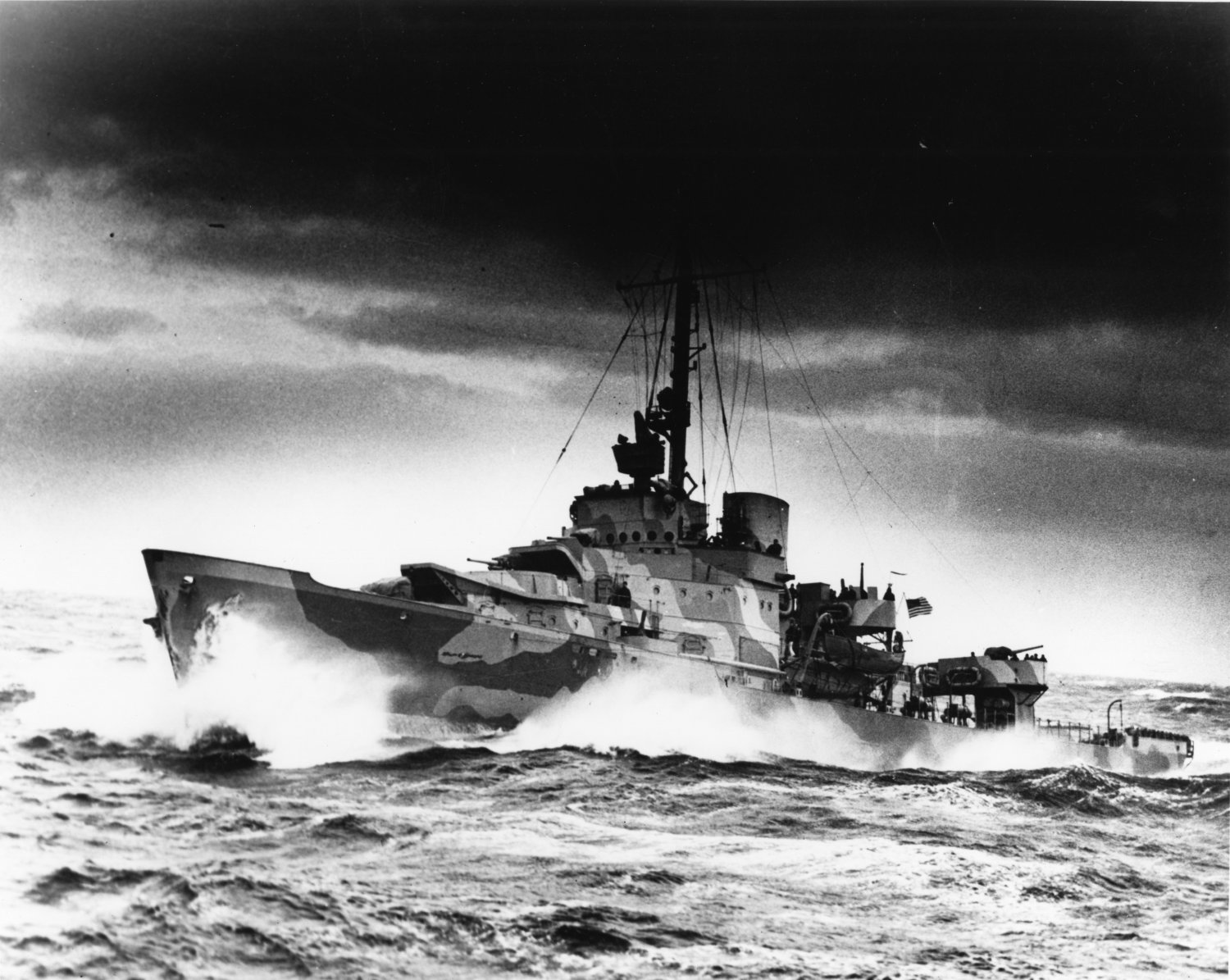
USCGC Ingham (WPG-35) underway in heavy seas, circa 1941-1944, location unknown.
US Coast Guard photo # 2000225945
1942 The Navy credited CGC Ingham with attacking and sinking the submerged U-626 south of Greenland.
U-626 was previously thought to have been sunk in the North Atlantic on 15 December 1942 by depth charges from US Coast Guard cutter USCGC Ingham. This attack was actually 200 nmi from U-626′s position and there is no evidence that the target was a U-boat.
1951 President Harry Truman presented the Collier Trophy to the Coast Guard, the Department of Defense and the “helicopter industry” in a joint award, citing “outstanding development and use of rotary-winged aircraft for air rescue operations.” Coast Guard Commandant VADM Merlin O’Neill accepted the trophy for the Coast Guard.
2000 An HH-60 from AIRSTA Elizabeth City hoisted 26 survivors from the sinking cruise ship Sea Breeze I and flew them to safety, a record for a single helicopter rescue. Another HH-60 rescued the remaining eight survivors from the cruise ship while an HC-130 also participated in this historic rescue.
She (Sea Breeze 1–Chuck) was part of Dolphin when the line merged with Premier in the late ’90s. (Interesting, as SeaBreeze was Premier’s first ship when the line was founded in the ’80s.) Anyway, when Premier went out of business in September 2000, SeaBreeze was seized in Halifax, and remained there through December. Later that month, she ran into a storm off the coast of Virginia and sank. She was carrying about 40 crew members, all of whom were rescued via helicopter in a heroic feat by the US Coast Guard. There were no passengers aboard.
2014 President Barack Obama and Cuban President Raúl Castro announced the beginning of a process of normalizing relations between the two countries. The Coast Guard announced its statement regarding the Cuba policy changes due to this change the following day, December 18, 2014.
 Chuck Hill's CG Blog