

Based on the Coast Guard Historian’s timeline, https://www.history.uscg.mil/research/chronology/
With inspiration from Mike Kelso
December 18

USLHT Amaranth, by Jerry McElroy
1912 The Lighthouse Service suffered its first gas-powered buoy accident when one exploded during maintenance. The explosion killed a machinist, John A. Dunbar, who was a member of the crew of the Lighthouse Tender Amaranth.
2014 The Coast Guard issued the following statement regarding “The Coast Guard on Cuba Policy Changes” announced by President Barack Obama on December 17, 2014: “Coast Guard missions and operations in the Southeast remain unchanged. The Coast Guard strongly discourages attempts to illegally enter the country by taking to the sea. These trips are extremely dangerous. Individuals located at sea may be returned to Cuba.”
December 19

Gurnet Pt Lifesaving Station, Plymouth, MA
1881 While the head keeper and six men of his crew were conducting drills away from their Gurnet Point, Massachusetts, Life-Saving Station, the surfman who remained in charge at the station saw a schooner standing inside of Brown’s Island Shoals. He realized that unless the vessel was warned she would go aground. So he rowed out to the schooner in a small boat and piloted her clear. She proved to be the schooner Milton and had mistaken the channel entrance to Plymouth Harbor.
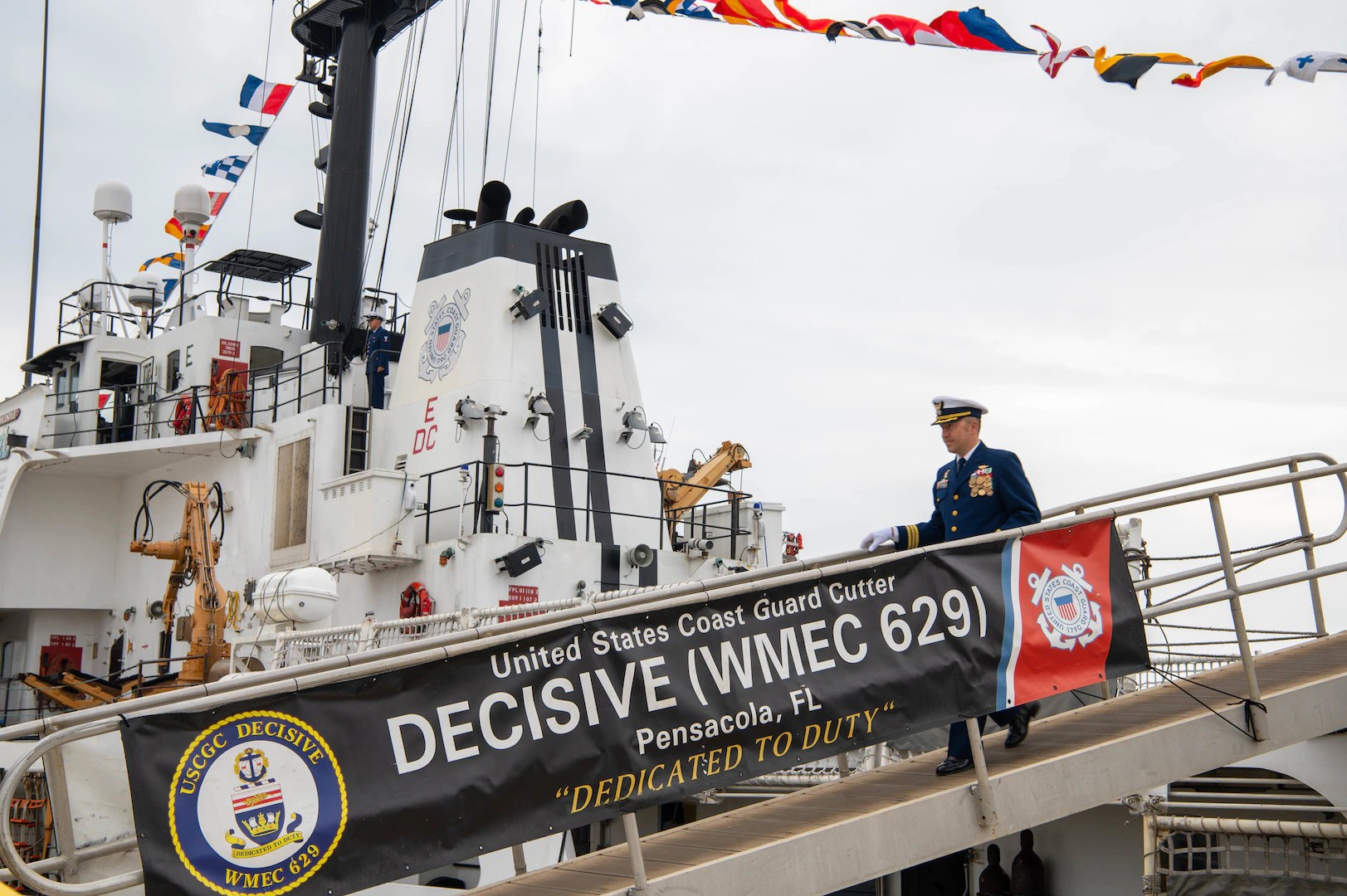
USCGC Decisive on the day of her decommissioning, March 2, 2023
2014 CGC Decisive returned to its homeport in Pascagoula, Mississippi, following a six-week patrol in the Caribbean Sea supporting the Joint Interagency Task Force-South. During the deployment, the 70-member crew of Decisive was primarily responsible for conducting counter drug operations in support of U.S. and international laws. Decisive worked directly with federal and international partners at JIATF-S and the 7th Coast Guard District to combat transnational organized crime networks operating in the Caribbean Basin. Decisive’s efforts directly contributed to the prevention of more than 4,100 pounds of contraband from reaching American shores. During Decisive’s 39-day deployment, the cutter’s crew also conducted a professional exchange with members of the Honduran Navy. These interdictions were part of Operation Martillo, an international operation focused on sharing information and bringing together air, land, and maritime assets from the U.S. Department of Defense and the Department of Homeland Security, as well as Western Hemisphere and European partner nation agencies, to counter illicit trafficking.
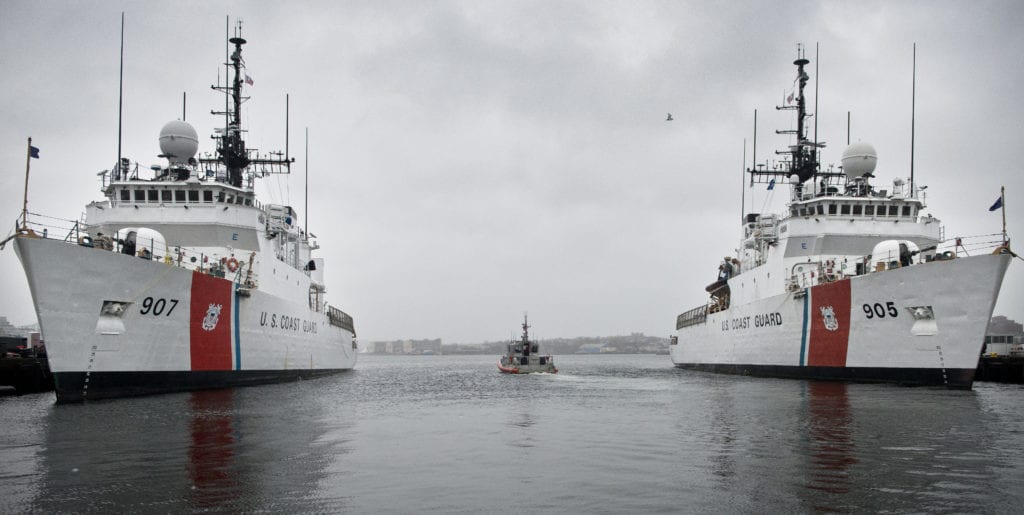
A Coast Guard Station Boston crew transits between Coast Guard Cutter Escanaba and Coast Guard Cutter Spencer in Boston on Nov. 24, 2014. The Escanaba and Spencer are 270-foot Famous-class medium endurance cutters. U.S. Coast Guard / Petty Officer 3rd Class MyeongHi Clegg
2015 CGC Escanaba returned to its homeport in Boston following a successful 52-day deployment in the Eastern Pacific Ocean. During the patrol, Escanaba steamed more than 11,200 miles, successfully transited the Panama Canal for the first time in more than 10 years, and interdicted 1,009 kilograms of cocaine, two vessels, and five narcotic smuggling suspects. Escanaba’s crew worked in partnership with an MH-65 Dolphin helicopter crew from the Coast Guard’s Helicopter Interdiction Tactical Squadron, based out of Jacksonville, Florida, to pursue and conduct boardings of eight vessels in five cases.
 Chuck Hill's CG Blog