
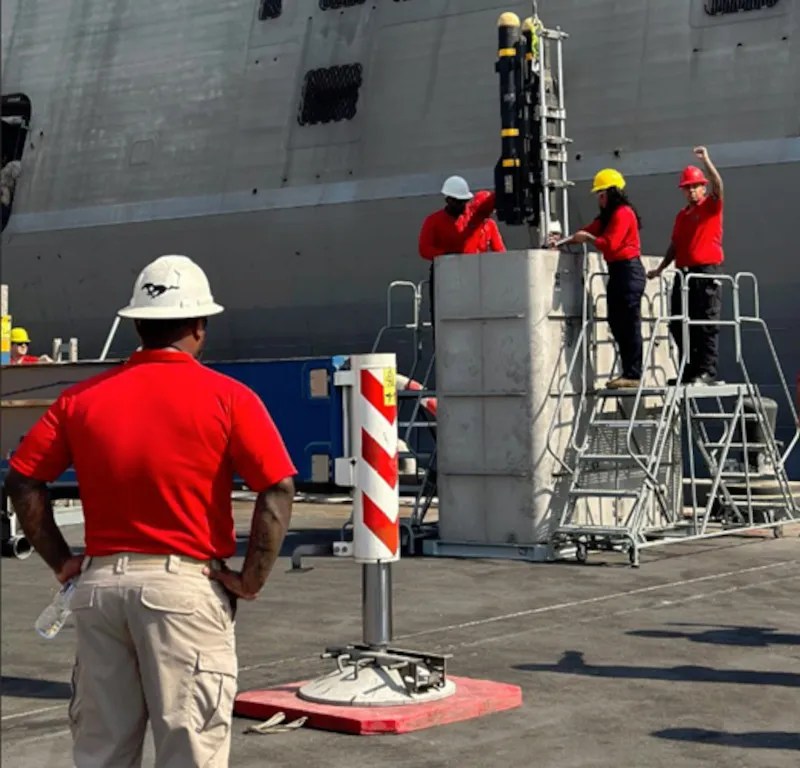
Enlisted technicians from the Navy Munitions Command (NMC) Bahrain Detachment support the delivery of hardware and software upgrades aboard USS Indianapolis (LCS 17) in September 2024 while the ship was forward deployed to the U.S. 5th Fleet Area of Responsibility. USN
The War Zone reports, “Littoral Combat Ship Can Now Rapidly Shoot Down Aerial Drones with Hellfire Missile.”
The Coast Guard needs a counter drone capability if Coast Guard ships are going to do force protection and the “Ports, Waterways, and Coastal Security” and “Defense Readiness” missions.
Hellfire, and its form factor twin replacement JAGM, are emerging as primary candidates for this role. Compared to gun systems, they do not throw multiple rounds well beyond the target that might cause collateral damage. They also have the advantage of being useful in other roles as well, including as an anti-aircraft weapon against low flying sub-sonic threats and as an effective surface to surface weapon against a range of naval threats from small fast highly maneuverable threats like kamikaze USVs to ships.
Included in the report was the photo below that depicts a proposed deck mounted vertical launcher for Hellfire/JAGM. It probably weighs about the same as a 30mm Mk38 Mod4 and would not require the same deck foundation strength since there is no recoil.
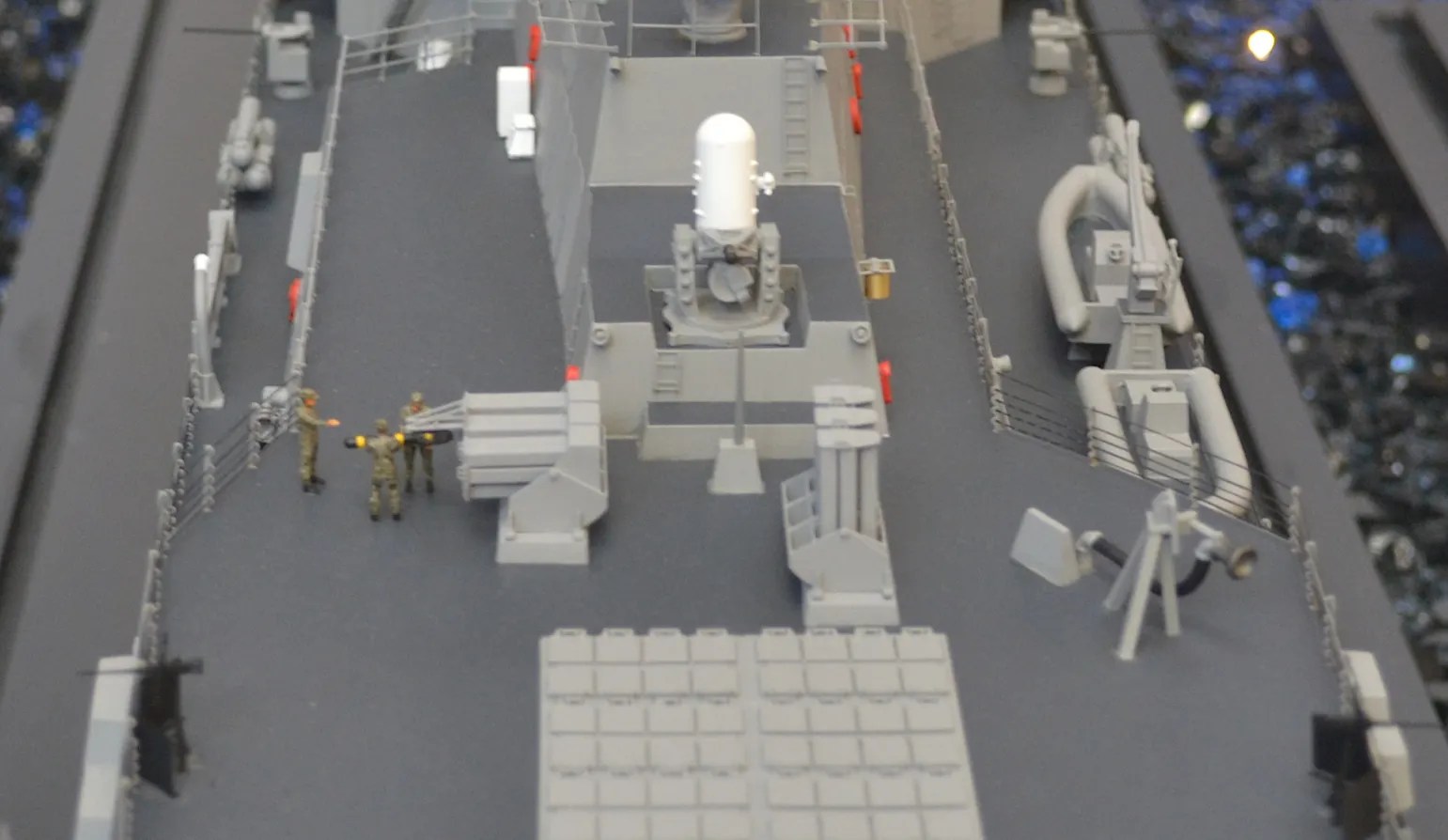
A close-up of the Hellfire/JAGM launchers on the Arleigh Burke model on display at the 2025 Surface Navy Association symposium. Joseph Trevithick
I cropped the photo to get a better look at the launchers. It appears the mount is being loaded in the horizontal position and would return to the vertical for firing. This means reloading would be relatively easy and the location of the mount could be very flexible.

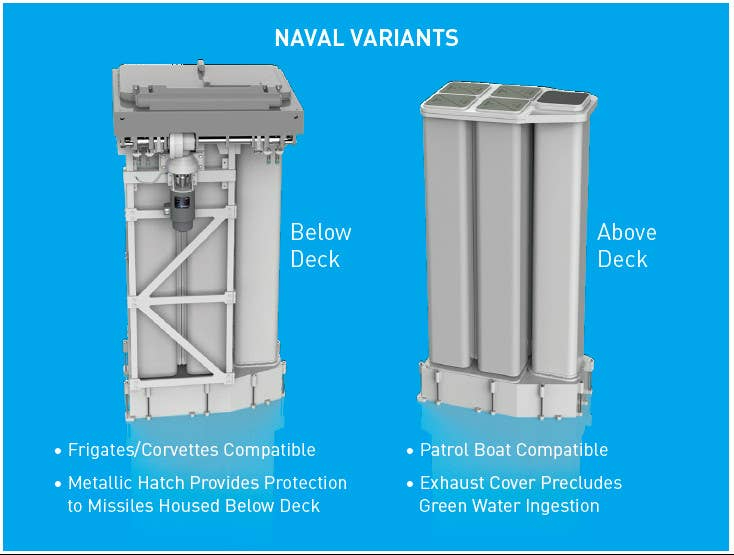
It appears that each of the three sets of tubes (above) are much the same as the “Patrol Boat Compatible” above deck launchers pictured below, which would mean each mount could house twelve missiles. A pair of these would provide up to 24 rounds ready to launch–same as the number in the LCS mission module.
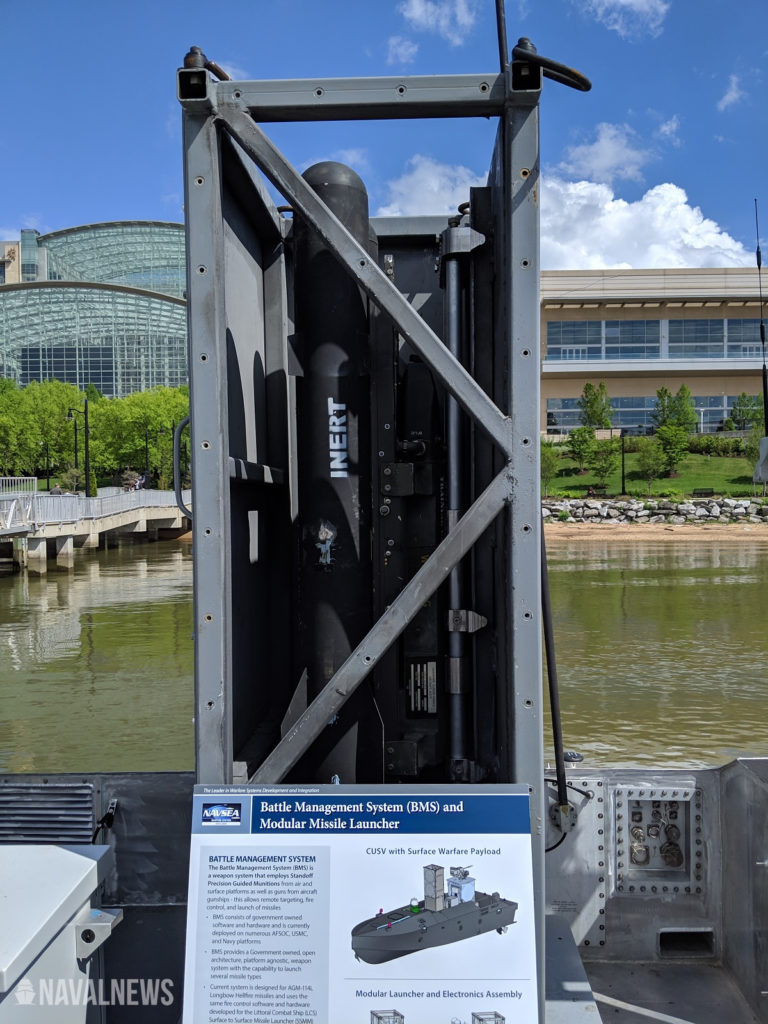
For smaller cutters Hellfire has been adapted to USVs as small as 12 meters.
 Chuck Hill's CG Blog
Cannot help but view the loading of these missiles in the picture of the Arleigh Burke DDG, archaic. Seems like something you would see on wooden sailing ships loading cannon balls into a cannon.
Would hate to be doing that job in the dark in some heavy seas!
Looks a lot easier than the way torpedoes are loaded into the mark 32 torpedo tubes. The Hellfire is about one quarter the weight of the torpedoes. There is also apparently some load handling equipment attached to the launcher to make it relatively easy. Certainly, less awkward than dropping the round down from the top into a fixed vertical launcher.
For real excitement, consider that on WWII battleships projectiles up to 2700 pounds were manhandled by walking them on their base from their storage position in the magazine to the hoist. Could not believe they were doing that.