

Based on the Coast Guard Historian’s timeline, https://www.history.uscg.mil/research/chronology/
With inspiration from Mike Kelso
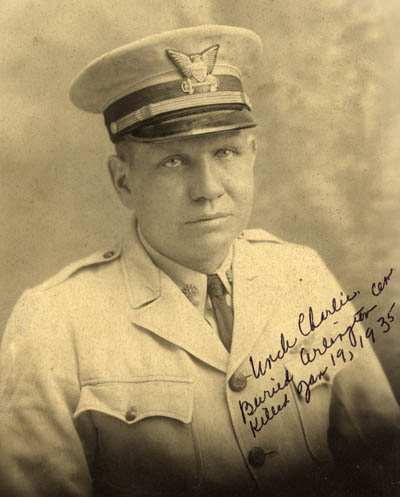
1935 Chief Warrant Gunner and Naval Aviation Pilot (CWO-GUN; NAP) Charles T. Thrun, USCG, Coast Guard Aviator Number 3, was killed when his Grumman JF-2 Duck crashed at Cape May. CWO Thrun was the first Coast Guard aviator to die in the line of duty.

U.S. Army Corps of Engineers photo of Fourth Avenue in Huntington, WV 25 January 1937
1937 Coast Guard units began flood relief operations in the Mississippi and Ohio River valleys. These operations lasted until March 11th and resulted in the rescue of hundreds of victims and thousands of farm animals.
1946 Staged jointly by the Coast Guard and the Navy, the first public demonstration of LORAN was held at Floyd Bennett Field in New York.
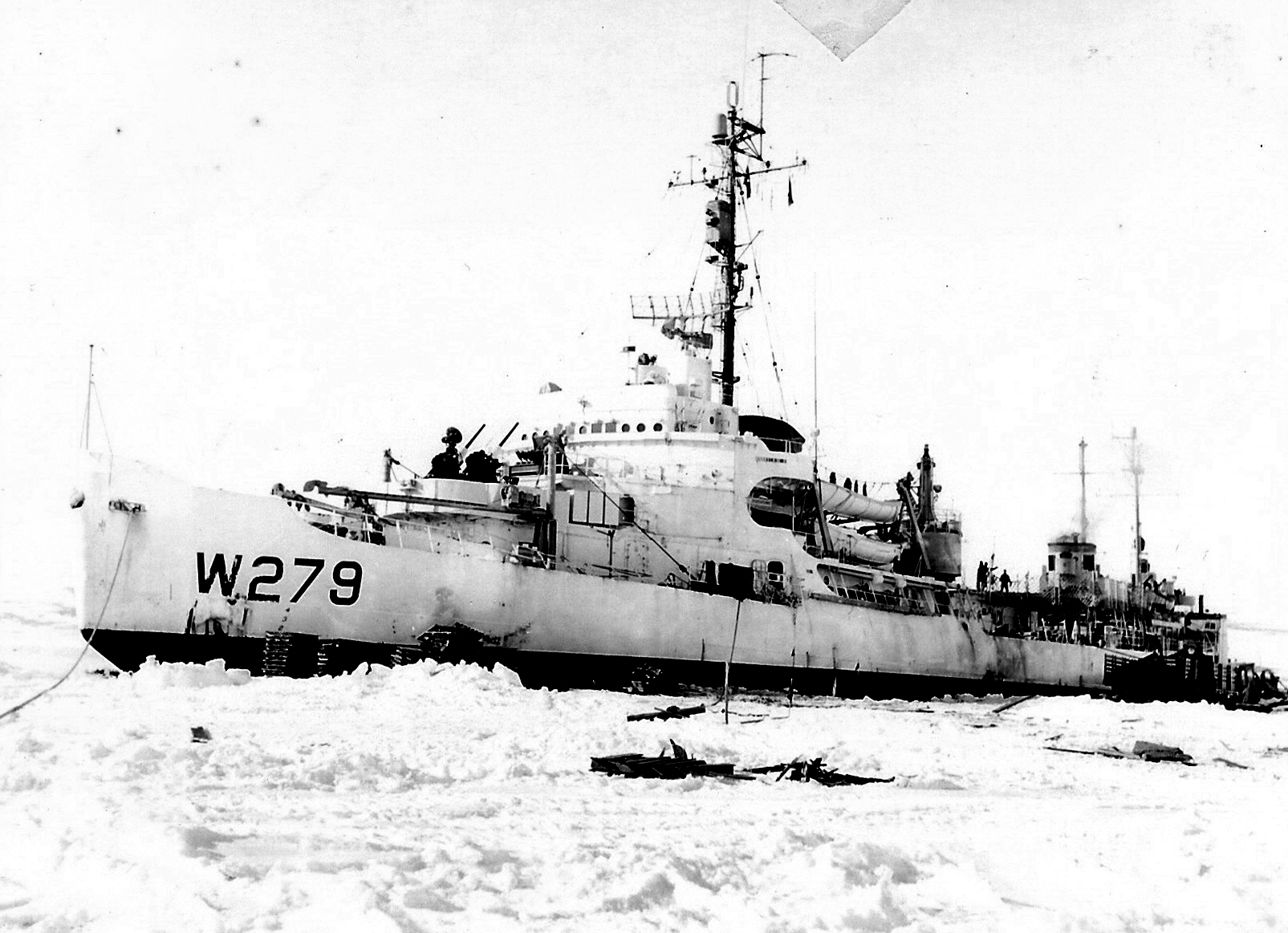
The U.S. Coast Guard icebreaker USCGC Eastwind (WAGB-279) was one of three icebreakers used by Operation Deep Freeze in the Ross Sea area, December 1955. US Navy photo.
1949 The tanker Gulfstream collided with icebreaker CGC Eastwind. The collision and resulting fire killed 13 of Eastwind’s crew, nine of whom were chief petty officers.
Haley, Alex. “Tragedy Stalks the Sea: An Account of the Eastwind Disaster.” –
“It was half-past four the morning of January 19th. Off Cape May, New Jersey, long, shapeless tendrils of fog converged to shroud in a vast milkiness the Gulf Oil tanker SS Gulfstream, travelling light from Philadelphia to the Persian Gulf, and the U.S. Coast Guard’s super-icebreaker Eastwind, Boston to Baltimore. At 4:35 they came together with a rasping snarl of steel on steel. Men catapulted from their bunks fought back terror. There came a second jolt when the Gulfstream bucked clear, her bow a huge, snaggled tooth that had left a gaping wound in the Eastwind’s starboard midsection. Almost immediately a fire broke out, filling compartments with stifling, acrid smoke. Through it more than a hundred bewildered Coast Guardsmen groped their way topside. Among them were ambulatory cases, men in varying stages of undress, men suffering from shock, guided more by instinct than reason….
“The United Fruit Company’s new, sleek SS Junior arrived as the Eastwind fire began to get the upper hand. Faced squarely with the possibility of even more appalling disaster should the magazines be set off, Captain John A. Glynn of the Eastwind ordered 83 of his men to board the Junior which would carry them to New York….
“As this is written the death toll has risen to 13. They were:
- William E. Barnett, CSC
- Ewell Busby, ENC
- Harry F. Brown, HMC
- Donald W. Bryson, BMC
- Stanislaus Coindreau, SA [Died in Marine Hospital, Staten Island, from injuries.]
- Robert E. Connors, EN3
- Louis Cywinski, DCC
- Peter A. Everett, QMC
- Kenneth S. King, SKC
- Anthony G. Machansky, RMC
- Rupert D. Midgette, ENC
- John V. Kerr; FA
- Albert P. Williams, SA… [Died in Marine Hospital, Staten Island, from injuries.]

1969 CGC Absecon, while on ocean station duty, was directed to assist the sinking M/V Ocean Sprinter. Absecon launched a small boat and rescued all of the merchant vessel’s crew. The five Coast Guardsmen manning the small boat received the Coast Guard Medal for their actions.

USCGC Polar Sea
1977 The Coast Guard accepted delivery of CGC Polar Sea from Lockheed Shipbuilding and Construction Company, Seattle, Washington. Polar Sea was placed “In Commission, Special” on January 31, 1977 under the command of CAPT Richard Cueroni.
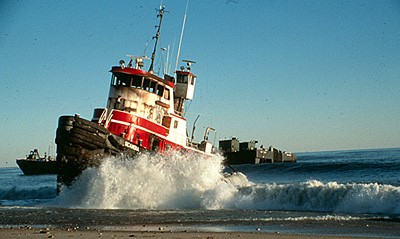
The tug Scandia and barge North Cape that ran aground on Moonstone Beach in South Kingstown, Rhode Island
1996 The tug Scandia and its barge, the North Cape, ran aground on the shore of Rhode Island, spilling 828,000 gallons of oil. This was the worst spill in that state’s history. The Coast Guard rescued the entire crew, pumped off 1.5 million gallons of oil and conducted skimming operations.
The North Cape oil spill took place on January 19, 1996, when the tank barge North Cape and the tug Scandia grounded on Moonstone Beach in South Kingstown, Rhode Island, after the tug caught fire in its engine room during a winter storm. An estimated 828,000 US gallons (3,130 m3) of home heating oil was spilled. Oil spread throughout a large area of Block Island Sound, including Trustom Pond National Wildlife Refuge, resulting in the closure of a 250-square-mile (650 km2) area of the sound for fishing.
Hundreds of oiled birds and large numbers of dead lobsters, surf clams, and starfish were recovered in the weeks following the spill. US federal and Rhode Island state governments undertook considerable work to clean up the spill and restore lost fishery stocks and coastal marine habitat. The North Cape oil spill is considered a significant legal precedent in that it was the first major oil spill in the continental U.S. after the passage of the Oil Pollution Act of 1990, resulting from the Exxon Valdez oil spill in Alaska on March 24, 1989.
 Chuck Hill's CG Blog