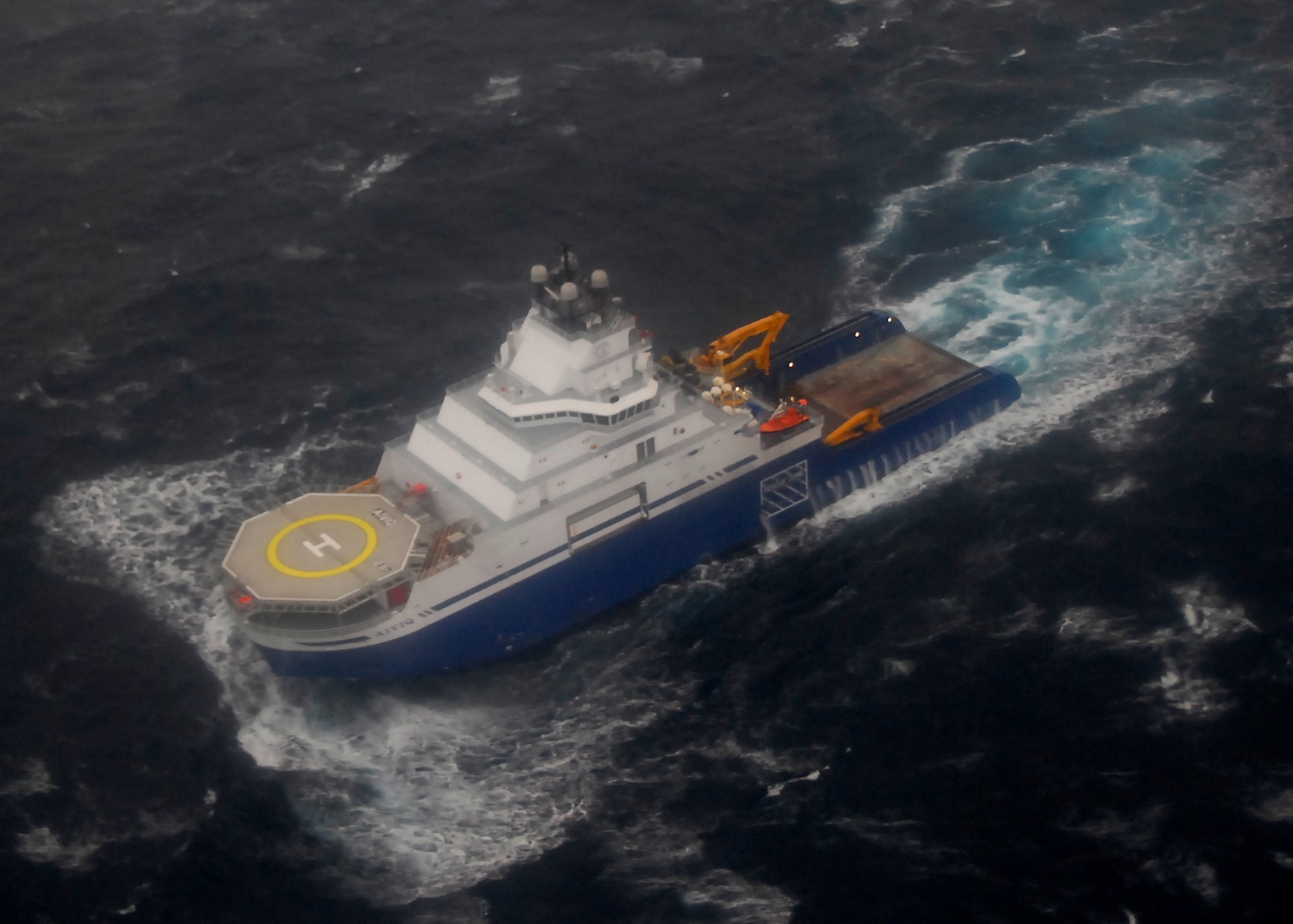
The tug Aiviq traveling with the mobile drilling unit Kulluk in tow 116 miles southwest of Kodiak City, Alaska, in 2012. Credit: U.S. Coast Guard | Petty Officer 2nd Class Chris Usher
Military.com provides an article, originally published by ProPublica, that questions the acquisition of the new USCGC Storis, formerly M/V Aiviq., suggesting undue influence in the decisions to procure the vessel and to homeport it in Anchorage.
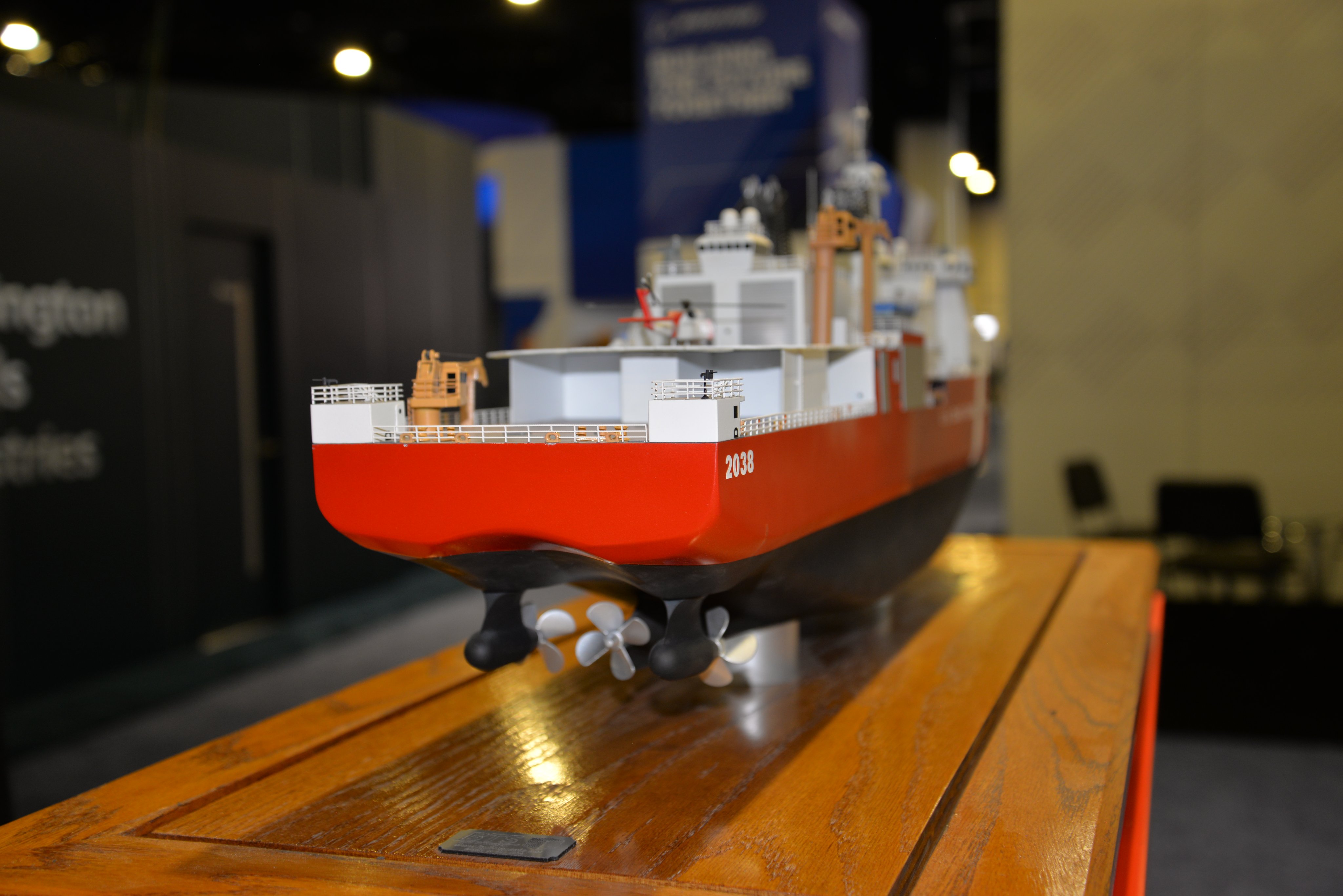
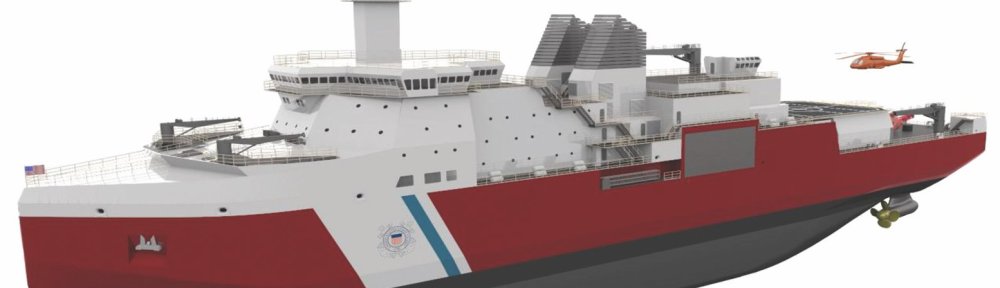
Photo of a model of Halter Marine’s Polar Security Cutter seen at Navy League’s Sea-Air-Space Exhibition have surfaced. Photo credit Chris Cavas.
We would like to think that the Coast Guard has free reign in its award of contracts, but that is, of course, not entirely true.
With this and with the long history of difficulties with the Polar Security Cutter (PSC) program, I have to wonder about the decision to award the contract to award the decision to relatively inexperienced Halter Marine for a design that did not meet the RFP requirement that the design be based on a proven design.
In February 2017, the USCG awarded five fixed-price contracts for heavy polar icebreaker design studies to Bollinger Shipyards, Italy’s Fincantieri Marine Group, National Steel and Shipbuilding Company, Huntington Ingalls Industries, and Singapore’s Halter Marine Inc .
On 23 April 2019 Halter Marine was awarded a $745.9M contract for detailed design and construction of the lead ship. This was probably the low bid, but it has proven an unrealistically low bid.
Of the five contenders, Halter Marine was the least experienced and the least familiar to the Navy and Coast Guard.
Halter Marine had changed hands in 1983, 1996, 1999, 2003, and 2022, not a picture of stable management, and it was not partnered in this offer with any experienced builder of icebreakers.
At the time of the award, Halter Marine had built two ships for the US Navy, none for the Coast Guard. The two ships for the Navy were USNS Howard O. Lorenzen (T-AGM-25), 12,642 tons, a Missile Range Instrumentation Ship and USNS Maury (T-AGS-66), 5000 tons, an oceanographic survey ship.
The Navy’s experience with the construction of USNS Howard O. Lorenzen might have raised red flags. Defense News’ Chris Cavas reported,
“The new ship, built under an initial $199 million contract awarded in 2006, has been under construction at VT Halter’s yard since August 2008, when delivery was scheduled for June 2010. The design is based on a pair of Navy survey ships built in the mid-1980s.“The Navy’s Board of Inspection and Survey, known as INSURV, conducted the Lorenzen’s acceptance trials in the Gulf of Mexico during the week of May 9, …”“The trial “was reported as unsatisfactory” by INSURV…The failed grade was due to three major discrepancies – thrust bearing temperature, and steering and anchor demonstrations. Three of 15 graded areas – electrical, damage control and aviation – were also graded unsatisfactory.“INSURV recommended that acceptance not take place until the systems “can be fully re-demonstrated.”“…In recent years, problems have emerged with several ships under construction at the Moss Point yard for U.S. government customers.“Last fall, the National Oceanographic and Atmospheric Administration (NOAA), for which VT Halter built a number of fisheries research ships, abruptly canceled completion of a new research ship when it was nearly finished, claiming it was overweight and unable to carry out its coastal mapping mission. The ship was seized by NOAA and moved elsewhere for completion and modifications.“In 2005, contract disputes led the U.S. Army to cancel completion of a logistics vessel and delay delivery of two others.
The Coast Guard might also have looked at their safety record.
“…in 2009, unsafe working conditions led to an explosion that killed two employees and injured five others. The company was fined $1.32 million by the United States Department of Labor for 17 willful and 11 serious violations, including willfully exposing workers to toxic fumes in a confined space. According to Secretary of Labor Hilda L. Solis, the explosion “was a horrific and preventable situation. VT Halter Marine was aware of the hazards and knowingly and willfully sent workers into a confined space with an explosive and toxic atmosphere.”
The use of a never completed design should have disqualified Halter Marine. With this as background, could the Coast Guard have missed the warning signs, or might they have been overruled in the selection of the yard? Could this have been a case of undue influence? Who made the final decision, the Coast Guard/Navy acquisition team, the Commandant, the Department of Homeland Security, or someone else? and why?
 Chuck Hill's CG Blog
The gift that keeps on giving!
With no experience in building a heavy icebreaker (let alone one with complex naval equipment and armament), it really makes you scratch your head why Halter Marine chose an incomplete and unproven design as the basis.
But then again, who knows if a better design basis would have made a difference in the first place.
At least Bollinger has taken over…hopefully that helps move things along?
Largest vessel VT Halter Marine has constructed to date was the ~26,000-ton ~692’ long vehicle/container Ro-Ro ship MC Marjorie C, which somewhat gives VT Halter Marine a modicum of competency in constructing a similar size and mass of ship of the PSC-class…