
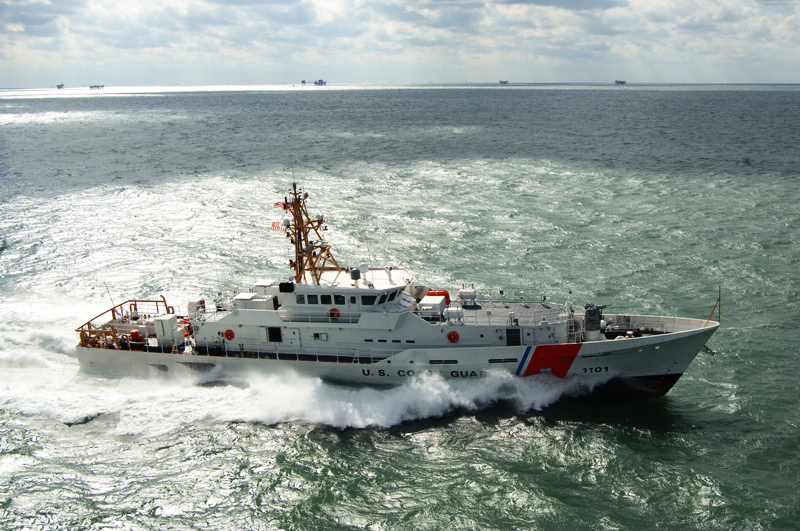
 Below is a news release from CG News. We knew this was coming. There are only three WPB110s left in the USCG, all in Alaska. Presumably, this will be their last year.
What I found most interesting here was this statement, “… they will operate throughout the 17th Coast Guard District to include the U.S. Arctic, Gulf of Alaska, and Bering Sea.”
We have already seen Alaska based FRCs operating in the Aleutians. The US considers the Bering Sea as part of the Arctic, though it is below the Arctic Circle, so it may not mean they will operate North of the Bering Strait, but that’s what it sounds like.
Earlier story about Captain Witherspoon here.

The crew of U.S. Coast Guard Cutter John Witherspoon (WPC 1158) arrives to their homeport in Kodiak, Alaska, aboard their cutter for the first time, Jan. 28, 2025. (U.S. Coast Guard photo by Petty Officer 1st Class Shannon Kearney)
First of 3 new Coast Guard cutters arrives to homeport in Kodiak, Alaska
D17 Public Affairs
KODIAK, Alaska — The crew of Coast Guard Cutter John Witherspoon (WPC 1158) arrived at the cutter’s new homeport in Kodiak, Tuesday.
The cutter is scheduled to be commissioned during a ceremony in April.
The Witherspoon is the first of three Fast Response Cutters (FRCs) scheduled to be homeported at Coast Guard Base Kodiak and is now the fourth FRC currently based in Alaska. While these ships will be homeported in Kodiak, they will operate throughout the 17th Coast Guard District to include the U.S. Arctic, Gulf of Alaska, and Bering Sea.
The crew of the Witherspoon will carry out integral Coast Guard missions such as maritime law enforcement and security, living marine resources, and search and rescue. They will provide security for Alaskan coastal communities as they continue to utilize the ocean for their livelihoods while preserving Alaska’s living marine resources in conjunction with our partner agencies.
“The crew is humbled to be associated to a namesake honoring Capt. John G. Witherspoon, a trailblazer who found enjoyment and purpose in leading and mentoring others,” said Lt. Cmdr. Adam Young, commanding officer of the Witherspoon. “It is fitting that the cutter’s first sail was no tall order, stretching more than 7,000 nautical miles from Key West to Kodiak. Throughout the last five months, the crew displayed remarkable teamwork and resilience, a true testament to the core values Capt. Witherspoon epitomized throughout his illustrious career. I couldn’t be prouder of the team we have onboard, and I look forward to experiencing the beauty of Alaska once again.”
The new FRCs arriving in Alaska are designed to replace the service’s fleet of 110-foot cutters that are projected to be decommissioned this year. The Coast Guard is currently scheduled to have six FRCs operating throughout Alaska by the end of 2025 to reinforce our maritime boundaries and shorten on-scene response times to support search and rescue efforts and better serve the people of Alaska.
FRCs feature advanced command, control, communications, computers, intelligence, surveillance and reconnaissance equipment as well as over-the-horizon response boat deployment capability and improved habitability for the crew. The ships can reach speeds of 28 knots and are equipped to coordinate operations with partner agencies and long-range Coast Guard assets such as the Coast Guard’s National Security Cutters.
FRCs are 154-foot multi-mission ships designed to conduct drug and migrant interdictions; ports, waterways and coastal security operations; fisheries and environmental protection patrols; national defense missions; and search and rescue. Each cutter is designed for a crew of 24, has a range of 2,500 miles and is equipped for patrols up to five days. The FRCs are part of the Coast Guard’s overall fleet modernization initiative.
 Chuck Hill's CG Blog
Why only 5 day endurance? Given the distances in Alaska and other operating areas that more days endurance would be more efficient.
They’re small cutters, only 353 tons. Where would you store all the supplies (including food and fuel) needed to increase their endurance from 5 days to, say, 30 days? That said, some have gone on trips considerably longer than 5 days, even crossing the Pacific Ocean, but only when escorted by another Coast Guard cutter as a tender to resupply them with food and fuel.
Five days is still the official endurance, but they have been stretching that. Getting to Dutch Harbor would not be too difficult if the weather cooperates. From there they could make it to Nome.
Since they are small, they can go just about anywhere a fishing boat can go and they can take shelter where larger cutters cannot.
Still, you can’t be stupid. Have to watch the weather and plan ahead.
I was not thinking of 30 days but something over 5 days, with 5 days you could spend 1 day getting to the patrol area and be limited to only 3 days patrol time then a day to return for supplies. Here in Puget Sound (the Pacific Northwest, Seattle, the 87’s need to fuel every 3 days I think since a few years ago one of them had an emergency call but had to divert for fuel before they could answer the distress call.
Yes Chuck watching the weather and conditions is always prudent. I have worked in Alaska and one time a storm came in and everyone went to shelter, some of the smaller boats started to drag anchors, after some back and forth on the radio with the larger seiners about the wind speed, end was nobody knew what the wind speed was since the seiner’s wind speed only went to 99 knots and it had not been down off the peg in over an hour!
@Captain Mike, I am sure that they are going more than 5 days between replenishments in the Western Pacific and the long transits to station. It did seem they were making use of lockers added on the deck forward of the bridge.
One of the initial problems was limited laundry facilities, but that problem has been addressed by an improved laundry arrangement.
They have also been adding spare berths.
Not that you want to run the fuel down to zero but 2500 miles at 14 knots is about sevexn and a half days, and they probably spend some time at lower speeds and even that probably includes a buffer. Originally the reported range was 2950 nautical miles.
If they are doing SAR or fishery inspections on fishing vessels they can operated out of the same ports the fishing vessels do. Will probably be doing some safety inspections in port too.
A new article in The Maritime Executive on Wednesday 1/29/25:
Trump: U.S. Will Order 40 Big Icebreakers for the Coast Guard
“We ordered — we’re going to order about 40 Coast Guard big icebreakers. Big ones,” Trump said last week.
https://maritime-executive.com/article/trump-u-s-will-order-40-big-icebreakers-for-the-coast-guard
(By “big ones,” the stable genius presumably means “heavy icebreakers.” But 40 is absolutely impossible, LOL. It’s either the deranged delusion of a demented dotard, or yet another whopper of a lie to claim “We ordered… 40 Coast Guard big icebreakers.”
At the current build rate of one icebreaker every 10 years, it would take 400 years to build 40 icebreakers, and at $1 billion per ship, 40 ships would be about three time the entire Coast Guard budget. And who is going to man those icebreakers? We barely have enough certified ice captains for the current Coast Guard fleet of two and a half icebreakers! I’m counting the Alviq, soon to be the USCGC Storis, as only half an icebreaker, as it’s just beginning the process of conversion for Coast Guard use, and it’s a flawed design even for its original purpose as an anchor-handling tug, until recently described by the Coast guard as “totally unsuitable” for use as a Coast Guard icebreaker.)
Ships could be built quicker using more than one yard – but I think we would have a yard capacity issue, even going overseas I suspect would be an issue for this many ships.
Ignore the ice captain issue, where would we get the regular skilled crew? A large increase in people and budget for an organization that is under funded.
I suspect that someone was told that Russia had more icebreakers than we do and that our fleet is not great, probable a late night joke by a staffer just to see the reaction. Maybe someone should ask the White House about this
You should read “Art of the Deal”. It is all about negotiations and we actually buy more Icebreakers like the Cutter Storis in the short term as we wait in INTERMINABLE time for the Polar Security Cutter to actually be built. If they ever get one built they should not stop until they have build at least six (6).
Obviously we are not going to order 40 new large icebreakers, at least not during this presidential term.
I’m wondering if EO/IR equipment is on board, and if they are slated for the RADA upgrade to their radar system.