

Based on the Coast Guard Historian’s timeline, https://www.history.uscg.mil/research/chronology/
With inspiration from Mike Kelso
February 1
 |
1871 Using his administrative authority, Secretary of the Treasury George S. Boutwell re-established a Revenue Marine Bureau within the Department and assigned Sumner I. Kimball as the civilian Chief. (He was 36 at the time.) Kimball’s duties included administering both the revenue cutters, which were then under the control of the local Collectors, and the life-saving stations.

Sumner Increase Kimball, organizer of the United States Life-Saving Service and the General Superintendent of the Life-Saving Service from 1878–1915.1913, American magazine, Volume 150
1938 The Lighthouse Service Radio Laboratory was moved from the shops of the lighthouse depot in Detroit, Michigan, “to the Lazaretto Lighthouse Depot in Baltimore, Md., where a building had been constructed providing more adequately for this important branch of the work of the Service.”
1942 Enlistees after this date were restricted to enlistment in the Coast Guard Reserve. This was done to prevent having too many regulars in the service at the end of World War II.
1944 Coast Guardsmen participated in the invasion of Namur Island, Kwajalein Atoll.
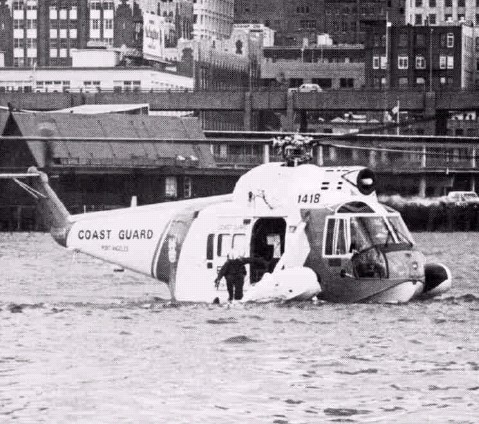
1963 The Coast Guard’s “newest” helicopter, the Sikorsky HH-52, performed its first rescue. On February1, 1963, the F/V Enterprize sank after colliding with ice off Hyannis, Massachusetts. The two crewman of the vessel abandoned and sought safety on the ice. After a 63-mile flight, 56 of which were over water at night, the aircraft commander, LT R. A. Johannsen, landed the HH-52A (CG-1352) on the ice and made the rescue.
 Chuck Hill's CG Blog