

Based on the Coast Guard Historian’s timeline, https://www.history.uscg.mil/research/chronology/
With inspiration from Mike Kelso
February 20
1845 President John Tyler vetoed a bill providing that no cutter be built nor purchased unless an appropriation was first made by law, on grounds that sanctity of contract of those already contracted for should not be overridden by Congress. Congress overrode his veto on March 3, 1845.

The U.S. Coast Guard Cutter USCGC Coos Bay (WAVP-376). Originally USS Coos Bay (AVP-25) was a Barnegat-class small seaplane tender commissioned by the U.S. Navy for use in the Second World War. From 1949 to 1966 she was loaned to the U.S. Coast Guard, first designated WAVP-376, later WHEC-376. After her return to the Navy, the Coos Bay was struck from the Naval Register and on 9 January 1968 she was expended as target by the guided missile destroyer USS Claude V. Ricketts (DDG-5), and 35 aircraft, 200 km (120 mi) off the coast of Virginia (USA). (The 40mm and boats suggest this is early in Coos Bay’s Coast Guard service.–Chuck)
1964 CGC Coos Bay rescued 11 of the crew of the foundering British freighter Ambassador in heavy seas, 1,000 miles east of Boston. Coast Guard aircraft from Air Station Argentia, Newfoundland, were first on the scene after the freighter issued an SOS on February 18th. The Coos Bay, on Ocean Station patrol 350 miles distant, steamed to the area and arrived there 24 hours later. In concert with the Norwegian freighter Fruen, they managed to get lines aboard the wallowing Ambassador in what was called one of the most dramatic rescues of the year. Demonstrating outstanding seamanship during the rescue, the cutter’s commanding officer, Commander Claude W. Bailey, was awarded the Legion of Merit. Many of his crew had volunteered to enter the frigid water to assist in the rescue as well. Two were awarded the Coast Guard Medal while seven others received the Coast Guard Commendation Medal.
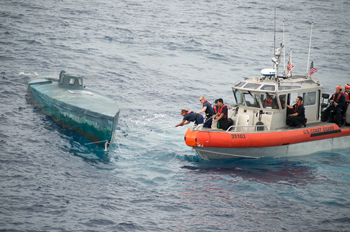
A team aboard Coast Guard Cutter Stratton’s long range interceptor-II cutter boat participates in the interdiction of a self-propelled semi-submersible vessel in the Eastern Pacific Ocean July 18, 2015. U.S. Coast Guard photo by Petty Officer 2nd Class LaNola Stone.
2013 The first LRI-II was delivered by MetalCraft Marine U.S. to the Coast Guard on this date and commenced testing activities soon after. The LRI-II, which were built to be deployed on the National Security Cutter fleet, was 35 feet long with a range of over 220 nautical miles and was capable of achieving speeds in excess of 38 knots. “The stern-launched LRI-II’s high speed and extended range significantly enhanced its host cutter’s ability to execute missions while underway, particularly in migrant interdiction and law enforcement operations where teams need to be put on scene quickly. Its ability to extend the reach of its host cutter is also critical to search and rescue operations, enabling NSC cutter crews to patrol larger search areas. The LRI-II can carry up to 15 passengers, including crew, and safely operate in seas up to 13 feet.”
 Chuck Hill's CG Blog