

Based on the Coast Guard Historian’s timeline, https://www.history.uscg.mil/research/chronology/
With inspiration from Mike Kelso
March 1
1876 Nuova Ottavia, an Italian vessel, grounded near the Jones Hill North Carolina Life-Saving Station. The rescue attempt by the crew of that station resulted in the loss of seven surfmen, the first deaths in the line of duty since the service began using paid crews in 1870. Among the dead was African-American Surfman Jeremiah Munden, the first African-American surfman to die in the line of duty.
1902 The first regular light stations in Alaska were established at Southeast Five Finger Island and at Sentinel Island. Both were on the main inside passage between Wrangell Strait and Skagway.

1927 The U.S. Lighthouse Service put into effect a system of broadcasting radio weather reports by four lightships stationed along the Pacific Coast.
1933 In the interest of administrative economy and efficiency, the 13th and 14th Lighthouse Districts were consolidated with the 15th Lighthouse District. Also, the aids to navigation on the entire Mississippi River system were placed in charge of a civilian lighthouse engineer as superintendent. This relieved the Army engineers detailed for that duty. The offices at Rock Island, Illinois and Cincinnati, Ohio were discontinued, and all the river work was placed under a single office at St. Louis, Missouri.
1975 The Coast Guard issued regulations that became effective on March 1, 1975 that required an emergency position indicating radio beacon (EPIRB) on small passenger vessels engaged in ocean and coastwise service.
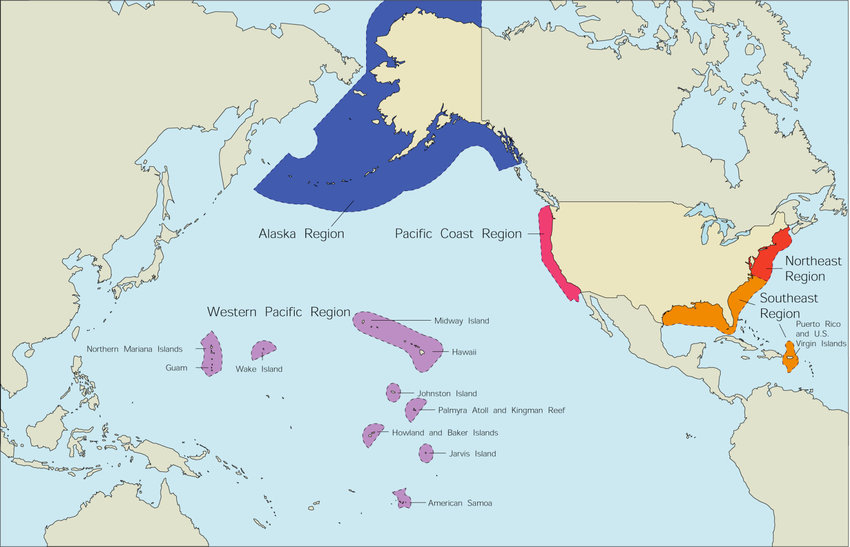
1977 The Coast Guard began enforcement of the Fishery Conservation and Management Act with 19 cutters and 17 aircraft patrolling within the 200-mile Fishery Conservation Zone.
2003 Administrative control of the Coast Guard transferred to the newly created Department of Homeland Security from the Department of Transportation, where it had served since April 1, 1967.

Courtesy Photo | USCGC Escanaba (WMEC 907) and USCGC Richard Snyder (WPC 1127) practice maneuvering with the Royal Canadian Navy’s HMCS Goose Bay (MM 707) in the Davis Strait on Aug. 13, 2021. In Operation Nanook, the U.S. Coast Guard seeks to work collaboratively with other international partners to enhance collective abilities to respond to safety and security issues in the High North through the air and maritime presence activities, maritime domain defense, and security exercises. (Photo courtesy Royal Canadian Navy)
2015 Her Majesty’s Canadian Ships Goose Bay and Shawinigan, in collaboration with the U.S. Navy and in support of the U.S. Coast Guard, assisted in seizing more than 1000 kg of cocaine while patrolling in the Caribbean Sea, as part of Operation CARIBBE. Following the initial search of a suspect vessel by a boarding team from USS Kauffman, HMCS Goose Bay was tasked to conduct an additional inspection. A subsequent boarding and search of the suspect vessel by the USCG LEDET embarked with HMCS Goose Bay, supported by HMCS Shawinigan, resulted in the seizure of 1017 kg of cocaine.

Coast Guard Cutter Alex Haley (WMEC 39) transits inbound Dutch Harbor while on patrol in the Gulf of Alaska. As the only major cutter homeported in Alaska, Alex Haley’s primary missions are search and rescue, international/domestic fisheries enforcement, and homeland defense. (U.S. Coast Guard Photo by Lt. j.g. John Walsh)
2015 CGC Alex Haley returned to Kodiak, Alaska, following a successful 70-day deployment patrolling more than 10,800 miles throughout the Bering Sea and Aleutian Islands. Alex Haley, the “Bulldog of the Bering,” departed Kodiak on December 1, 2014 and spent 70 days conducting law enforcement and community outreach operations in the Bering Sea and Aleutian Islands. During the deployment, Alex Haley’s crew performed 41 at sea domestic fisheries enforcement boardings and covered more than 5,000 square miles in search efforts for the sunken Korean fishing vessel 501 Oryong.

SAN FRANCISCO. The Coast Guard Cutter Waesche transits through the San Francisco Bay for the first time en route to its homeport of Alameda, Calif., Feb. 28, 2010. The Waeshe is the second Legend Class Cutter and is scheduled to be commissioned in May.(U.S. Coast Guard photo by Petty Officer 3rd Class Kevin Metcalf)
2015 CGC Waesche returned to homeport at Coast Guard Island in Alameda following a 79-day, 13,000 nautical-mile patrol in the Eastern Pacific Ocean. Since its departure on December 12, 2014, Waesche patrolled international waters off the coast of Central America, disrupting Transnational Organized Crime networks through joint inter-agency counter-drug operations, seizing nearly 1,400 lbs of cocaine with an estimated value of more than $22 million. During the last four weeks of its deployment, crewmembers aboard Waesche spent time off the coast of San Diego completing rigorous proficiency exercises geared toward sharpening the unit’s readiness to conduct the many operations that are vital to the Coast Guard’s military, homeland defense, and law enforcement missions. Many of these exercises included helicopter operations, gunnery, shipboard firefighting and damage control, and medical training. Additionally, they practiced national defense scenarios to ensure seamless integration with partners from the Department of Defense.
 Chuck Hill's CG Blog