

Based on the Coast Guard Historian’s timeline, https://www.history.uscg.mil/research/chronology/
With inspiration from Mike Kelso
March 29
1867 The lighthouse at Timbalier Bay was destroyed in a hurricane. The brick tower “was leveled to the ground and covered with from three to six feet of water.” The Lighthouse Board commended the keepers, “who faithfully performed their duty, barely escaping with their lives, and living for some days in an iron can buoy . . .”

Members of the Overland Relief Expedition
1898 Lieutenants David Jarvis and Ellsworth P. Bertholf and Surgeon Dr. Samuel J. Call of the Revenue cutter Bear reached Point Barrow, Alaska, after a 2,000 mile “mush” from Nunavik Island that first started on December 17, 1897, driving reindeer as food for 97 starving whalers caught in the Arctic ice. This Overland Rescue was heralded by the press and at the request of President William McKinley, Congress issued special gold medals in their honor.
1938 By an Executive Order of this date, President Franklin Roosevelt enlarged substantially the number of “personnel in the Lighthouse Service who are subject to the principle of the civil service,” which allowed advancement in the Service based solely on individual merit.
1984 Coast Guard AIRSTA Cape May and Group Cape May responded to severe flooding in southern New Jersey and Delaware after a late winter storm struck the area on March 29, 1984. Coast Guardsmen evacuated 149 civilians from Cape May and Atlantic City.

1985 The last lightship in service with the Coast Guard, CGC Nantucket I, was decommissioned, thus ending 164 years of continuous lightship service by the U.S. Government. Nantucket I was the last of the U.S. lightships and the last of the Nantucket Shoals lightships that watched over that specific area since June of 1854. Launched as WLV-612 in 1950 at Baltimore, the ship also stood watch as the light vessel for San Francisco and Blunts Reef in California, at Portland, Oregon, and finally at Nantucket Shoals. Nantucket I also spent time in service as a “less-than-speedy” law enforcement vessel off Florida.
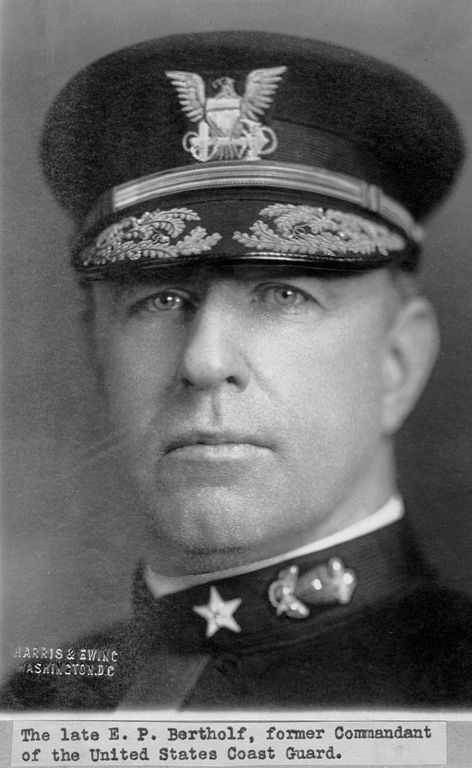
Photograph of Ellsworth P. Bertholf, Commandant of the U.S. Revenue Cutter Service from 1911 to 1915 and Commandant of the U.S. Coast Guard from 1915 to 1919. Coast Guard photo.
2005 The keel was laid for the first of the new 418-foot National Security Cutters, CGC Bertholf (WMSL-750), named for Commodore Ellsworth Bertholf, former commandant of the U.S. Coast Guard. Bertholf was constructed at Northrop Grumman Ship Systems in Pascagoula, Mississippi. The cutter was christened on November 11, 2006 after being launched on September 29, 2006. The Coast Guard commissioned Bertholf on August 4, 2008.
March 30
1867 The United States signed the Alaska purchase treaty with Russia.

Admiral Russell R. Waesche, Sr., USCG Commandant 1936 to 1945
1942 By Presidential proclamation, the Coast Guard was designated as a service of the Navy to be administered by the Commandant of Coast Guard under the direction of the Secretary of the Navy, similar to the administration of the Marine Corps.
As Commandant from 1936 through 1945 Waesche insured the successful integration of the U.S. Lighthouse Service, a purely civilian agency, with the Coast Guard in 1939 as ordered by President Franklin Roosevelt. He also presided over the greatest expansion of the USCG in its history and made sure the service maintained its separate identity while it was under the administrative control of the U.S. Navy. Admiral Waesche saw his small peacetime fleet swell with Coast Guardsmen manning more than 750 cutters, 3,500 miscellaneous smaller craft, 290 Navy vessels, and 255 Army vessels. The Coast Guard participated in every major amphibious operation. Furthermore, activities at all Coast Guard air stations were increased as aviators engaged in anti-submarine and convoy escort operations and performed numerous search and rescue missions. In 1943 Waesche also secured Congressional support for the Coast Guard’s return to the control of the Treasury Department as quickly as possible after the end of the Second World War. In doing this, the service avoided the problems that occurred after the end of the First World War when the Navy attempted to maintain its control of the Coast Guard.
Admiral Waesche earned praise from the Secretary of the Navy for his stewardship of the Coast Guard during the Second World War.
After the longest tenure as Commandant, Admiral Waesche retired from the Coast Guard effective 1 January 1946. He died later that year on 17 October 1946 and was buried at Arlington National Cemetery on 21 October. Two weeks after he retired Navy Secretary James Forrestal decorated Admiral Waesche with the Distinguished Service Medal for “exceptionally meritorious service to the government of the United States in a duty of great responsibility as Commandant, United States Coast Guard.”
In March 1946 President Harry S. Truman nominated the ten top U.S. wartime generals and admirals to retain permanently their wartime ranks. At the same time the President announced the formation of an “elder statesmen’s organization” for national defense consisting of those ten officers. Admiral Waesche was one of those officers so-designated.
Though largely responsible for the efficient expansion of the service, Admiral Waesche also improved the traditional functions of the Coast Guard. The activities on the Great Lakes and the inland waterways were extended and intensified. His administration placed increased emphasis on maritime safety, icebreaking, and aids to navigation. As Commandant he also took a keen interest in the work in the field and frequently made personal inspections of district units and activities. In short his tenure as Commandant was one of the most successful in the service’s distinguished history.
Admiral Waesche received an honorary degree as Doctor of Engineering from Purdue University in February, 1944. He was elected President of the Society of American Military Engineers in May, 1944. He was survived by his wife, Agnes R. Cronin, and four sons, three of whom entered military service. His oldest son, Russell Randolph Waesche, Jr., later retired from the Coast Guard as a flag officer.
 Chuck Hill's CG Blog