
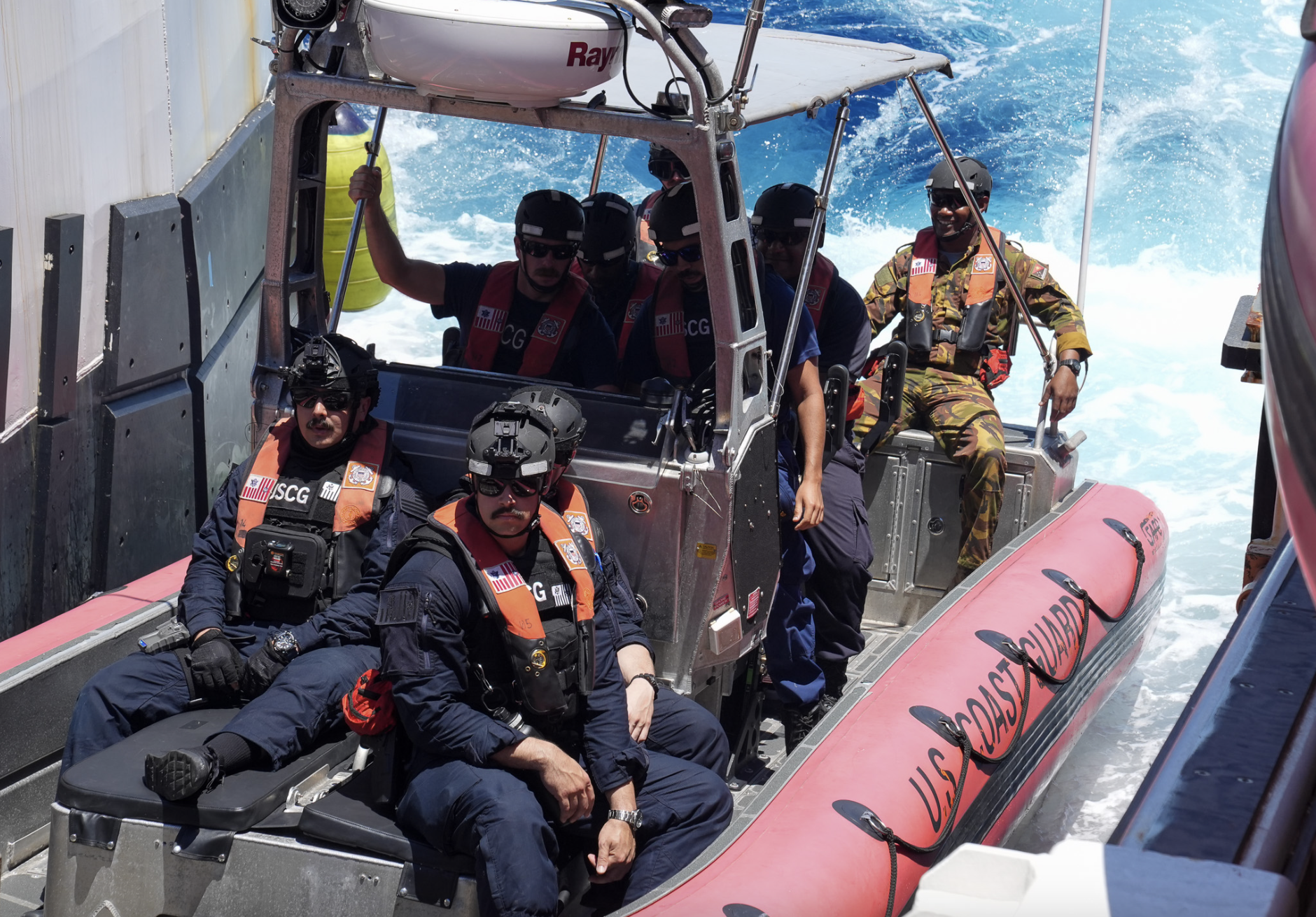
Coast Guard Cutter Midgett’s (WMSL 757) law enforcement team and Papua New Guinea shipriders return after a boarding in Papua New Guinea’s exclusive economic zone, Mar. 11, 2025. Papua New Guinea lies in the heart of key shipping routes and lucrative fisheries. The U.S. Coast Guard and Papua New Guinea collaborate to mitigate shared maritime challenges and threats, promoting regional security and stability within Oceania. (U.S. Coast Guard photo by Petty Officer 3rd Class Jennifer Nilson)
Below is a news release from US Coast Guard News.
U.S. Coast Guard cutter promotes regional security in the Pacific with Papua New Guinea
RABAUL, Papua New Guinea – The U.S. Coast Guard Cutter Midgett (WMSL 757) recently concluded its second port call in Papua New Guinea (PNG), following nine days of shiprider operations with representatives from the PNG Defence Force, PNG Customs Service, and PNG National Fisheries Authority.
Midgett was invited by the Papua New Guinea government to participate in the operation. The PNG shipriders led the mission by selecting vessels of interests and conducting boardings while the U.S. Coast Guard provided ship based and shoreside support. The successful shiprider operations reinforced the importance of deepening and expanding strong bilateral relationships.
During the nine-day operation, Midgett facilitated six at-sea inspections within the PNG Exclusive Economic Zone (EEZ) under the PNG-U.S. bilateral agreement. The U.S Coast Guard and PNG’s bilateral maritime law enforcement agreements enhance PNG sovereignty with the capacity to enforce PNG’s maritime laws through shared information exchanges and joint patrols that deter illegal activities and malign behavior in PNG’s EEZ.
While in Rabaul, Midgett hosted a key leadership engagement with the East New Britain Governor, Michael Marum, and PNG fisheries stakeholders. During the engagement, members of Midgett and PNG representatives participated in roundtable discussions focused on PNG-U.S. bilateral agreements and security within the PNG EEZ and received a tour of the cutter.
Midgett crewmembers visited a local school to participate in sports and seamanship activities. Midgett also hosted students on board, allowing students to learn about shipboard life and participated in firefighting training.
Commissioned in 2019 and homeported in Honolulu, Midgett is the eighth Legend-class National Security Cutter. At 418-feet, these cutters are the largest and most capable in the U.S. Coast Guard fleet. Equipped with advanced technology, they are ideally suited to support a wide range of missions, including maritime security, law enforcement, and search and rescue operations.
 Chuck Hill's CG Blog
That’s call Diplomacy and something the USCG is good at and excels in. The USCG is good at using Soft power to affect change in the region.
“USCG style diplomacy” typically refers to the approach to diplomacy used by the United States Coast Guard (USCG), often in maritime or international contexts, particularly in regions where the Coast Guard plays a significant role in security, humanitarian efforts, or law enforcement.
The USCG is unique among military branches in that it has a mission set that blends traditional defense roles with civilian law enforcement and humanitarian assistance, making its style of diplomacy somewhat distinct. USCG style diplomacy often involves:
In essence, “USCG style diplomacy” is marked by a blend of practical cooperation, humanitarian work, and the promotion of the rule of law on the seas, which strengthens both national and international security and partnerships.
Paging Chuck Hill, You wanted in the CIC;
BREAKING: Trump, Finnish President Alexander Stubb discuss purchase of icebreakers
https://thepostmillennial.com/breaking-trump-finnish-president-alexander-stubb-discuss-purchase-of-icebreakers-for-ships?utm_campaign=64494