
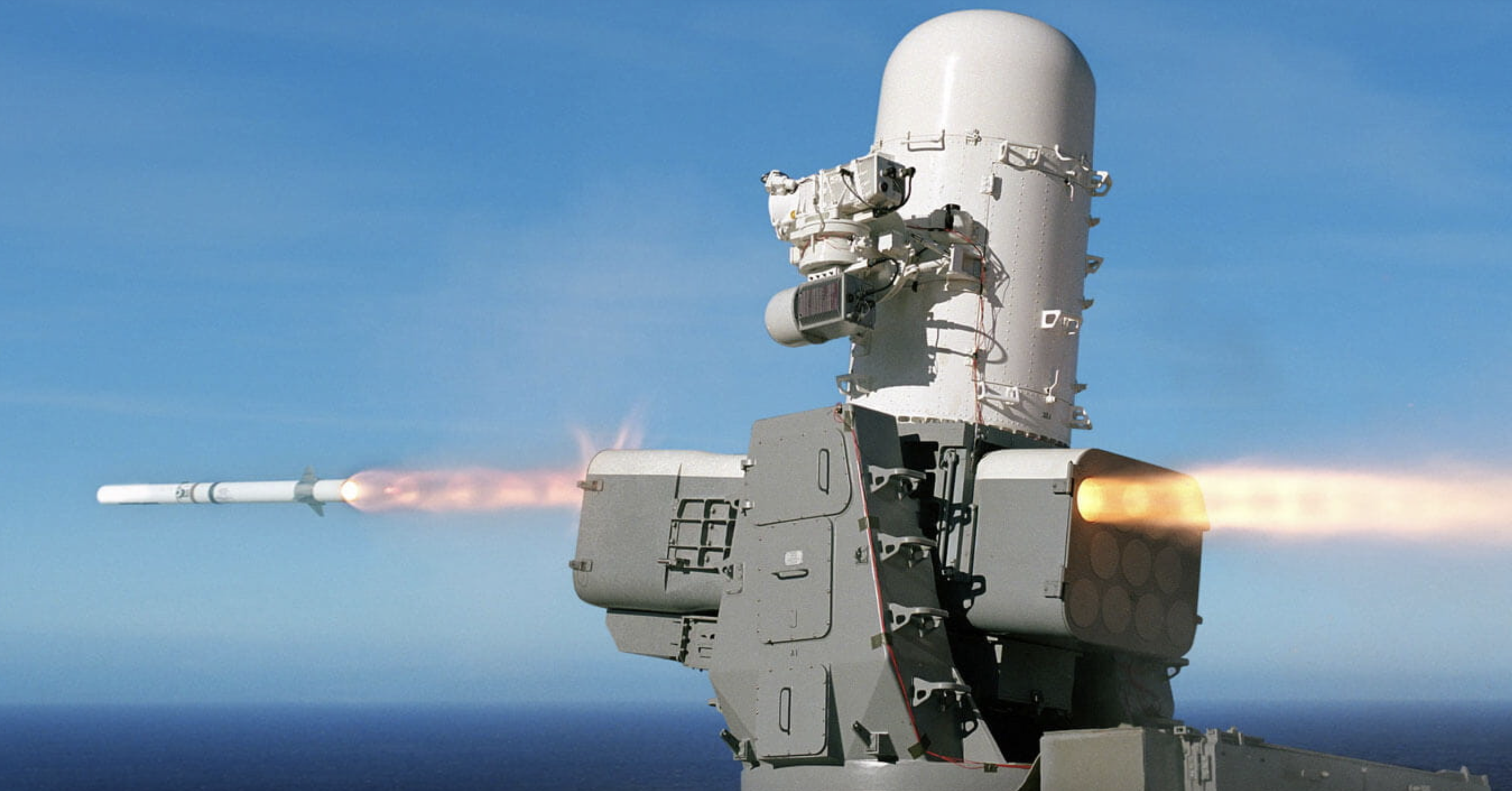
SeaRAM
The U.S. Navy plans to add RIM-116 Rolling Airframe Missiles(RAM) to the arsenals of its Arleigh Burke class destroyers to boost their defenses against incoming cruise missiles, drones, and other air and surface threats. RAM launchers will take the place of existing 20mm Vulcan cannon-armed Mk 15 Phalanx Close-in Weapon Systems (CIWS), but the exact final configuration will differ depending on the sub-class of ship.
Replacing the Phalanx with SeaRAM on National Security Cutters would be a major improvement in their ability to survive an air attack. It has much greater range and greater ability to deal with multiple targets, as well as much better anti-surface capabilities, than the Phalanx which has an absolute max range of about three miles and an effective range of about one mile.
The SeaRAM combines the radar and electro-optical system of the Phalanx CIWS Mk-15 Block 1B (CRDC) with an 11-cell RAM launcher to produce an autonomous system—one which does not need any external information to engage threats. Like the Phalanx, SeaRAM can be fitted to any class of ship. Due to the common mounting, SeaRAM inherits the relatively easy installation characteristics of its gun-based sibling, with Raytheon stating that SeaRAM “fits the exact shipboard installation footprint of the Phalanx, uses the same power and requires minimal shipboard modification”. In 2008, the first SeaRAM system was delivered to be installed on USS Independence.
The Missile:
RAM or Rolling Airframe Missile, RIM-116, is a relatively small, relatively cheap, quite mature weapon system having its Initial Operational Capability in 1992. Fitting SeaRAM would bring the NSC’s weapons fit more in line with that of the LCSs which are also fitted with the 57mm Mk110 and RAM. RAM is currently fitted on virtually every US Navy surface combatants other than cruisers which will soon be decommissioned and the destroyers that will be getting the system.
Anti-Surface Capability:
RAM would also provide an enhanced anti-surface capability. SeaRAM would be an excellent complement to the 57mm Mk 110. The 57mm has a greater maximum range than the RAM, but effective ranges are similar, at five to six miles. SeaRAM has only eleven rounds immediately available, but it’s combination of high hit probability, Mach 2+ speed, 164 pound mass, and a 1.3 kg (24 lb 15 oz) warhead means it can inflict significant damage quickly.
(Eleven rounds times 164 pounds equals 1804 pounds. That mass is equal to 340 rounds of 57mm HE and the RAM probably has a higher hit probability.)
Why isn’t the Navy Converting all Phalanx?
The fact that the Navy is not replacing all Phalanx systems with SeaRAM might suggest they don’t believe RAM is necessary for all classes, but, actually, every US Navy combatant that has a Phalanx, also has a longer ranged missile system. If they don’t have the longer ranged Standard or ESSM missile systems, then they have RAM, many have more than one.
Hopefully all Coast Guard NSC Phalanx systems will be replaced by SeaRAM.
The Offshore Patrol Cutter:
For many potential naval missions, OPCs are interchangeable with the NSCs. They probably should be similarly equipped. If the NSCs need SeaRAM, the OPCs need it more.
 Chuck Hill's CG Blog
DEFEA 2025: RAMSYS Invests in New Missile Generation to Counter Emerging Naval Threats.
https://www.armyrecognition.com/news/navy-news/2025/defea-2025-ramsys-invests-in-new-missile-generation-to-counter-emerging-naval-threats
https://www.naval-technology.com/news/raytheon-makes-ram-launcher-landmark-with-uss-pittsburgh/?cf-view
“Raytheon has recently sought to double production capacity of the RAM GMLS system, as global demand for missile defence systems remains strong.”