
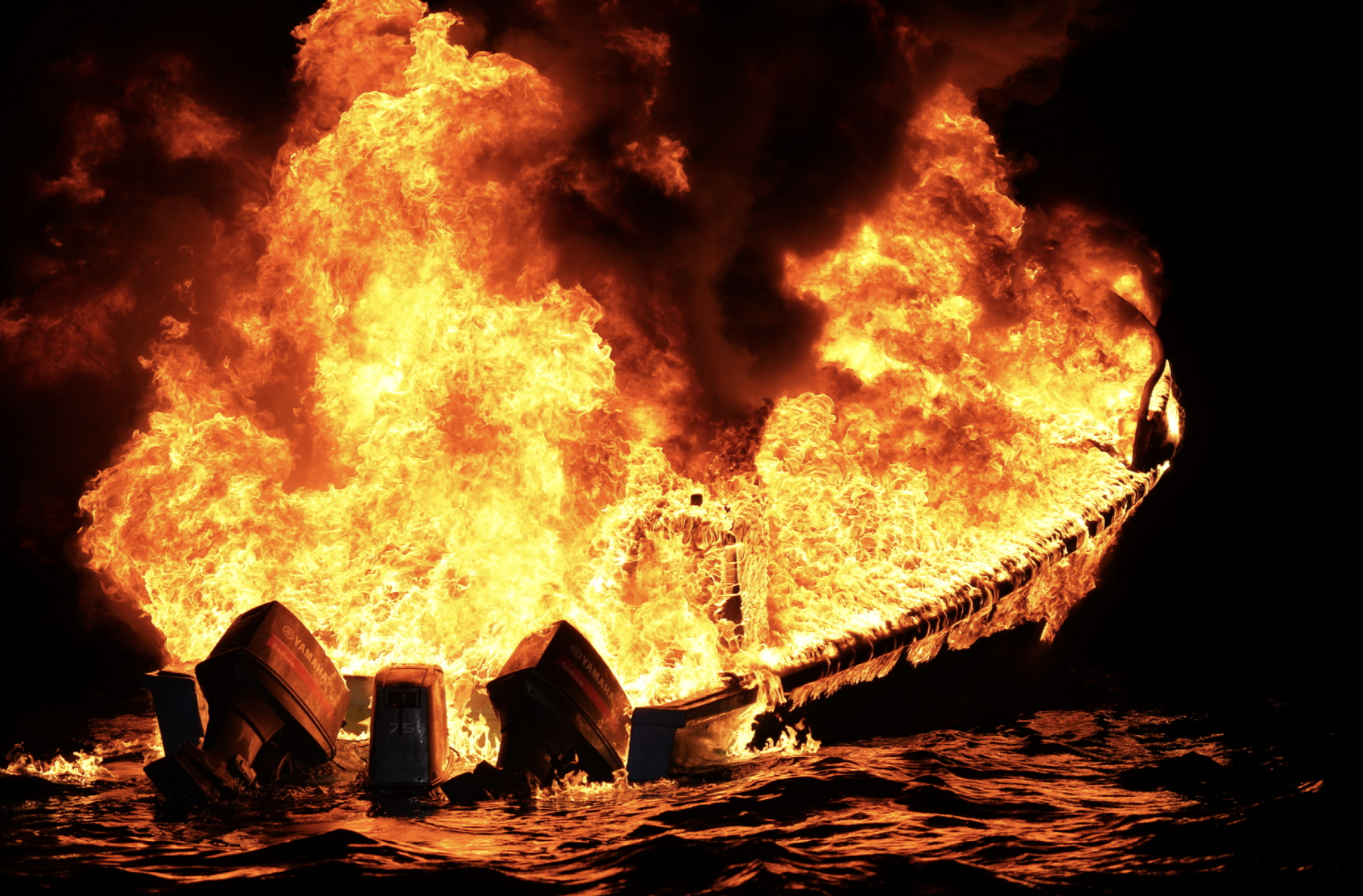
A suspected drug vessel burns in the Eastern Pacific Ocean, Feb. 1, 2025. (U.S. Coast Guard photo)
Below is a news release from District Seven. I have highlighted some parts of the news release–mention of UAS, intercept locations, and sightings of multiple suspected smuggling craft. I went back and similarly highlighted the same information in the previous USCGC Stone offload report, which I will refer back to, because it shows a similar pattern.
A few things of note:
- USCGC James, Stone, and Mohawk were all down in the Eastern Pacific drug transit zone simultaneously. All three began their patrols before the “surge.” All three are Atlantic Area ships, home-ported in Charleston and Key West. It may be counter-intuitive, but these bases are closer to the Eastern Pacific transit Zones, than any Pacific Area ports.
- This news release lists three incidents where groups of suspected smuggling craft were sighted together. The earlier news release about Stone’s highly successful patrol was the first such report I have seen. Stone managed to bag all four vessels they observed on February 19. James managed to stop three on January 6. In two other cases (Jan. 30 and Feb. 3) only one of the group was intercepted.
- In this report, UAS were mentioned as instrumental in completing the intercept in four out of eight incidents including one when James intercepted three go-fast boats. Looking back at Stone’s earlier report, UAS were mentioned as important in four of eight cases including the incident in which she intercepted four go-fast boats in 15 minutes. UAS appear to have been essential for maintaining contact with fleeing boats in those cases where multiple boats are being pursued simultaneously.
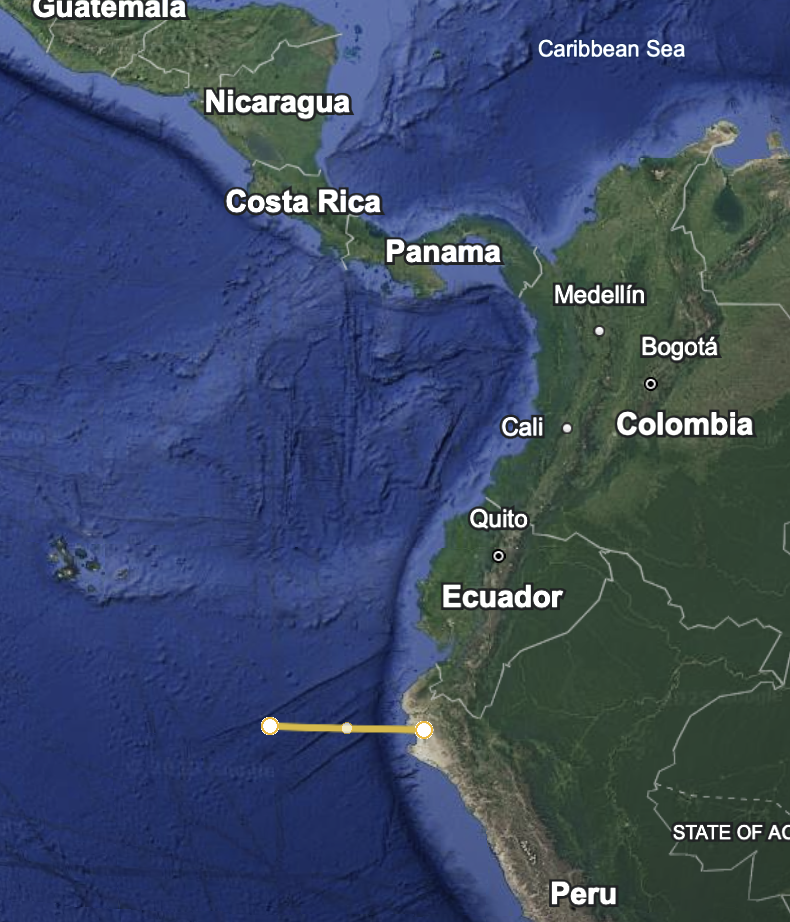
- I have been surprised in both reports by how far offshore and how far South go-fast boats are being intercepted. In this report, all James’ intercepts were more than 200 miles off shore, including a report of multiple go-fast boats 380 miles off the coast of Peru. In the USCGC Stone report, an intercept was made 715 miles from shore. The screen grab below is from Google Earth. The line extending West from Peru is 500 km in length, about 270 miles. The Galápagos Islands can be seen near the left edge. They are 900 km (486 nautical miles) West of mainland Ecuador.
Coast Guard offloads nearly $510 million in illegal narcotics interdicted in Eastern Pacific Ocean
MIAMI – The crew of U.S. Coast Guard Cutter James offloaded more than 44,550 pounds of cocaine and 3,880 pounds of marijuana valued at approximately $509.9 million in Port Everglades, Wednesday.
This patrol resulted in 11 interdictions in the Eastern Pacific Ocean and the detainment of 34 suspected drug traffickers who were transferred ashore to face federal prosecution. All of these interdictions are tied to criminal investigations by federal partners and are linked to transnational criminal and foreign terrorist organizations including the Clan del Golfo, Sinaloa Cartel, and Cartel Jalisco Nueva Generacion.
“This is a key example of the Department of Justice working with our law enforcement partners to fight crime and keep drugs from flowing into America,” said Attorney General Pamela Bondi. “Thanks to the incredible work of the Coast Guard and FBI, these drugs will help lock up criminals instead of ruining lives.”
On Jan. 5, James’ embarked unmanned aircraft system (drone) spotted a suspicious vessel approximately 260 miles off the coast of Ecuador. James’ boarding team interdicted the vessel, apprehending three suspected smugglers and seizing more than 2,025 pounds of cocaine.
On Jan. 6, a maritime patrol aircraft spotted three suspicious go-fast vessels approximately 280 miles off the coast of Ecuador. James simultaneously intercepted the three go-fast vessels, with the help from the embarked UAS and Coast Guard Helicopter Interdiction Tactical Squadron aircrew, James’ boarding teams interdicted the vessels, apprehending nine suspected drug traffickers and seizing more than 13,960 pounds of cocaine.
On Jan. 7, a maritime patrol aircraft detected a suspicious low-profile go-fast vessel approximately 330 miles off the coast of Galapagos Islands, Ecuador. James’ embarked HITRON aircrew employed airborne use of force tactics to compel the non-compliant vessel to stop, and the boarding team apprehended three suspected drug traffickers and seized over 8,240 pounds of cocaine.
On Jan. 11, a U.S. Customs and Border Protection, Air and Marine Operations aircrew detected a suspicious go-fast vessel approximately 275 miles off the coast of Ecuador. James’ boat crew and Coast Guard Cutter Stone’s embarked HITRON aircrew interdicted the go-fast vessel, apprehending three suspected drug traffickers and seizing more than 3,385 pounds of cocaine.
On Jan. 18, Coast Guard Cutter Mohawk’s crew detected a suspicious go-fast vessel, approximately 185 miles off the coast of Ecuador. After the suspected smugglers jettisoned the presumptive narcotics into the water, James’ small boat chased down the fleeing go-fast from 60 nautical miles away while Mohawk’s crew recovered the jettisoned bales. James’ boarding teams interdicted the go-fast vessel, apprehending three suspected drug traffickers and seizing approximately 5,950 pounds of cocaine.
On Jan. 30, James’ embarked UAS crew detected multiple suspicious go-fast vessels approximately 380 miles west off the coast of Peru. James’ boarding team employed surface use of force tactics to interdict the go-fast vessel, apprehending three suspected drug traffickers and seizing more than 3,870 pounds of cocaine.
On Feb 1, James’ embarked UAS crew spotted a suspicious go-fast vessel operating approximately 280 miles off Ecuador. James’ boarding team interdicted the vessel, apprehending three suspected drug traffickers and seizing more than 3,630 pounds of cocaine.
On Feb. 3, James’ embarked UAS crew detected multiple suspicious go-fast vessels operating 215 miles off Peru. James’ boarding team interdicted the vessel, apprehending three suspected drug traffickers and seizing nearly 3,490 pounds of cocaine.
On Feb. 15, a CBP-AMO aircrew spotted a suspicious go-fast vessel, operating 260 miles off Costa Rica. James’ embarked HITRON aircrew employed airborne use of force tactics to compel the non-compliant vessel to stop. James’ boarding team interdicted the vessel, apprehending four suspected drug traffickers and seizing nearly 3,880 pounds of marijuana.
“I could not be prouder of the James crew and the teams who embarked with us to stand the watch over the holidays to keep our border secure and keep Americans safe,” said Capt. Thomas Rodzewicz, commanding officer of James. “Over a remarkable 72-hour period, our crews interdicted six go-fast vessels and one low-profile vessel across the vast ocean, culminating in the extraordinary seizure of over 24,000 pounds of cocaine and 15 suspected narco-traffickers. We delivered a substantial blow to narco-terrorism organizations, sending those attempting to bring drugs to our border to face federal prosecution, halting the profits criminals use to fuel the fentanyl trade, and most importantly, preventing deadly contraband from reaching American communities and families.”
The following assets and crews assisted James in the interdiction operations:
- U.S. Coast Guard Cutter Mohawk (WMEC 913)
- U.S. Coast Guard Helicopter Interdiction Tactical Squadron (HITRON) Jacksonville
- U.S. Coast Guard Tactical Law Enforcement Team-Pacific (PAC-TACLET)
- U.S. Customs and Border Protection, Air and Marine Operations (CBP-AMO) aircrews
- Joint Interagency Task Force-South (JIATF-S)
Detecting and interdicting illicit drug traffickers on the high seas involves significant interagency and international coordination. The Joint Interagency Task Force-South, based in Key West, is responsible for detecting and monitoring the aerial and maritime movement of illegal drugs. When an interdiction is imminent, the operation transitions to the law enforcement phase, with the U.S. Coast Guard taking control for the interdiction and apprehension stages. Interdictions in the Eastern Pacific Ocean are performed by members of the U.S. Coast Guard under the authority and control of the Eleventh Coast Guard District, headquartered in Alameda, California.
The Coast Guard continues increased operations to interdict, seize and disrupt transnational shipments of cocaine, marijuana, and other bulk illicit drugs by sea. These drugs fuel and enable cartels and transnational criminal organizations to produce and traffic illegal fentanyl, posing a significant threat to the safety of the United States.
These interdictions denied criminal organizations more than half a billion dollars in illicit revenue. They provide critical testimonial and drug evidence as well as key intelligence for their total elimination. These interdictions relate to Organized Crime Drug Enforcement Task Forces (OCDETF) Panama Express Strike Force investigations in support of Operation Take Back America. OCDETF identifies, disrupts, and dismantles the highest-level criminal organizations that threaten the United States using a prosecutor-led, intelligence-driven, multi-agency approach. Additional information about the OCDETF program can be found at https://www.justice.gov/OCDETF.
USCGC James is one of four 418-foot Legend-class national security cutters homeported in Charleston, South Carolina under U.S. Coast Guard Atlantic Area Command.
For breaking news, follow us on X (formerly Twitter). For additional information, find us on Facebook and follow us on Instagram.
Make a difference on land, at sea or in the air with the Coast Guard. Visit GoCoastGuard.com to learn more about active duty and reserve, officer and enlisted opportunities. Information on how to apply to the U.S. Coast Guard Academy can be found here.
 Chuck Hill's CG Blog
Are these small craft using prevailing currents and winds? Are they meeting vessels near the Galapagos to tranship cargo to other than North America?