
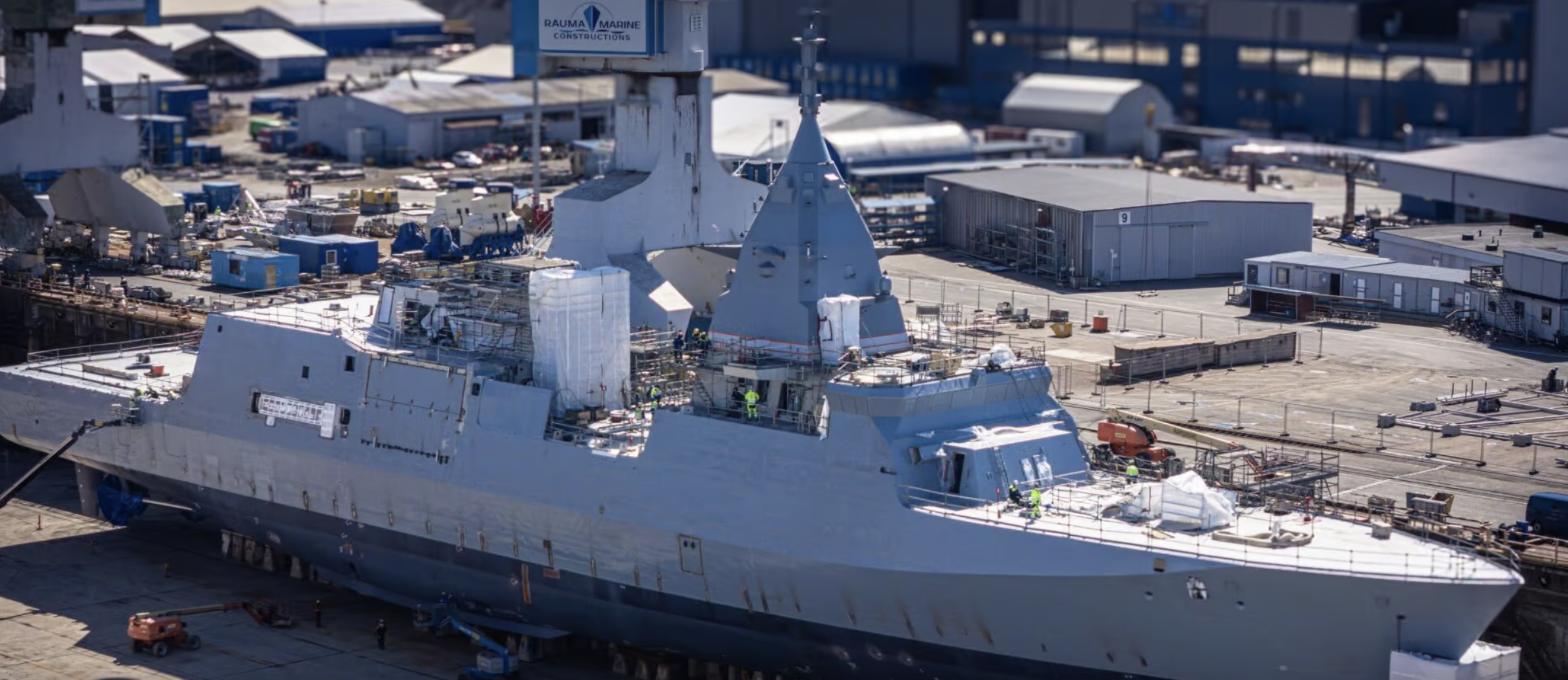
The first multi-purpose corvette built for the Finnish Navy’s Squadron 2020 project was launched at Rauma shipyard on Wednesday 21 May 2025.
A new type of ice capable combatant is emerging. There is nothing else quite like it.
While it is not an icebreaker, I don’t know of any other combatant that combines relatively high speed and robust AAW, ASW, and ASuW capability with the ability to operate in ice.
No US Navy combatants are designed to operate in areas where they might encounter ice, even if assisted by an icebreaker.
This isn’t just about hull thickness,
In addition to structural details, the Polar Class rules have requirements for machinery systems such as the main propulsion, steering gear, and systems essential for the safety of the crew and survivability of the vessel. For example, propeller-ice interaction should be taken into account in the propeller design, cooling systems and sea water inlets should be designed to work also in ice-covered waters, and the ballast tanks should be provided with effective means of preventing freezing.
What makes these really unique, and perhaps of interest to the USCG, is the Ice Class requirement which translates to non-consolidated (refrozen) ice channels with a thickness of 1.0 meter (3.3 ft) in the middle.
(“Consolidated ice: Floating ice in which the concentration is 10/10 and the floes are frozen together. Compact ice. Floating ice in which the concentration is 10/10 and no water is visible.”)
Since the Finnish-Swedish ice class 1A is considered comparable to Polar Class 7 they should also be capable of operating in thin (30 to 70 cm (0.98 to 2.30 ft)) first year ice without icebreaker assistance.
Unlike ships we have seen designed for Arctic patrol the naval warfare capabilities of these ships are not compromised by the fact that they are designed to operate in ice.
The Coast Guard is already sending National Security Cutters North of the Arctic Circle. With the possibility of fisheries extending into the Arctic, the Coast Guard will want to be able to do fisheries patrols anywhere fishing vessels may go in the US EEZ including Alaskan Arctic waters that open seasonally but where ice may be encountered.
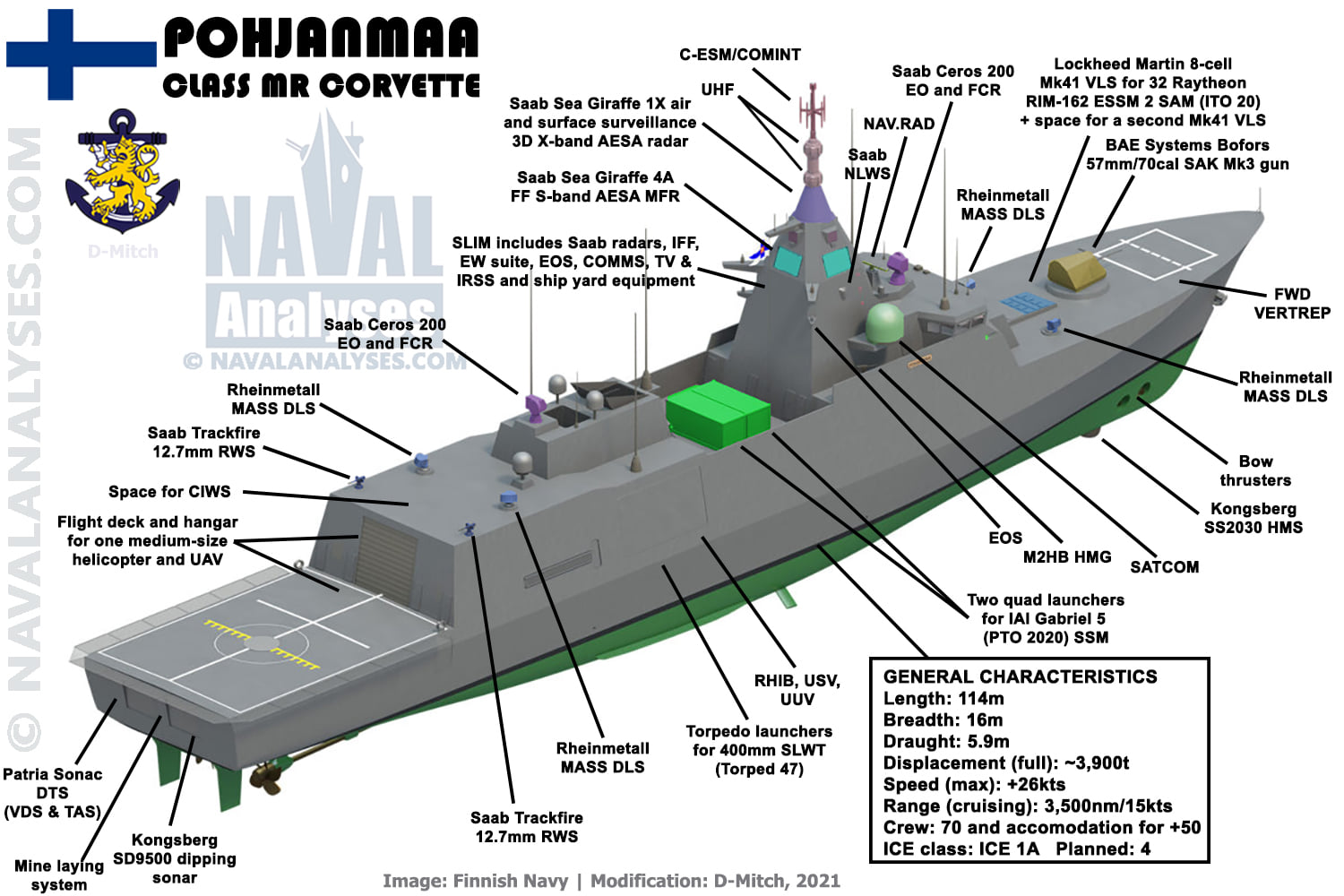
Since the graphic above, some specifications have changed.
- Displacement: 4300 tons
- Length: 117 m (384′)
- Width: 16 m (52.5′)
- Draught: 5 m (16.4′)
- Power: 29,000 kW (39,000 HP)
- Speed: 26 knots (48 km/h)
- Crew: 73
We first talked about this unique class almost ten years ago. The initial request for information went out in December 2015.
In 2017 we found out,
“…work on the propellers that was done in conjunction with the USN to make props to meet conflicting requirements…
The propellers are a minor project on their own, and are set to be of a highly advanced design. This is due to the somewhat conflicting demands of high top-speed, small diameter (due to overall draught requirement), and low noise (and high cavitation margin). All this, while at the same time being strong enough to cope with ice.”
The props are variable pitch. CODELAG (Combined Diesel Electric and Gas) propulsion includes a gas turbine for high speed and heavy ice conditions and electric motors for cruise speeds.
Our Situation:
The President has said he wants to build 40 icebreakers. While these would not be true icebreakers they can break ice.
The Icebreaker Collaboration Effort, or ICE Pact, provides a legal basis for technology transfer and collaboration in construction between Finland and the US.
The Coast Guard needs more ships capable of conducting law enforcement in the Arctic.
The Coast Guard needs more large cutters in the Pacific Area than the ten currently planned.
In the not too distant future the US may need combatants capable of fighting in Arctic or even Antarctic waters.
The US certainly would need more escort vessels to protect logistics across the vast distances of the Pacific in the event of a conflict with China.
Conclusion:
Ships like the Pohjanmaa class can meet many of the Coast Guard’s current and possible future needs.
We seem to have a confluence of political will and diplomatic possibilities that would allow the Finns to build ships for the US Coast Guard. They have a hot production line that will probably start production of the fourth and last Pohjanmaa class for the Finnish Navy in 2026.
The Coast Guard would probably want a ships with greater endurance and range but that could probably be provided by lengthening amidships.
If we could move fast enough, we might see steel cut for the first Coast Guard modified Pohjanmaa class in 2027 and delivery in 2031.
 Chuck Hill's CG Blog
These would take a bit to make an American copy for the USCG, but they seem like they might have the margin to do so for a cutter in that you could probably do with a bit less on the air search radar and the weapon suite. Curtis will tell me no, but getting the hull built in the U.S. might again open the door to a naval variant.
Would it be feasible to procure an enlarged flight II NSC that is ice capable and has adequate AAW n ASW capabilities.
“Would it be feasible to procure an enlarged flight II NSC that is ice capable and has adequate AAW n ASW capabilities.”
It would not necessarily need to be larger, but it would probably require trading off some range for a heavier hull, rerouting some water intake and discharge, and one fewer boat on the stern to make room for a towed array. There was provision for adding vertical launch ESSM in the original design and eight Mk41 VLS would probably fit.
The Finns are such recognized experts they even build them for the Russians.