
Based on the Coast Guard Historian’s timeline, https://www.history.uscg.mil/research/chronology/
With inspiration from Mike Kelso
May 28

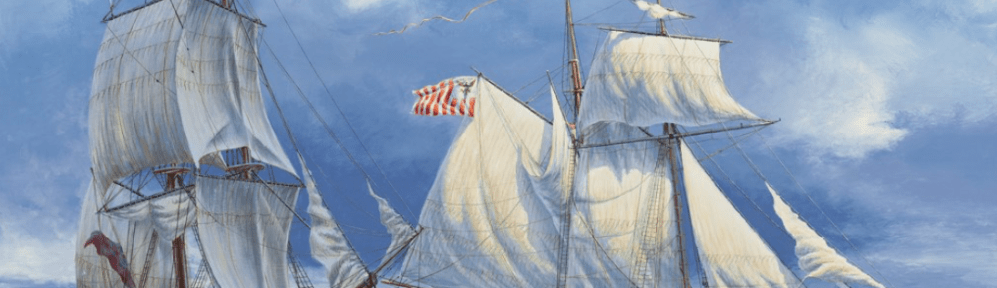
A painting by Peter Rindlisbacher of the Cutter James Madison capturing the British merchantman Shamrock. Credit: Coast Guard Collection
1813 Revenue Cutterman John Bearbere died of pneumonia while being held as a Prisoner of War by the British after his cutter, James Madison, was captured by the Royal Navy frigate HMS Barbadoes near Savannah, Georgia on November 24, 1812 during the War of 1812. He was one of five crewmen captured aboard the cutter who died in captivity. James Madison had only recently captured and seized the 300-ton, six-gun British brig Shamrock in July 1812.

USCGC Icarus (WPC-110) arriving at Charleston Navy Yard with prisoners of war from the U-boat U-352, 10 May 1942, US Navy photo
1938 CGC Icarus, patrol boats CG-176 and CG-135 as well as motor lifeboats from stations Rockaway Point and Sandy Hook responded to a distress call after the collision of two vessels, the SS Acadia and SS Mandalay, in New York Harbor. The Coast Guard vessels safely transported to New York City all 325 passengers and crew from the Mandalay which sank soon after the collision.
1947 The Coast Guard announced the disestablishment of all U.S. Coast Guard Merchant Marine Details in foreign ports. During World War II, a total of 36 foreign Merchant Marine Details had been activated for the purpose of performing “on-the-spot” services in connection with the preventive aspects of safety of life and property of the US Merchant Marine. These functions reverted to the continental U.S. ports in which there were located U.S. Marine Inspection Offices. The Merchant Marine Details disestablished were located in the following ports: Antwerp, Belgium; Bremerhaven, Germany; London, England; Cardiff, Wales; Le Havre, France; Marseille, France; Naples, Italy; Piraeus, Greece; Shanghai, China; Manila, Philippine Islands; and Trieste, Venezia Giulia.
1984 The first Marine Safety Information System (MSIS) module was deployed Coast Guard-wide. The Port Safety Module replaced the Interim MSIS system, first established when the Port and Tanker Safety Act of 1978 was passed, to provide field units with vessel histories. The replacement module was vital in the day-to-day execution of Port Safety and Marine Violation functions.
 Chuck Hill's CG Blog