
Based on the Coast Guard Historian’s timeline, https://www.history.uscg.mil/research/chronology/
With inspiration from Mike Kelso
June 17
1832 The practice of utilizing “surplus” naval officers as officers of the Revenue Marine was discontinued. Revenue officer vacancies were henceforth filled by promotion from within the service.

1910 An Act of Congress (36 Stat. L., 534) abolished the Lighthouse Board and created the Bureau of Lighthouses to have complete charge of the Lighthouse Service. This law constituted the organic act under which the Lighthouse Service operated thereafter.

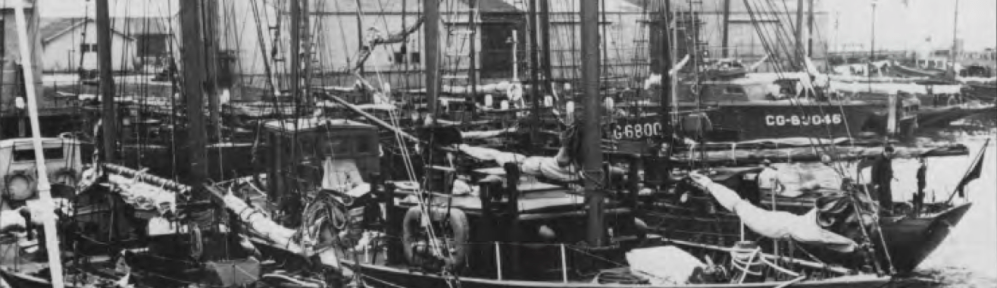
1942 The Commander-in-Chief, U.S. Fleet ordered the organization of coastal pickets to combat the “submarine menace” off the Atlantic Coast. The hodge-podge fleet of primarily small private recreational craft taken into government service under Coast Guard direction became known as the “Corsair Fleet.” This was in the response to U-boat attacks along the East and Gulf coast that began after the US entered WWII. This period was referred to by the German Navy as the “Second Happy Time.”
The Second Happy Time lasted from January 1942 to about August of that year and involved several German naval operations, including Operation Neuland. German submariners named it the “Happy Time” or the “Golden Time,” as defense measures were weak and disorganized, and the U-boats were able to inflict massive damage with little risk. During this period, Axis submarines sank 609 ships totaling 3.1 million tons, against a loss of only 22 U-boats. This led to the loss of thousands of lives, mainly those of merchant mariners. Although fewer than the losses during the 1917 campaign of the First World War, those of this period equaled roughly one quarter of all ships sunk by U-boats during the entire Second World War.
The Second Happy Time ended primarily because a coastal convoy system was instituted, but there was a rationale for the formation of the Corsair Fleet using sailing vessels. U-boats would stay submerged during the day but surface at night to hunt and recharge their batteries. Because boats under sail would make very little noise, they might escape detection by the U-boat before they surfaced. The Corsair fleet was armed with depth charges and machine guns but they were primarily expected to report sightings.
1983 National Narcotics Border Interdiction System (NNBIS) began operations under the direction of Vice President George Bush and the executive board consisting of Secretaries of State, Transportation and Defense, the Attorney General, the Counselor to the President, the Director of Central Intelligence, and the Director of the White House Drug Abuse Policy Office. “U.S. Army, Air Force, Navy, and Marine Corps airborne and seaborne craft, intelligence, technology, surveillance, and manpower now are used to augment operations by the U.S. Coast Guard, Customs Service, the Drug Enforcement Agency, Federal Bureau of Investigation, Immigration and Naturalization Service, Border Patrol, and the U.S. Attorney’s Office. The system provides a coordinated national and international interagency network for prioritizing interdiction targets, identifying resources, recommending the most effective action, and coordinating joint special actions.

2013 The Coast Guard 13th District and the Royal Canadian Mounted Police “E” Division signed a finalized agreement for the Pacific region Integrated Cross-border Maritime Law Enforcement program, known as “Shiprider,” during a ceremony at the Peace Arch Provincial Park in British Columbia, Canada. Shiprider was a program that enabled specially-trained officials from both nations to pursue or interdict suspected criminals transiting across the shared maritime border. The concept of Shiprider was first introduced in 2005. A version of the agreement proved successful during the Winter Olympic Games in Vancouver, British Columbia, in 2010.
 Chuck Hill's CG Blog