

Based on the Coast Guard Historian’s timeline, https://www.history.uscg.mil/research/chronology/
With inspiration from Mike Kelso
June 18

Crew of the Coast Guard Cutter James Rankin readies to set the Francis Scott Key buoy, June 2, 2017, where a ship carrying the author of “The Star-Spangled Banner” was anchored during the Fort McHenry bombardment in the War of 1812.
1812 The United States declared war against Great Britain.

An illustration of the Steamship Pulaski disaster, an 1838 boiler explosion. From page 170 of the 1848 book The tragedy of the seas; or, Sorrow on the ocean, lake, and river, from shipwreck, plague, fire and famine. Photo credit: Charles Ellms
1838 The steamboat Pulaski, a passenger vessel traveling between Baltimore and Charleston, suffered a boiler explosion while at sea, killing over 100 passengers and crew. This was one of three fatal steamboat boiler explosions within as many months that forced the Federal Government to begin regulating merchant steam vessels.

1878 Congress established the U.S. Life-Saving Service as a separate agency under the control of the Treasury Department (20 Stat. L., 163).
1878 The 45th Congress enacted a rider on an Army appropriations bill that became known as the Posse Comitatus Act [Chapter 263, Section 15, U.S. Statutes, Vol. 20.] This act limited military involvement in civil law enforcement leaving the Revenue Cutter Service as the only military force consistently charged with federal law enforcement on the high seas and in U.S. waters. The rider prohibited the use of the Army in domestic civilian law enforcement without Constitutional or Congressional authority. The use of the Navy was prohibited by regulation and the rider was amended in 1976 outlawing the use of the Air Force. In 1981, however, new legislation allowed the Secretary of Defense to bring Army, Navy, Air Force, and Marine Corps support to civilian authorities in intelligence, equipment, base and research facilities, and related training.

The original 1903 Scotch Cap Light, located on the SW corner of Unimak Is., Alaska . US Coast Guard photos
1903 Alaska’s first coastal lighthouse, Scotch Cap Lighthouse, was first lit. It was located near the west end of Unimak Island on the Pacific side of Unimak Pass, the main passage through the Aleutian Islands into the Bering Sea.
1930 An Act of Congress provided “for the transfer of the old lighthouse at Cape Henry, Virginia, to the Association for the Preservation of Virginia Antiquities.”
1938 The first low power, unattended “secondary” radio aid to navigation was established at St. Ignace, Michigan.
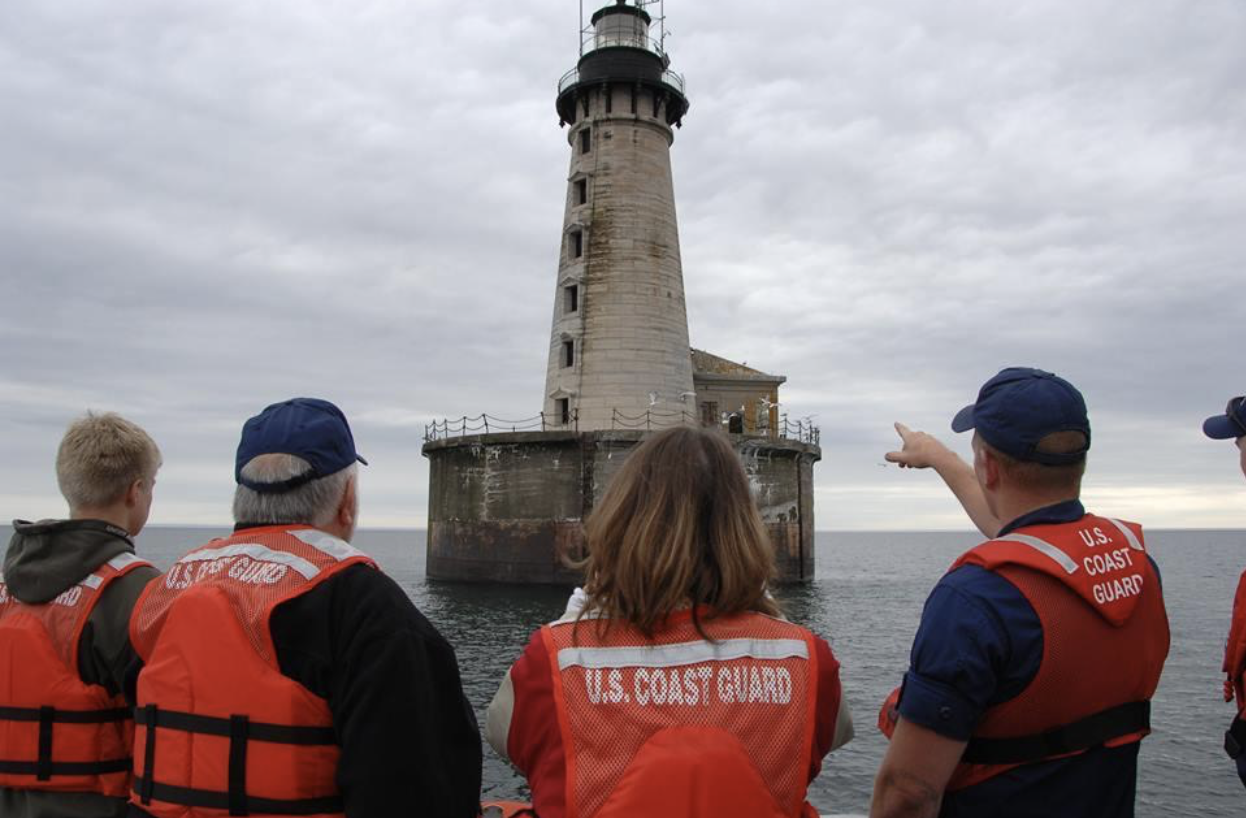
Former Coast Guard member Walter Scobie visited Stannard Rock Lighthouse in Lake Superior with family members on June 17, 2015. Scobie was stationed at the lighthouse in 1961 when an explosion killed a Coast Guardsman, damaged the inside and caused him and two others to be stranded for three days before being rescued. (Courtesy photos | U.S. Coast Guard Senior Chief Alan Haraf).
1961 An explosion in the power room of the Stannard Rock Lighthouse killed PO1c William Maxwell, one of the four Coast Guardsmen at the station at that time.

Courtesy photos | U.S. Coast Guard Senior Chief Alan Haraf

U.S. Coast Guard Cutter Forward (WMEC 911) approaches the pier, Sept. 26, in Portsmouth, Virginia. Forward completed a two-and-a-half month-long patrol in the North Atlantic Ocean to support the Coast Guard Arctic Strategy and participate in the Canadian Armed Forces-led Operation Nanook 2023, an annual military exercise conducted to strengthen shared maritime objectives in the high northern latitudes. (U.S. Coast Guard photo by Petty Officer 2nd Class Brandon Hillard)
1995 The 736-foot cruise ship Celebration suffered an engine-room fire and lost power while off the coast of San Salvador, Bahamas. CGC Forward responded and was designated as the on-scene commander. CGC Vigorous was also diverted to lend assistance. The cruise ship’s Halon system put out the fire but she was drifting dangerously close to shore. The Forward then towed her throughout the night away from shore until the arrival of commercial tugs the next day. A Coast Guard helicopter medevaced one passenger– a 25-year-old quadriplegic from Israel who relied on electrically powered medical equipment . On June 20 the crew of the Forward and MSO Miami team members stood by while the 1,735 passengers still aboard were transferred from the Celebration to the cruise ship Ecstasy, which had arrived in the area. The Ecstasy then sailed for Miami and the Celebration, with one engine then on-line, sailed to Freeport for repairs.

1999 CGC Midgett departed its homeport of Seattle for a six-month deployment to the Persian Gulf. Midgett was attached to a Navy carrier battle group and its crew brought the Coast Guard’s expertise in boarding ships to the group. Once in the Gulf, the cutter’s primary mission was to enforce United Nations’ sanctions against illegal Iraq petroleum shipments and conduct SAR operations.
 Chuck Hill's CG Blog