

Based on the Coast Guard Historian’s timeline, https://www.history.uscg.mil/research/chronology/
With inspiration from Mike Kelso
July 1
1797 Congress passed “An Act providing a Naval Armament,” empowering the President to “cause the said revenue cutters to be employed to defend the seacoast and to repel any hostility to their vessels and commerce, within their jurisdiction, having due regard to the duty of said cutters in the protection of the revenue.” The act also increased the complements of the cutters from ten men to a number “not exceeding 30 marines and seamen.”
1885 The Bureau of Navigation was permanently organized in accordance with the provisions of the Act of Congress of 3 March 1885.
1903 The Lighthouse Service, along with other activities having to do with navigation, was transferred from the Treasury Department to the newly created Department of Commerce and Labor.
1910 Under the Organic Act of 1910, Mr. George R. Putnam and Mr. John S. Conway took office as the first Commissioner of Lighthouses and first Deputy Commissioner of Lighthouses, respectively.
1910 The Lighthouse Board was terminated; its place being taken by the newly organized Bureau of Lighthouses.
1918 Congress directed that retired officer personnel may be recalled to active duty during war or national emergency.
1921 A system of longevity increase of pay, after six months service for the un-appointed members of the crews of Light-house Service vessels, was introduced for the first time as a means of maintaining “a more efficient personnel on these vessels.”
1921 The Coast Guard’s first air station, located at Morehead City, North Carolina, was closed due to a lack of funding.
1924 An adjustment of the compensation of vessel officers in the Lighthouse Service was made effective in order to bring the pay of these positions more nearly on a level with that of similar Positions in the U .S. Shipping Board, the Lake Carriers Association, and other shipping interests.
1939 Lighthouse Service of Department of Commerce transferred to Coast Guard under President Franklin Roosevelt’s Reorganization Plan No. 11. Under the President’s Reorganization Plan No. 11, made effective this date by Public Resolution No. 20, approved June 7, 1939, it was provided “that the Bureau of Lighthouses in the Department of Commerce and its functions be transferred to and consolidated with and administered as a part of the Coast Guard. This consolidation made in the interest of efficiency and economy, will result in the transfer to and consolidation with the Coast Guard of the system of approximately 30,000 aids to navigation (including light vessels and lighthouses) maintained by the Lighthouse Service on the sea and lake coasts of the United States, on the rivers of the United States, and on the coasts of all other territory under the jurisdiction of the United States with the exception of the Philippine Island and Panama Canal proper.” Plans were put into effect, “Providing for a complete integration with the Coast Guard of the personnel of the Lighthouse Service numbering about 5,200, together with the auxiliary organization of 64 buoy tenders, 30 depots, and 17 district offices.”

The wooden fishing trawler Belmont was acquired for service for a fee of $2,122 to serve under charter by the Navy “for Coast Guard use as a vessel of the Greenland Patrol.” After conversion, including the addition of two small depth charge tracks and minimal anti-aircraft armament, she was commissioned as a vessel of the Coast Guard on 19 June 1942 and renamed Natsek.
1941 The “Northeast Greenland Patrol” was organized in Boston.
1946 As a final step in the return of the Coast Guard to the Treasury Department from wartime operation under the Navy Department, the Navy’s direct control of the following Coast Guard functions was terminated: search and rescue, maintenance and operation of ocean weather stations, and air-sea navigational aids in the Atlantic, continental United States, Alaska, and Pacific east of Pearl Harbor.
1949 The Seventeenth Coast Guard District, eliminated in 1947, was reestablished with its headquarters in Juneau, Alaska.

USCGC Storis in July 1957, during the transit of the Northwest Passage, prepares to send a helicopter aloft on ice reconnaissance before proceeding eastward through Amundsen Gulf to Dolphin and Union Straits, Canadian Northwest Territory. The Storis, along with Coast Guard ships Spar and Bramble, on Sept. 6, 1957, became the first deep-draft vessels to complete transit of Ballot Strait from west to east. USCG photo
1957 CGC Storis, Bramble, and Spar departed Seattle for their traversal of the Northwest Passage. The three arrived in Boston after the successful completion of the mission on September 19, 1957.
1958 The new Atlantic merchant vessel position reporting program (known by the acronym AMVER) was established. It was aimed at encouraging domestic and foreign merchant vessels to send voluntary position reports and navigational data to U.S. Coast Guard shore based radio stations and ocean station vessels. Relayed to a ships’ plot center in New York and processed by machine, these data provided updated position information for U.S. Coast Guard rescue coordination centers. The centers could then direct only those vessels which would be of effective aid to craft or persons in distress. This diversion of all merchant ships in a large area became unnecessary.
1968 The Coast Guard’s Merchant Marine Detachment-Saigon was formally established at the U.S. Embassy in Saigon, Republic of Vietnam.
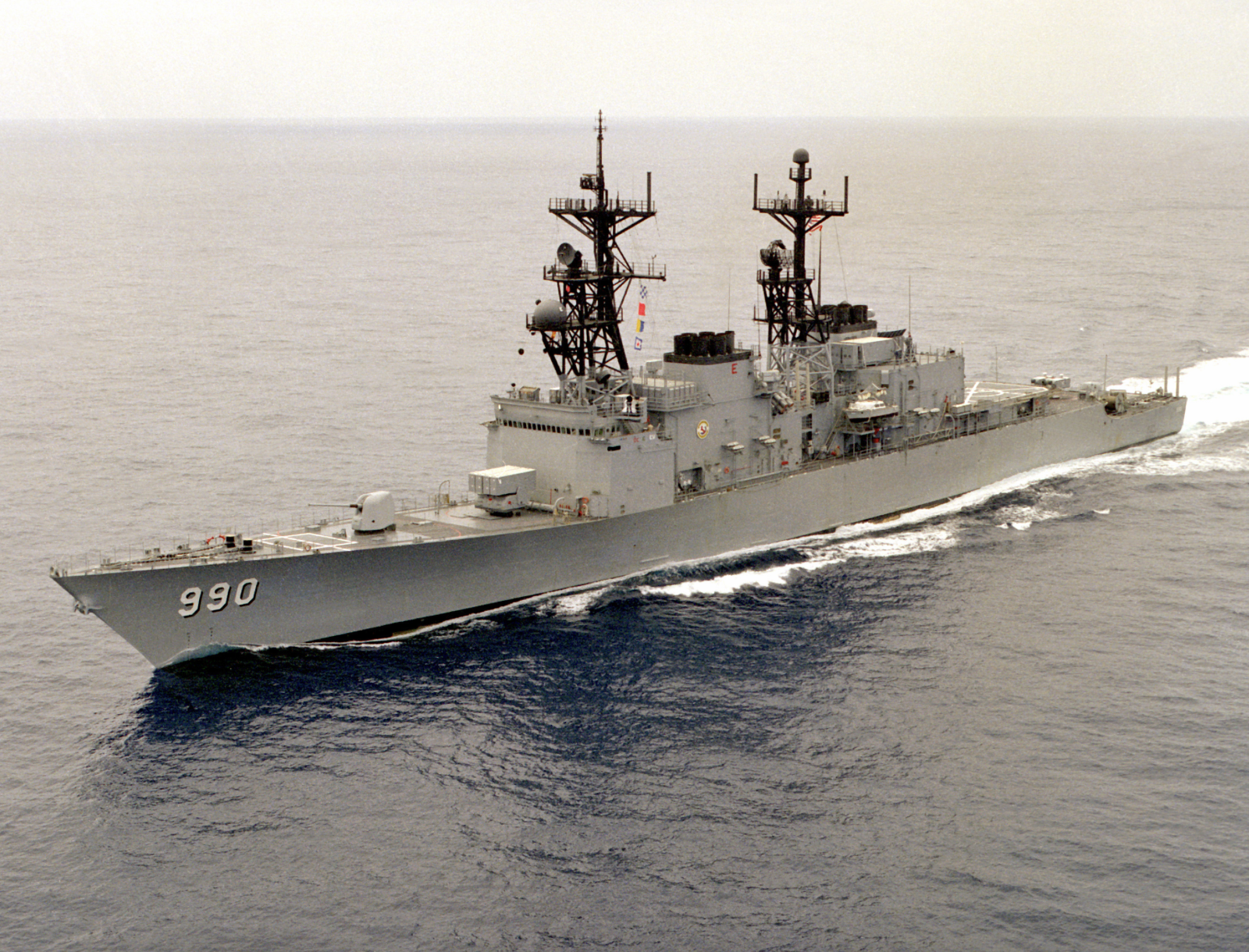
A port bow view of the Spruance Class destroyer USS Ingersoll (DD-990) underway.
1991 A 14th Coast Guard District LEDET, all crewmen from CGC Rush, deployed on board the U.S. Navy’s USS Ingersoll, made history when they seized the St. Vincent-registered M/V Lucky Star for carrying 70 tons of hashish, the largest hashish bust in Coast Guard history to date. The team, led by LTJG Mark Eyler, made the bust 600 miles west of Midway Island.
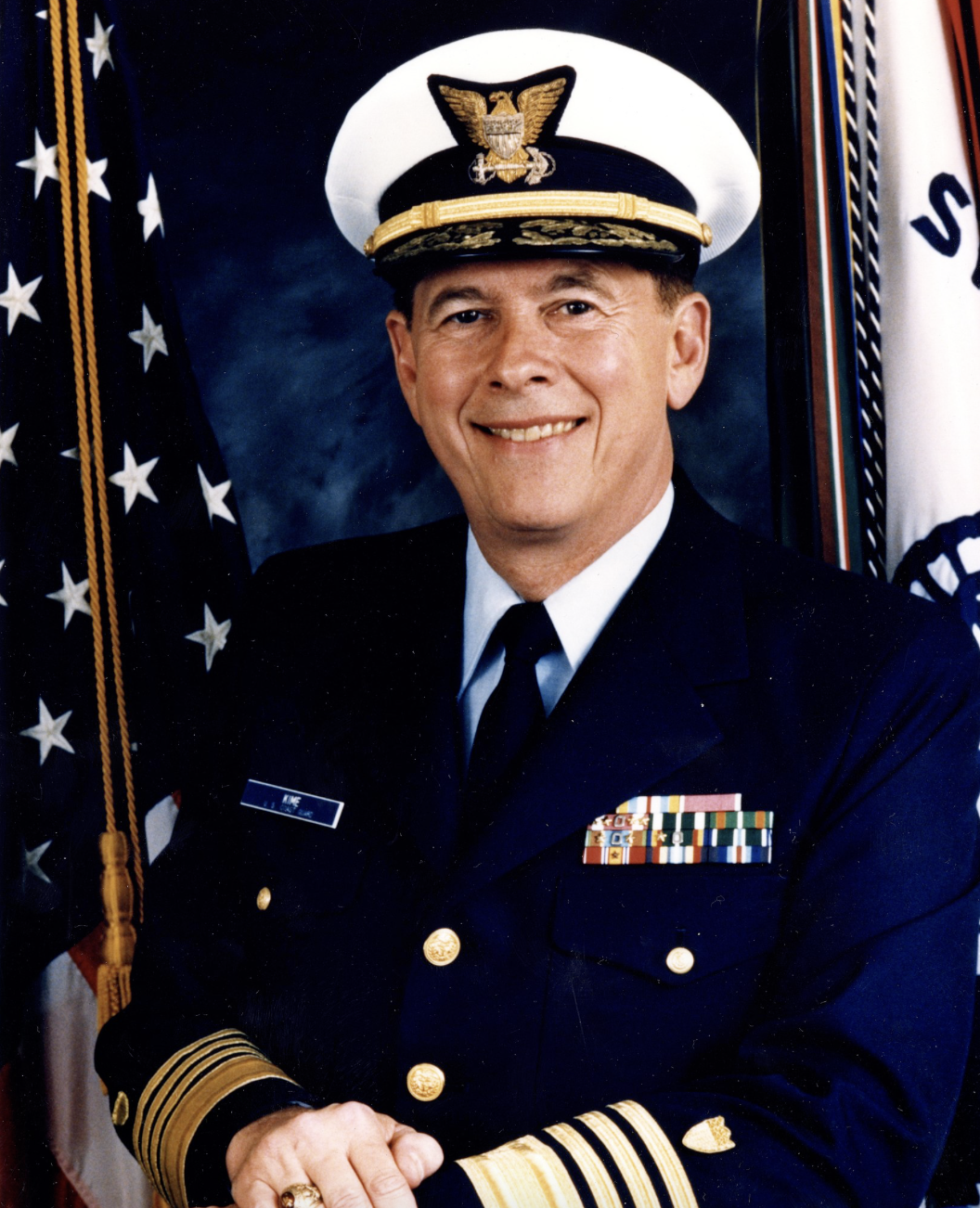
Admiral John William Kime, USCG
1991 A high personnel retention level led the Commandant, ADM J. William Kime, to begin implementing a high-year tenure program, otherwise known as an “up or out” policy to “improve personnel flow and opportunities for advancement.” Two significant points of the program were that they limited enlisted careers to 30 years of active service and established “professional growth points” for paygrades E-4 through E-9, which had to be attained in order to remain on active duty. Up until this time, enlisted members could remain on active duty until age 62 – the only U.S. military work force with that option.

1995 The 750-foot Greek-flagged freighter Alexia collided with the 514-foot Singapore-flagged Enif near the mouth of the Mississippi River, 70 miles south of New Orleans. The two ships were joined at the point of collision and drifted through the maze of oil and gas platforms scattered across the area, narrowly missing one by a mere 25 yards. CGC Courageous served as the on-scene commander to coordinate the response. AIRSTA New Orleans launched three helicopters to provide SAR coverage and to evaluate the damage suffered by the foundering vessels. Personnel from MSO New Orleans and the Gulf Strike Team were sent on-scene to deal with the 80,000 gallon fuel-oil spill. CGC White Holly and M/V Secore Osprey provided skimming resources. The freighters were separated successfully, their remaining fuel was lightered off and they made it to Mobile escorted by CGC Point Lobos.
 Chuck Hill's CG Blog