

Based on the Coast Guard Historian’s timeline, https://www.history.uscg.mil/research/chronology/
With inspiration from Mike Kelso
July 7
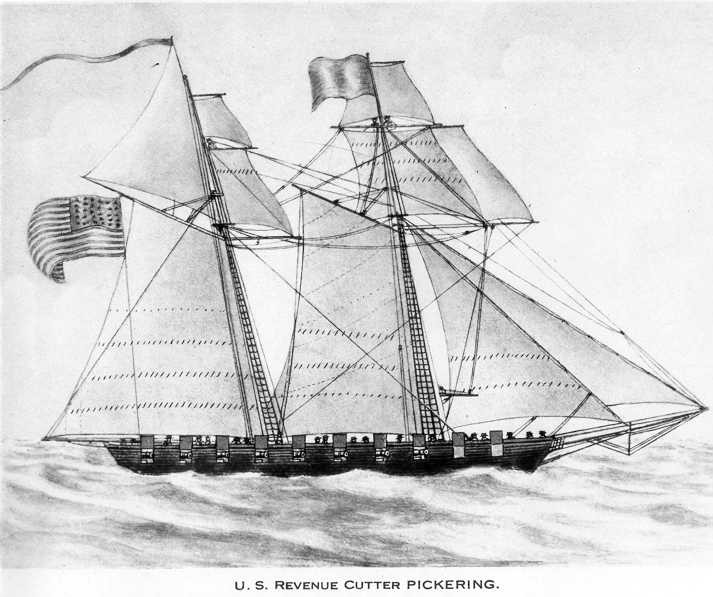
United States Revenue Cutter Service Ship Pickering, later renamed to USS Pickering U.S. Navy Historical Center Photograph- -Released
1798 Hostilities began in the Quasi-War with France. The Revenue cutters Pickering, Virginia, Scammel, South Carolina, Governor, Jay, Eagle, General Greene, and Diligence were the first to be placed under Naval orders, comprising about one-third of the U .S. Fleet.
1801 In a cost saving measure, the Treasury Department sent circulars to the various Collectors looking toward reducing the size of the cutters and their crews.
1838 Under the authority of an Act of Congress passed this date, the President divided the Atlantic coast into six, and the Great Lakes coast into two, lighthouse districts. A naval officer was detailed to each lighthouse district, a revenue cutter or a hired vessel was placed at his disposal, and he was instructed to inspect all aids to navigation, report on their conditions, and recommend future courses of action.
1838 Congress passed the first legislation “to provide better security of the lives of passengers on board of vessels propelled in whole or in part by steam.” (5 Stat.L., 304) The Act specified that the program would be administered by the Justice Department whereby U.S. District court judges were to appoint engineers to inspect merchant steamboats. This Act laid the groundwork for what later became the Steamboat Inspection Service.
1884 Congress directed that cutters be used exclusively for public service and “in no way for private purposes.”
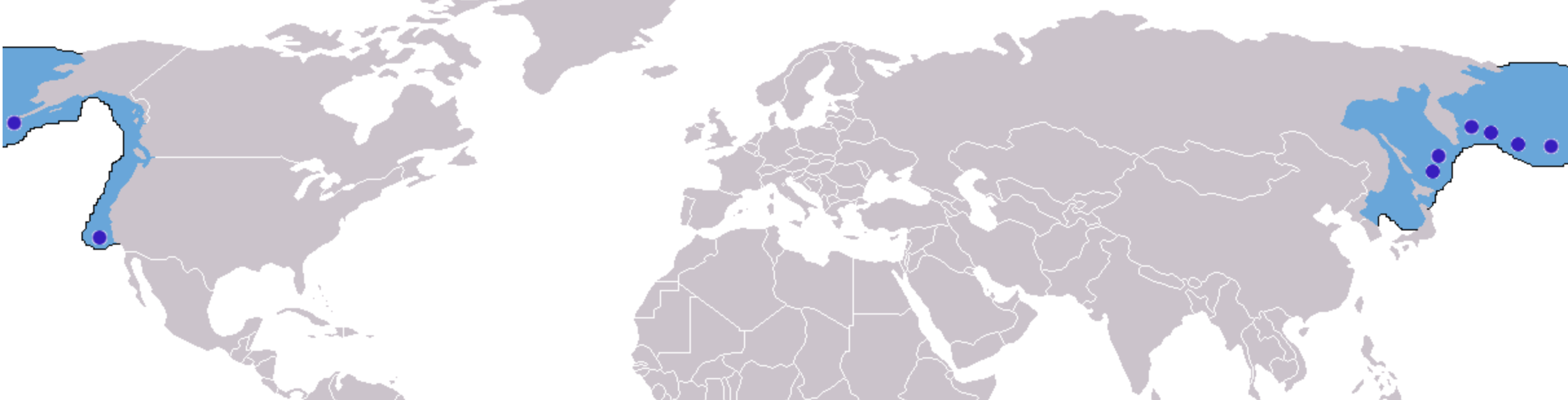
Distribution of the Northern Fur Seal (dark blue = breeding colonies; light blue = non-breeding individuals). Credit: Mirko Thiessen via Wikipedia.
1911 North Pacific Fur Seal Convention signed between United States, Great Britain, Japan, and Russia prohibiting taking of fur seals and sea otters in North Pacific Ocean and Bering Sea north of 30 degrees latitude, except for food and clothing.
1938 The Coast Guard began an operation to transport and guard each shipment of 77,000,000 pounds of silver bars from New York City to the silver depository at West Point, New York for the Bureau of the Mint. The 1,101,320 bars of silver were moved by truck and the Coast Guard contingent responsible for its safe delivery were under the command of CDR Stephen S. Yeandle, who at the time served as the Intelligence Officer for the Coast Guard’s New York Division.
1939 On this date, “the Lighthouse Bureau went out of existence and its personnel moved themselves and their equipment to Coast Guard Headquarters from the Commerce Department building. Thus, lighthouses returned to the Treasury Department from the Department of Commerce.

United States Coast Guard Cutter Mellon (WHEC-717) makes way through the Bering Sea while acting as search and rescue standby cutter for the Bering Sea Opilio Crab fishery. U.S. Coast Guard photograph 010209-C-6130A-500, PA1 Keith Alholm
2020 The crew of Coast Guard Cutter Mellon (WHEC 717) returned to their homeport of Seattle on July 7, 2020, after completing the final patrol for the 52-year-old ship. The 150-person crew left Seattle April 17 to conduct missions throughout the Aleutian Islands and Bering Sea. During the patrol the crew conducted 38 law enforcement boardings, four search and rescue cases and enforced federal regulations governing Alaska’s $13.9 billion commercial fishing industry. In the midst of the COVID-19 pandemic, the Mellon crew instituted protective measures to ensure crew safety and the safety of the commercial fishing fleet and Alaskan public. Mellon was one the last remaining 378-foot high endurance cutters built for extended offshore patrols. Its capabilities spanned from helicopter operations to pursuit boat operations and served as a key asset for the Department of Homeland Security and humanitarian missions at sea.
 Chuck Hill's CG Blog