

Based on the Coast Guard Historian’s timeline, https://www.history.uscg.mil/research/chronology/
With inspiration from Mike Kelso
July 18
1818 The Revenue Cutter Active captured the pirate vessel India Libre in the Chesapeake Bay.
1866 Congress authorized officers to search vessels and persons suspected of concealing contraband.
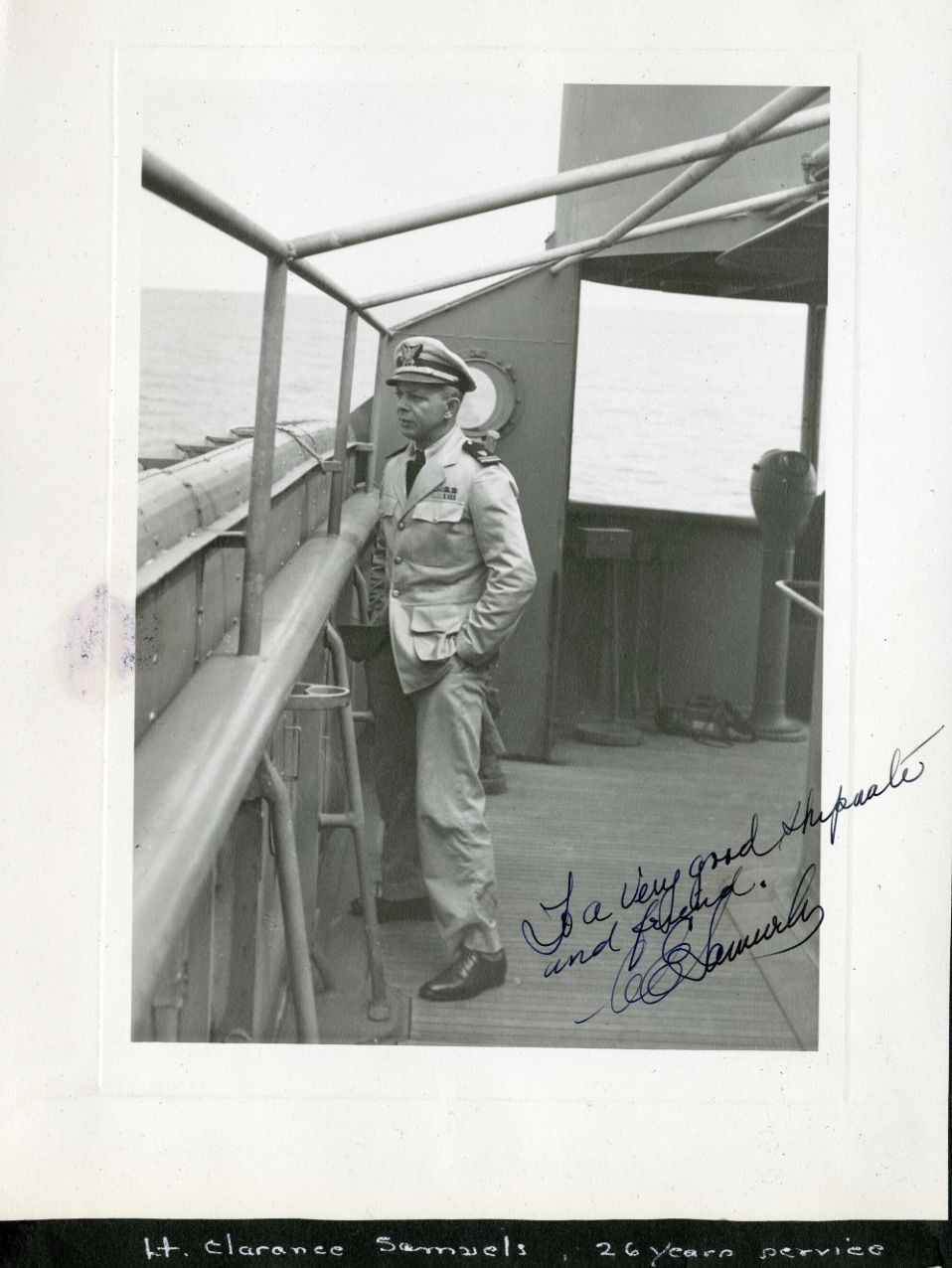
The Long Blue Line: Clarence Samuels—the U.S. military’s Afro-Latino color barrier buster!
A signed photo of Lt. Clarence Samuels commanding a Coast Guard vessel near the end of World War II. (U.S. Coast Guard Collection)
1928 Clarence Samuels assumed command of Coast Guard Patrol Boat AB-15, thereby becoming the second African-American to command a Coast Guard vessel, the first being Revenue Captain Michael Healy.
2015 CGC Stratton seized a self-propelled semi-submersible vessel carrying more than 16,000 pounds of cocaine in the Eastern Pacific Ocean. Stratton‘s crew apprehended four suspected smugglers and seized 275 bales of cocaine worth more than $181 million wholesale from the self-propelled semi-submersible. A U.S. Navy maritime patrol aircraft detected the 40-foot semi-submersible vessel more than 200-miles south of Mexico. After removing 12,000 pounds of the narcotics aboard, Stratton attempted to tow the vessel to shore as evidence; however, the semi-submersible began taking on water and sank. Approximately 4,000 pounds of cocaine left in the SPSS vessel to stabilize it during the towing evolution sank in over 13,000-feet of water and is unrecoverable. Stratton interdicted or disrupted 15 different drug smuggling attempts since April 2015 including another self-propelled semi-submersible vessel carrying 5,460 pounds of cocaine June 16. Stratton has seized more than 33,000 pounds of cocaine since May 2015. The July 18 semi-submersible seizure is the largest recorded semi-submersible interdiction in Coast Guard history. Stratton’s semi-submersible busts are also the first and second by a Legend Class Cutter. This is the first interdiction of two semi-submersibles in a single patrol at sea where Coast Guardsmen recovered both the narcotics and the vessels. CGC Mohawk from Key West, Florida, interdicted two semisubmersibles in the Caribbean in 2011; however, both vessels sank during the course of the interdiction. There have been 25 known semi-submersible interdictions in the Eastern Pacific Ocean since November 2006 when the first documented interdiction occurred. A semi-submersible is a vessel constructed for illicit trafficking that is mostly submerged with just a cockpit and exhaust pipe visible above water. These vessels are extremely difficult to detect and interdict because of their low-profile and ability to scuttle. U.S. Customs and Border Protection Office of Air and Marine also assisted by monitoring the semi-submersible using a maritime patrol aircraft during the course of the interdiction July 18.
 Chuck Hill's CG Blog
Hey Chuck
Guess where the USCGC STEADFAST is going to:
https://www.mmea.gov.my/index.php/en/allcategories-en/12-berita-utama/2832-misi-bawa-pulang-ex-uscg-cutter-steadfast-bermula