
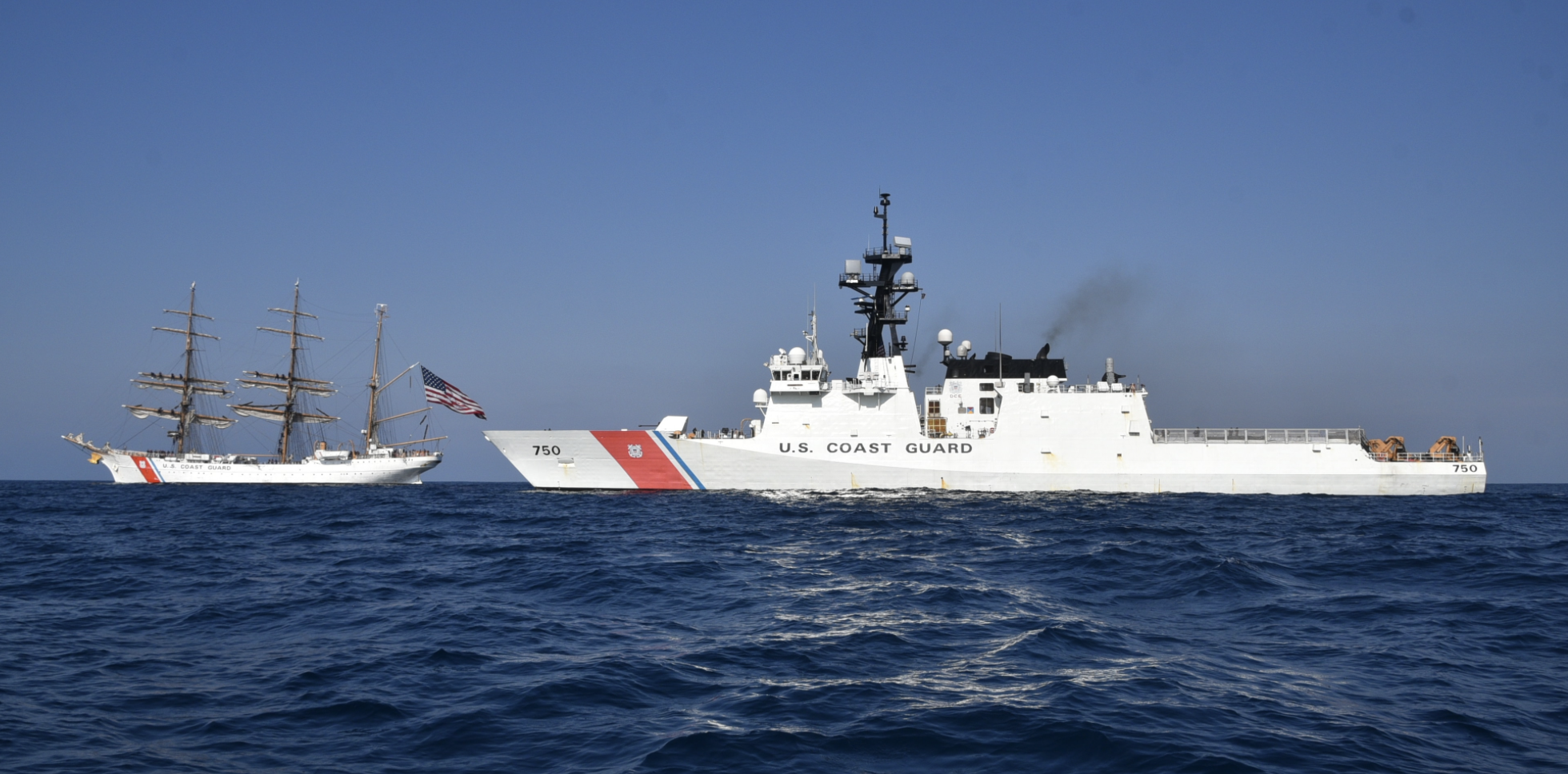
250806-G-G0200-1001, U.S. Coast Guard Cutter Bertholf (WSML 750) rendezvoused with U.S. Coast Guard Cutter Eagle (WIX 327) for a passenger exchange and formation steaming in the Pacific Ocean, August 6, 2025. Eagle is underway for her West Coast summer cadet tour, and Bertholf was nearing the completion of her Deployment in support of Operation Border Trident. (U.S. Coast Guard photo by Ensign Holli Welcker)
Below is a US Coast Guard news release.
Bertholf found some useful things to do, but they intercepted no drugs and apparently intercepted no migrants while smaller units did.
Is this really the way we want to use one of the most expensive Coast Guard assets?
As a former Coast Guard liaison to Fleet Training Group San Diego I would also note that the 378s used to train annually for four weeks, but of course they had an ASW missions.
U.S. Coast Guard Cutter Bertholf Returns Home from Deployment in Support of Southern Border Operations
ALAMEDA, Calif. — The U.S. Coast Guard Cutter Bertholf (WMSL 750) crew returned to their home port on Coast Guard Base Alameda, California, Sunday, following a 70-day patrol operating along the Southwest maritime boundary line (MBL) near San Diego.
Bertholf deployed in support of Operation Border Trident, Coast Guard District Southwest’s (CGD-SW) standing operation to counter-illicit maritime activity along the Southwest MBL.
Operation Border Trident is a Coast Guard-led interagency approach to detection, monitoring, interdiction, and apprehension operations to combat transnational criminal organizations and illegal alien activity in the California Coastal Region. Bertholf increased Coast Guard operational presence in the area, maintaining border control and territorial integrity of the United States.
While at sea executing Operation Border Trident, Bertholf conducted 86 security boardings and queries in the vicinity of San Diego, checking more than 250 IDs and inspecting closed cabin vessels to thwart illegal activity. This included more than 250-crew hours deployed in Bertholf’s cutter response boats, providing law enforcement presence and deterrence on the Southwest MBL.
Departing Alameda on June 2, Bertholf conducted a change of command followed by an annual readiness assessment and training in San Diego prior to deploying to their assigned operating area. On June 9, 2025, Capt. Andrew Pate relieved Capt. Billy Mees as Bertholf’s 10th commanding officer.
Beginning on June 10, under the guidance of Afloat Training Organization San Diego, Bertholf conducted the first full Basic Cutter Operations assessment for the Legend-Class national security cutter fleet which included two weeks of drills, evaluations, and training reviews. The crew was tested against simulated shipboard fires and flooding in both the in port and underway environments, as well as shipboard emergencies in various tactical scenarios. Bertholf displayed high proficiency in several complex ship evolutions, including mooring, unmooring, and anchoring. Scoring a 95% average across all training areas, Bertholf earned certifications in naval warfare, damage control, seamanship, navigation, medical, and engineering proficiency.
Bertholf was twice diverted to respond to search and rescue tasking, a core responsibility that remains a sacred trust between the U.S. Coast Guard and the maritime public. The first case involved the search for a downed aircraft about 460 miles off San Diego. Bertholf conducted search patterns, including flying its embarked small, unmanned aircraft system (sUAS) and used one of its cutter response boats as part of a multi-service search effort.
Later in the deployment, Bertholf received tasking from Coast Guard Sector San Diego to respond to a person in the water 36 miles west of San Diego reported to be experiencing medical distress. Once on scene, Bertholf response boat crewmembers safely recovered the person in distress and brought them aboard Bertholf for initial medical care. Onboard health services technicians provided medical evaluations and care to stabilize the survivor until they were transferred to Emergency Medical Personnel for further care in San Diego.
“Bertholf’s crew displayed exceptional proficiency and professionalism recovering the survivor, stabilizing their condition, and conducting a smooth transfer via cutter boat to waiting EMS at Sector San Diego for further transfer to higher level care,” said Capt. Andrew Pate, commanding officer of Bertholf.
To maintain the cutter’s shipboard helicopter operation proficiency, Bertholf conducted 180 helicopter deck landings with U.S. Coast Guard Air Stations (AIRSTA) San Diego and Ventura aircrews. Bertholf also completed 24 fast rope exercises with AIRSTA Ventura and U.S. Coast Guard Maritime Security Response Team West. Coordination of flight operations provided critical training and proficiency opportunities for helicopter crews and Bertholf’s crew, supporting their ability to respond to emergencies requiring shipboard helicopter operations both during the day and at night.
Routinely operating independently, far from other U.S. Coast Guard cutters, Bertholf capitalized on several unexpected opportunities to rendezvous at sea with multiple cutters deployed from other districts.
Teaming with the U.S. Coast Guard Cutter Active (WMEC 618) early in the deployment, the cutters ran several small boat exercises to certify Bertholf’s boarding teams for law enforcement operations.
Later, while transiting south to evade a hurricane in Puerto Vallarta, Mexico, Bertholf rendezvoused with the U.S. Coast Guard Cutter Storis (WAGB 21), the first polar icebreaker acquired by the U.S. Coast Guard in over 25 years. Storis was partway through its maiden voyage and briefly conducted formation steaming with Bertholf.
Finally, Bertholf capitalized on the U.S. Coast Guard Cutter Eagle’s (WIX 327) visit to the west coast, coordinating a passenger exchange for 36 crew members and formation steaming. Eagle is a 295-foot, three-masted barque used exclusively as a training vessel for future officers of the United States Coast Guard. Bertholf and Eagle were briefly joined by the U.S. Coast Guard Cutter Florence Finch (WPC 1157), one of the Coast Guard’s newest 154-foot Fast Response Cutters.
During this deployment, Bertholf had several opportunities to interact with Department of Defense and international partners. While on a port visit in San Diego, Bertholf’s crew hosted the 89th Military Police Brigade and the 716th Military Police Battalion, strengthening relationships between the land and maritime services and enhanced their understanding of domain awareness capabilities in support of Operation Border Trident.
“I couldn’t be prouder of the Bertholf crew,” said Pate. “Their proficiency, professionalism, and pride throughout this deployment reflect a selfless commitment to defeating adversaries and providing security for the American people we serve.”
Bertholf is named for Commodore Ellsworth Price Bertholf, the Coast Guard’s first Commandant. Commodore Bertholf’s most notable service was his role in the famous Alaska Overland Expedition in 1897. When over 265 American whalers became trapped in ice at Point Barrow, Bertholf led the relief party 1,600 miles via dogsled. Along with Lt. David Jarvis and Dr. Samuel Call, Bertholf herded almost 400 reindeer through a frozen Alaska winter to feed the starving whalers, an act that would later earn him the Congressional Gold Medal.
Homeported in Alameda, Bertholf was commissioned on August 4, 2008, as the Coast Guard’s first Legend-class national security cutter. National security cutters are 418-feet long, 54-feet wide, and have a 4,600 long-ton displacement. They have a top speed of 28 knots, a range of 12,000 nautical miles, and can hold a crew of up to 170. Bertholf routinely conducts operations throughout the Pacific, where the cutter’s combination of range, speed, and ability to operate in extreme-weather conditions provides the mission flexibility necessary to conduct vital strategic missions. The ship’s motto is “Legends Begin Here.”
 Chuck Hill's CG Blog
Bertholf had a very productive deployment. I have no qualms about her utilization. Her crew trained in all her capabilities (that can’t be oversold), she conducted operations in all CG mission areas, and she was an overall presence of the US government in the Op Area. That Press Release was full of achievements.
What kind of deployments do you propose for NSC’s?
No problem with the training that was done, however we don’t need an NSC to intercept migrants a few miles off San Diego. We are doing that pretty well already.
On the other hand NSCs are uniquely suited to interdict drugs in the Eastern drug transit zones or police distance US EEZ fisheries.
“On the other hand NSCs are uniquely suited to interdict drugs in the Eastern drug transit zones or police distance US EEZ fisheries.“
I will agree to that. I’m just not throwing their D11 (or whatever they call it now) deployment out the window.
I’m not sure of the C2 of the D11 deployment, but if it was anything like AMIO ops I was on, Bertholf had C2 over subordinate units and shares in their success. Maybe Bertholf sensors and C2 are responsible for the drug and migrant interdictions.
@un1787, virtually all the migrant interdictions around San Diego were very local. Before my accident July 16 , I kept a fairly complete list of successful interdiction in a post and subsequent comments. https://chuckhillscgblog.net/2025/02/02/west-coast-migrant-interdiction/
Feel like 2 weeks is a pretty short Reftra/training availability event. Spent 3-4 weeks at the NSC pier in ’94 and ’95 on the 210 (pre-MMA/post-MMA so it was close together, but a clean sweep both times though).
Off topic, but it seems the Nome Port expansion is back on. https://www.bairdmaritime.com/marine-projects/dredging/contract-awarded-for-port-modification-in-nome-alaska